

Why the sky is blue and sunsets turn red

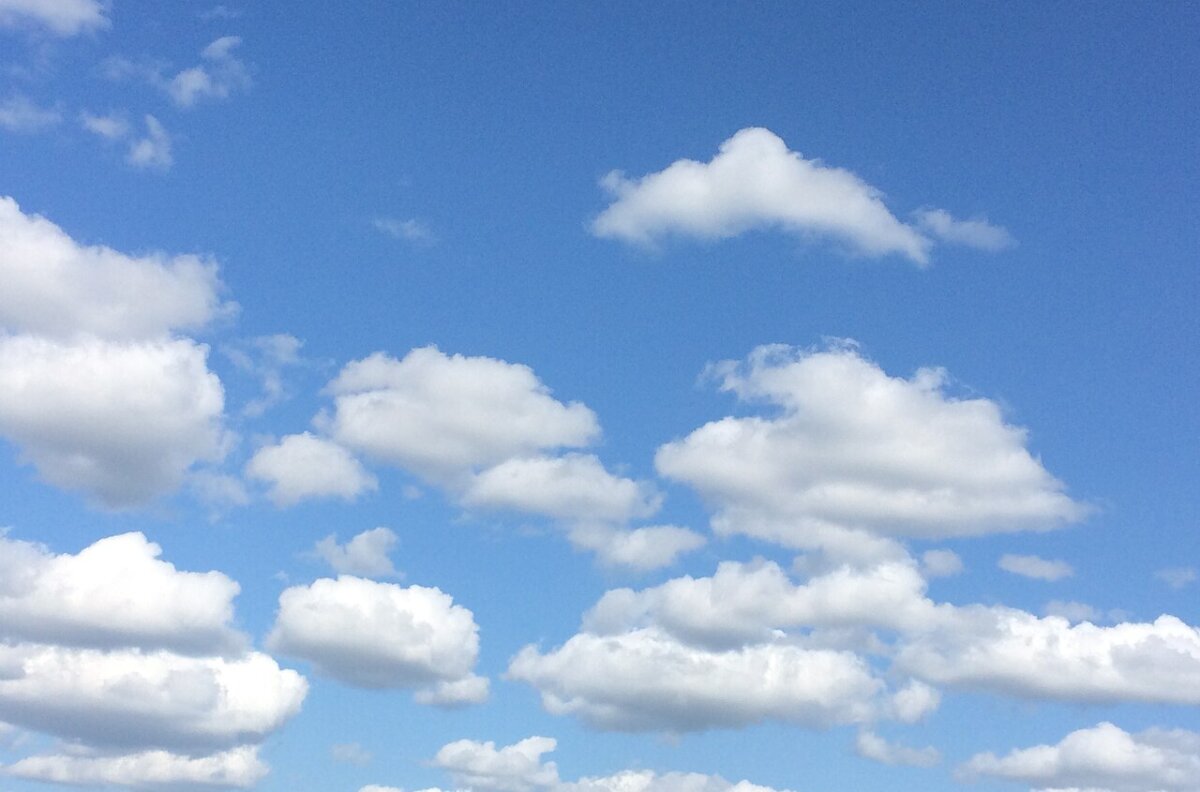
Cumulus clouds against a blue sky on 24 July 2019. Photo: Cbuske46, via Wikimedia Commons; CC BY-SA 4.0. Resized and cropped for display; image remains under the same licence.

The sky is blue on a clear day because molecules in Earth’s atmosphere scatter shorter wavelengths of sunlight more strongly than longer, red wavelengths. This process, called Rayleigh scattering, sends light towards us from many directions. At sunset, sunlight travels through a longer stretch of atmosphere, leaving a redder mix along its path.
Key facts
- Sunlight contains many colours. Its visible wavelengths form the spectrum we see separated in a rainbow or through a prism.
- Air scatters colours unequally. Molecules redirect short-wavelength light more strongly than long-wavelength light.
- Viewing direction matters. Scattered skylight and the light remaining along the Sun’s direction have different colour mixtures.
- Clouds and haze change the picture. Larger particles interact with light differently from individual gas molecules.
- Human vision completes the process. Our eyes respond to the mixture of wavelengths reaching them.
Start with the colours already in sunlight
Sunlight looks broadly white because it contains a range of visible wavelengths together. A prism separates that mixture into a spectrum. Red light has a longer wavelength than blue light; violet lies at still shorter visible wavelengths.
Wavelength is the distance between successive crests of a wave. For visible light, it is useful to express that distance in nanometres: a nanometre is one billionth of a metre. The differences are tiny on an everyday scale, but they strongly affect how light interacts with matter.
NASA Space Place explains the distinction between light being reflected, bent and scattered. For sky colour, scattering redirects colours that are already present in the incoming sunlight. The air supplies a route by which some of that light reaches an observer away from the Sun’s direction.
Why the sky is blue in daylight
Earth’s atmosphere contains gas molecules, mainly nitrogen and oxygen, that are very small compared with visible wavelengths. When sunlight interacts with them, some of it is redirected. The strength of this molecular scattering depends strongly on wavelength.
In the Rayleigh regime, shorter wavelengths are scattered more efficiently. That gives blue and violet light a stronger presence in the scattered light than they would have if all visible wavelengths were redirected equally.
The Penn State course on atmospheric radiation relates the type of scattering to the size of the particles and the wavelength involved. The same framework distinguishes the behaviour of tiny molecules from that of larger droplets and particles.
The useful distinction is between two routes to your eyes. Looking at a patch of daytime sky, you receive sunlight redirected towards you by the atmosphere. Light travelling along a beam also loses some of its shorter wavelengths as they scatter into other directions.
A worked example of the wavelength effect
The Rayleigh approximation makes scattering strength proportional to the inverse fourth power of wavelength, with the other relevant conditions held fixed. A shorter wavelength therefore produces a disproportionately stronger response.
Take 450 nanometres as an illustrative blue wavelength and 650 nanometres as an illustrative red wavelength. These are two chosen points in the visible spectrum. Comparing their scattering strengths gives:
Blue-to-red scattering ratio = (650 ÷ 450)4 ≈ 4.35
| Illustrative light | Wavelength | Relative scattering |
|---|---|---|
| Red | 650 nanometres | 1 |
| Blue | 450 nanometres | About 4.35 |
The ratio follows the formula used in Ohio State notes on Rayleigh scattering. It describes the model’s response at those two wavelengths. Predicting the brightness and perceived colour of a whole patch of sky also requires the incoming spectrum, the viewing geometry and the response of our eyes.
Why sunsets and sunrises look red
When the Sun is low, the sunlight reaching an observer passes through a longer atmospheric path than it does when the Sun is high. There are more opportunities for shorter wavelengths to scatter away from that path.
The remaining light is richer in longer wavelengths. Red, orange and yellow can therefore become prominent around sunrise and sunset. The Met Office explanation connects these colours with the same process that produces a blue daytime sky.
The colours depend on what light remains and what is redirected towards the observer. A bright blue sky overhead and a warm-coloured horizon can therefore appear together. They show different paths through the same atmosphere.
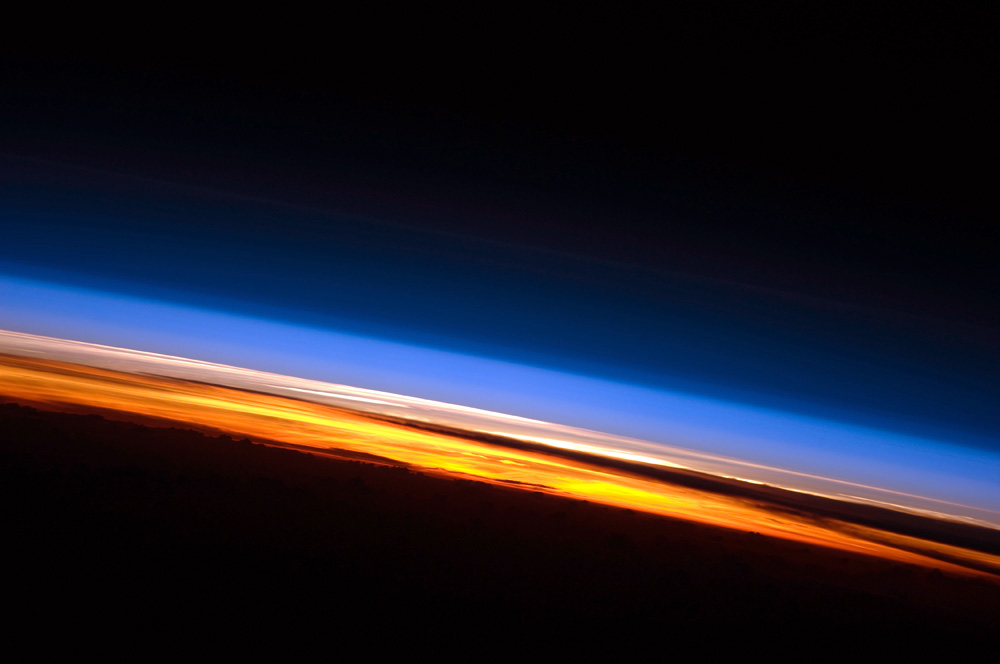
A photograph from orbit offers another perspective on those paths. NASA’s sunset image shows coloured bands along Earth’s edge above the Indian Ocean on 25 May 2010. Its explanation notes that clouds and airborne particles contribute to variations in the colours.
Why blue fades towards the horizon
A clear sky often looks deeper blue overhead and paler near the horizon. The light arriving from low in the sky has passed through more air and undergone more scattering along its route.
NASA Space Place describes how repeated scattering and light reflected or scattered from Earth’s surface mix colours together. The result can look whiter and less strongly blue. The horizon’s paleness is another reminder that the amount of atmosphere along a viewing direction matters.
Why clouds can be white or grey
Cloud droplets are much larger than individual air molecules. Their scattering treats the visible spectrum less selectively, so a cloud illuminated by broadly white sunlight can send a mixture of colours towards us that appears white.
NOAA’s cloud guide explains how cloud colour depends on the illumination received and on scattering by droplets. As a cloud becomes thicker, less sunlight may reach and emerge from its lower parts. Its base can then appear grey even while other parts are brightly lit.
Clouds can also inherit the colour of the light illuminating them. Near sunset, sunlight that has already lost much of its blue along a long atmospheric path can colour clouds orange or red. A cloud’s appearance can therefore change as its illumination changes.
The same filtering can redden an eclipsed Moon
During a total lunar eclipse, Earth blocks direct sunlight from reaching the Moon. Some sunlight passing through Earth’s atmosphere still reaches the lunar surface, after being bent and filtered along its route.
Shorter wavelengths scatter away more readily, leaving a redder illumination. The NASA eclipse guide connects the reddish appearance of an eclipsed Moon with the processes behind blue skies and red sunsets.
This filtering concerns the colour of the illumination. The usual monthly changes in the Moon’s visible sunlit portion are explained by its position relative to Earth and the Sun, as CrispNG’s Moon phases guide explains.
What the simple explanation leaves out
The molecular-scattering model explains the basic contrast between a blue daytime sky and redder light along a long atmospheric path. A particular view also depends on clouds, particles and the directions in which light has travelled.
Light can be scattered more than once. Larger particles have different scattering patterns, while the colour recorded by a camera or perceived by a person depends on the mixture of wavelengths received. These factors help explain why photographs of different skies show many shades rather than a single standard blue.
A colour alone therefore gives an incomplete account of atmospheric conditions. To understand an individual view, it helps to ask where the Sun was, which direction the observer faced and whether clouds or haze were present. The basic wavelength rule remains useful within that fuller picture.
Frequently asked questions
Why is the sky blue instead of violet?
Violet light is scattered strongly, but the colour we perceive depends on the sunlight spectrum and our eyes’ response to the entire mixture. The Royal Observatory explanation notes that sunlight contains less violet than blue and that our eyes are less sensitive to violet. That combination helps account for the blue appearance.
Is the sky blue because the sea is blue?
The sky’s blue comes from scattering in the atmosphere. Water has its own effect on light: NOAA’s ocean explanation describes how it absorbs colours towards the red end of the spectrum, leaving more blue visible. Similar appearances can therefore arise through different interactions with sunlight.
What is the true colour of the sky?
A blue patch of sky sends a mixture of visible wavelengths to your eyes, rather than a beam containing blue alone. Its perceived colour comes from the balance of that light and the combined response of the eye’s colour receptors, discussed in the physics FAQ hosted at UC Riverside. Changes in illumination and atmospheric conditions change the mixture we see.
Sources and further reading
- NASA Space Place, sky colour, sunlight and the horizon.
- Penn State course, atmospheric scattering regimes.
- Ohio State notes, the Rayleigh wavelength relationship.
- Met Office explanation, blue skies and red sunsets.
- Royal Observatory explanation, scattering and visual sensitivity.
- NOAA cloud guide and ocean explanation.
- NASA eclipse guide, filtered sunlight during lunar eclipses.
- Physics FAQ, by Philip Gibbs, hosted at UC Riverside.
- NASA sunset image, image record and atmospheric context.
Last reviewed: 27 October 2026