

How a Bill Becomes Law in Nigeria: The 30-Day Rule Explained

Editorial illustration of a legislative chamber.
A bill becomes law in Nigeria when the Senate and House of Representatives pass the same text and the President assents. That is how a bill becomes law in Nigeria; section 58 provides a two-thirds override route in each chamber when the President withholds assent. Money bills and constitutional amendments follow additional constitutional procedures.
Key facts
- A federal bill may start in either chamber of the National Assembly.
- The Senate and House must agree on one version before it goes to the President.
- Committee review and public hearings add scrutiny; chamber rules set the detailed stages.
- Section 58 covers ordinary federal bills and presidential assent.
- Sections 9 and 59 set separate routes for constitutional alterations and specified financial bills.
How a bill becomes law in Nigeria
The Constitution sets the main legal requirements, while each chamber’s rules guide its proceedings. The constitutional text assigns legislative powers to the National Assembly and describes assent, vetoes, financial bills and constitutional amendments. The National Assembly guide and PLAC’s bill process guide explain the usual stages in accessible terms.
This article follows federal bills considered by the Senate and House of Representatives. State bills go through a State House of Assembly and the Governor’s assent process under section 100 of the Constitution.
What happens at each stage of a Nigerian bill?
A bill is a proposed law. It can begin as an executive proposal or a legislator’s bill, then pass through debate, committee scrutiny and votes in both chambers. The National Assembly handbook presents drafting, gazette publication, first reading, second reading, committee consideration, third reading, final preparation and presidential assent as the broad sequence.
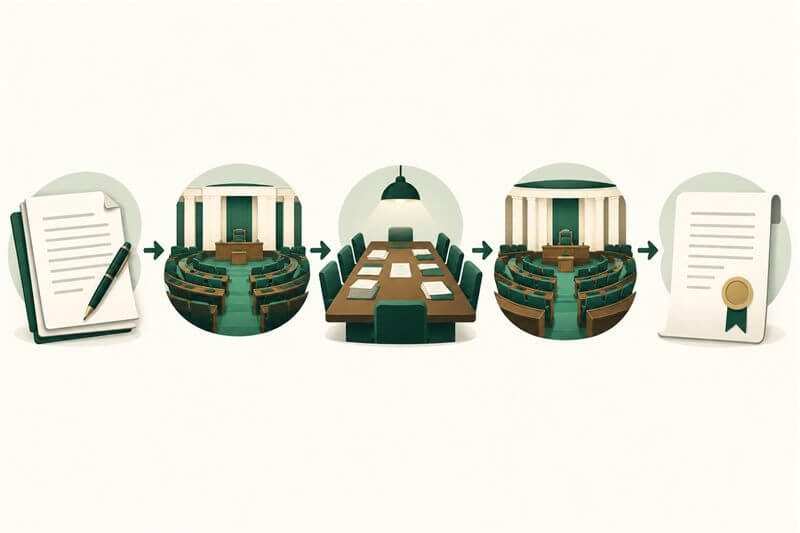
1. Drafting and introduction
A sponsor prepares a proposal and presents it in either chamber. The first reading formally introduces the bill, usually through its title, and gives members a chance to review the draft. The chamber’s Rules and Business Committee or another relevant body helps arrange the next stage, according to its standing orders.
2. Second reading and debate
At second reading, members debate the bill’s purpose and main principles. They consider the issue it addresses, the proposed solution and the likely effects of the law. The chamber then votes on whether the bill should proceed to detailed review.
3. Committee review and public input
A bill that passes second reading goes to a relevant committee or, where the chamber chooses, a committee of the whole. Members examine clauses, suggest amendments and seek evidence about how the proposal would work. Committees may hold public hearings and invite written submissions from government agencies, experts, civil society groups, businesses and members of the public.
PLAC’s account of the committee stage describes the detailed scrutiny that follows second reading. A hearing gives affected groups a chance to explain practical effects; the committee then reports its recommendations to the chamber.
4. Further consideration and third reading
Members review the committee’s report and proposed changes. At third reading, the chamber votes on the text as revised. Passage in one chamber moves the bill to the other chamber, where members conduct their own debate and review under that chamber’s rules.
5. Agreement between the Senate and House
The two chambers need to pass the same final wording. If the second chamber makes amendments, members work through the differences and agree a common text, using procedures set by their rules. The final version then goes through the required approval in both chambers.
This distinction matters when news reports describe a bill as “passed”. The phrase may refer to one chamber’s vote or to the National Assembly’s completion of both votes. Readers can check the bill number, the Senate and House records and the version that received final passage.
READ ALSO: State Police Bill Clears 24 Assemblies: What Happens Next?
What does presidential assent mean?
Once both chambers pass the same bill, it goes to the President for assent under section 58. The President may assent to the text or withhold assent. An assented bill becomes an Act, with its commencement clause setting when its provisions take effect.
When the President withholds assent, section 58(5) allows the Senate and House to pass the bill again by a two-thirds majority in each chamber. That vote completes the constitutional override route. The precise wording appears in the 2023 Constitution text.
What is the 30-day rule for bills in Nigeria?
The President has 30 days to signify assent or withhold assent under section 58. The National Assembly guide describes a bill as receiving automatic assent after 30 days of presidential inaction, while section 58(4)–(5) sets out the President’s 30-day response and the two-thirds override after assent is withheld; section 59(4) expressly gives a separate 30-day inaction route for specified financial bills.
Those descriptions identify different parts of the constitutional framework. Readers tracking an ordinary bill should state the National Assembly guide’s explanation alongside the wording of section 58. For a financial bill, section 59(4) describes a joint meeting of the National Assembly and a two-thirds vote when the President fails to signify assent within 30 days or withholds assent. The bill’s category and the constitutional provision therefore shape the accurate summary.
READ ALSO: State Police: Solution to Nigeria’s Insecurity or a Political Gamble?
How do financial bills follow a different route?
Section 59 covers appropriation and supplementary appropriation bills, payments from federal public funds, and bills that impose or increase taxes, duties or fees, or reduce, withdraw or cancel them. It also sets procedures for financial bills when the chambers disagree or the President withholds assent. A joint finance committee and, in defined circumstances, a joint sitting can help resolve those questions.
The National Assembly guide groups appropriation bills within the wider lawmaking sequence. The exact route depends on whether the proposal falls within section 59’s categories, so readers can use the bill’s subject and the enacted constitutional text to identify the applicable procedure.
How does a constitutional amendment become law?
A bill to alter the Constitution follows section 9. At least two-thirds of all members of each National Assembly chamber must support the proposed alteration, followed by resolutions from at least two-thirds of the State Houses of Assembly. Nigeria has 36 states, so the state-stage threshold is 24 assemblies.
Section 9 sets a higher National Assembly threshold for alterations to section 8, section 9 itself, or Chapter IV on fundamental rights: at least four-fifths of all members in each chamber, alongside approval from at least two-thirds of State Houses. These thresholds explain why a constitutional alteration can continue into state assemblies after the National Assembly has voted.
How can readers check a bill’s status?
Start with the bill’s title, number and chamber of introduction. Follow its readings, committee report, amendments and final votes in the Senate and House records. Then check the final text, presidential assent or the relevant override vote, and any special route for financial bills or constitutional alterations.
The National Assembly’s bill records and its process handbook provide starting points. After enactment, read the Act and its commencement clause to confirm when it takes effect. CrispNG’s report on the state police bill shows how a constitutional proposal can move from national votes to consideration by State Houses.
How a bill becomes law in Nigeria: frequently asked questions
Can a bill start in either chamber of Nigeria’s National Assembly?
Yes. Section 58 allows a bill to originate in either the Senate or the House of Representatives, subject to the Constitution’s provisions for financial bills. Both chambers then consider the final text.
How many votes are needed to override a presidential veto?
Each chamber must pass the bill again by a two-thirds majority under section 58(5). A successful override completes the ordinary bill route set out in that section.
Does every bill need a public hearing?
Public hearings form part of committee scrutiny when a committee arranges them. Standing orders and committee decisions guide the details for each bill.
When does an Act of the National Assembly take effect?
The Act’s commencement clause states when its provisions begin. Readers can check the enacted text and any commencement date stated there.
Last reviewed: 2 November 2026.