

Moon phases explained: why the Moon changes shape

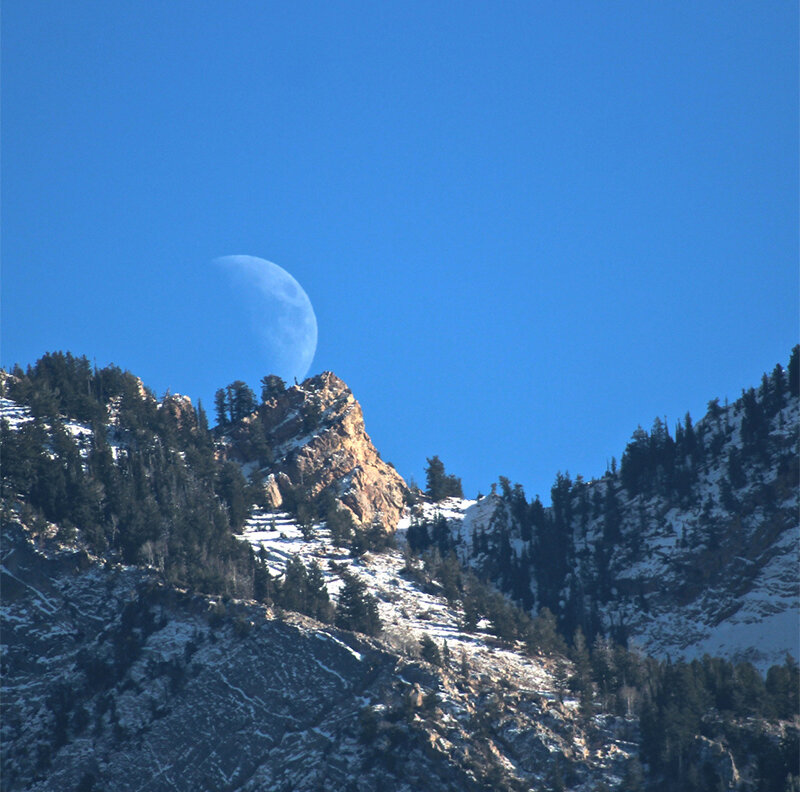
A waxing Moon above the Wasatch Mountains, Utah. Photograph: NASA/Bill Dunford.
Moon phases happen because we see different amounts of the Moon’s sunlit half as it travels around Earth. The Moon keeps its rounded shape; the changing angle between the Sun, Moon and Earth makes its bright face appear to grow from a crescent to a full circle and shrink again. One complete phase cycle takes about 29.5 days.
Key facts about Moon phases
- Moonlight is sunlight reflected from the lunar surface.
- Outside a lunar eclipse, sunlight illuminates roughly half the Moon at any moment.
- Waxing means the visible illuminated portion is increasing; waning means it is decreasing.
- The eight familiar phase names describe stages in a continuous cycle.
- People around Earth share essentially the same phase at the same instant, although its orientation and visibility differ.
How sunlight produces the changing shapes
Think of the Moon as a ball with one side lit by a lamp. Moving around the ball changes how much of its bright side you can see. A narrow view of that lit surface looks like a crescent; a view facing the illuminated half looks like a full disc.
The Harvard teaching guide uses this geometry to explain phases. The important distinction is between the Moon’s entire surface and the circular face visible from Earth. Half the sphere can receive sunlight even when only a small part of the face we see looks bright.
At new Moon, the lunar hemisphere facing Earth receives almost no direct sunlight. At full Moon, that hemisphere faces towards the Sun, presenting a bright disc. Between those positions, our view includes different proportions of lunar daytime and night-time.
Those changes take place gradually. The familiar drawings of eight separate Moons are a convenient way of labelling a smooth process, rather than eight shapes into which the Moon suddenly switches.
The eight Moon phases in order
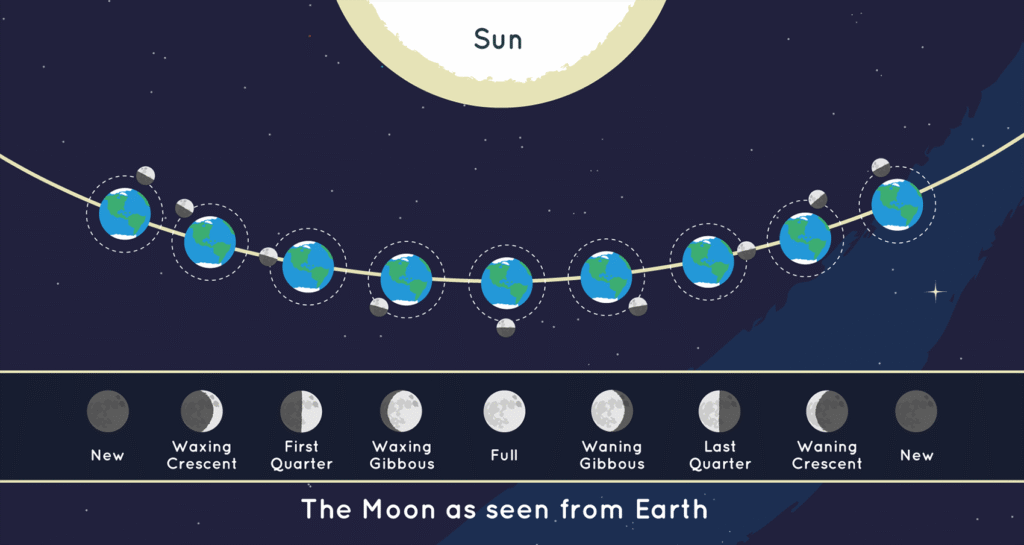
The Naval Observatory guide distinguishes crescent phases, with less than half the visible disc illuminated, from gibbous phases, with more than half illuminated. Starting at new Moon, the order is:
- New Moon: the near side faces away from direct sunlight, so the Moon is normally invisible.
- Waxing crescent: a thin illuminated curve appears and grows.
- First quarter: half the visible disc is illuminated, with the bright portion increasing.
- Waxing gibbous: more than half the disc is bright as it approaches full Moon.
- Full Moon: the visible disc appears fully illuminated.
- Waning gibbous: more than half remains illuminated, but the bright portion decreases.
- Last quarter: half the disc is illuminated again, this time with the bright portion decreasing.
- Waning crescent: a shrinking sliver remains before the cycle returns to new Moon.
“Quarter” refers to progress through the cycle from new Moon. First quarter falls about a quarter of the way through; last quarter falls about three-quarters of the way through. Both look like a half Moon.
Why the cycle takes 29.5 days rather than 27.3
The Moon completes an orbit relative to the distant stars in about 27.3 days. Astronomers call this the sidereal month. The interval between equivalent phases, such as one new Moon and the next, averages about 29.5 days: the synodic month.
During the Moon’s trip around Earth, Earth also advances along its orbit around the Sun. The Moon therefore has to travel farther before the same Sun–Earth–Moon geometry repeats. That additional movement takes a little over two days, as the explanation in NASA’s questions guide describes.
The two figures measure different kinds of return. For following crescents, full Moons and the rest of the phase sequence, use the longer cycle. Neither figure means the phases fit neatly into every calendar month.
How the same lunar face can have different phases
The Moon rotates once in roughly the same time that it completes an orbit around Earth. This relationship, called synchronous rotation or tidal locking, keeps approximately the same hemisphere facing us.
The explanation in NASA’s tidal-locking guide connects that synchronisation to the effect of Earth’s gravity on the Moon over time. Facing Earth and facing the Sun are separate matters. The familiar lunar face still passes through daytime and night-time as the system moves.
The far side also receives sunlight. “Near side” and “far side” describe direction relative to Earth; “day side” and “night side” describe illumination. Keeping those two pairs separate makes it easier to understand how a full Moon and a barely visible crescent can show parts of the same lunar hemisphere.
Why phases differ from lunar eclipses
Earth’s shadow darkens the Moon during a lunar eclipse. Ordinary phases come from the viewing geometry of its sunlit surface. A crescent therefore has a different cause from the darkened part of an eclipsed Moon.
The distinction is set out in the NASA eclipse guide. A lunar eclipse occurs at full Moon when the alignment allows Earth’s shadow to reach the lunar surface. A solar eclipse occurs at new Moon when the Moon blocks the Sun from a viewer’s position.
The Moon’s orbital plane tilts by about five degrees relative to Earth’s orbit around the Sun. Most months, the Moon passes above or below the alignment needed for an eclipse. That tilt explains why eclipses occur only at particular full and new Moons.
CrispNG’s lunar eclipse coverage provides an event-specific example. The monthly phases continue whether an eclipse occurs or not.
Why the Moon can appear in daylight
The Moon’s orbit places it in different parts of the sky relative to the Sun. For part of the cycle, it is above the horizon during daylight. A blue sky makes its reflected light less conspicuous, but a sufficiently bright lunar disc can still stand out.
The explanation in NASA’s Cosmicopia archive links daytime visibility to these positions. As a rough guide at most latitudes, first quarter rises around midday and sets around midnight; last quarter rises around midnight and sets around midday. Exact times depend on location and date, so check local predictions rather than treating those patterns as a timetable.
Does everyone see the same phase?
Observers in different countries see essentially the same illuminated fraction at the same instant. Their local clock time, horizon and weather determine whether they can see it then.
Orientation changes with viewpoint. A waxing crescent usually appears lit on the right in Northern Hemisphere diagrams and on the left in Southern Hemisphere views. The bright portion is growing in both cases. The hemisphere comparison in NASA’s questions guide explains why a familiar Moon can appear inverted after crossing the equator.
What causes the faint glow beside a crescent?
Sometimes the bright crescent sits beside a faintly visible outline of the rest of the lunar disc. This glow is earthshine: sunlight reflects from Earth, reaches the lunar night side, then reflects back towards us.
The NASA Earthshine article describes this indirect lighting. It can reveal the Moon’s rounded outline while only a slim section receives direct sunlight from our viewpoint. The bright crescent and the dimmer face are parts of one body lit through different paths.
How to recognise the phases yourself
Use a month of observations to connect the diagrams with the sky. The NASA observation journal recommends recording the date, time and appearance, including occasions when you cannot see the Moon.
- Choose a clear view of the sky and record your location and observation time.
- Sketch the visible disc, marking its illuminated portion and orientation.
- Compare successive observations to see whether the bright portion is increasing or decreasing.
- Record clouds or an obstructed horizon separately from the phase. A missed sighting leaves a gap in your observation record.
- Compare your sketches with a reliable phase guide and local rise-and-set predictions.
For surface detail, pay attention to the boundary between lunar day and night, called the terminator. Low-angle sunlight casts shadows that help reveal craters and mountains. The NASA viewing guide recommends observing phases other than full Moon for this reason. Keep any binoculars or telescope well away from the Sun.
Frequently asked questions
Why can a full Moon look full on more than one night?
The illuminated fraction changes continuously and remains close to complete illumination on neighbouring nights. Astronomical calendars give a precise full-Moon instant, while the eye may struggle to distinguish nearby appearances from that exact phase.
Why do phase calendars sometimes give different dates?
The astronomical event happens at the same instant, but local dates depend on time zone. The NASA Moon Guide uses UTC, so check the time standard before comparing it with a calendar using local civil time.
Can one calendar month contain two full Moons?
Yes. With an average interval of about 29.5 days, a full Moon near the beginning of a long calendar month can be followed by another near its end. The calendar boundary has no effect on the lunar cycle itself.
Sources and further reading
- NASA phase guide — phase sequence, viewing patterns and image credits.
- Naval Observatory guide — definitions and illuminated fractions.
- Harvard teaching guide — the geometry of phases.
- NASA’s questions guide — orbital periods and hemisphere comparisons.
- NASA tidal locking — rotation and the Earth-facing hemisphere.
- NASA eclipse guide — shadows, alignment and orbital tilt.
- NASA Cosmicopia archive — daytime visibility.
- NASA Earthshine article — light reflected from Earth.
- NASA observation journal — recording the cycle.
- NASA viewing guide — observing lunar surface features.
Featured photograph: waxing Moon above the Wasatch Mountains, Utah. Credit: NASA/Bill Dunford. Phase diagram: NASA/JPL-Caltech; illustration, not to scale, with Northern Hemisphere phase orientation. Both reproduced for editorial information under NASA media guidelines.
Last reviewed: 26 October 2026