

South Africa fuel levy relief: November dates and savings

Archive photograph of a Sasol filling station in Boksburg, 2009. Photo: Part Time Security / Wikimedia Commons, public domain.
South Africa fuel levy relief is due to begin on 4 November 2026, with the general fuel levy cut by R1.50 per litre for petrol and R3 per litre for diesel in the first phase. Smaller reductions will follow after 1 December and run until 5 January 2027.
Finance Minister Enoch Godongwana announced the temporary measure in his budget speech on 21 October. For motorists, the distinction to watch is between the tax reduction and the complete monthly fuel-price adjustment.
South Africa fuel levy relief dates
- 4 November to 1 December 2026: the petrol levy is reduced by R1.50 per litre and the diesel levy by R3 per litre.
- After 1 December to 5 January 2027: the reductions become R1 per litre for petrol and R1.50 per litre for diesel.
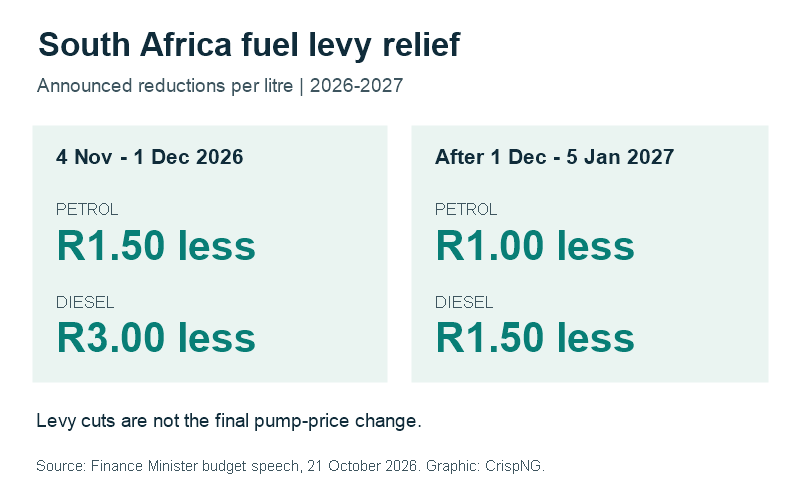
These are reductions in the levy, rather than the remaining levy amounts. The lower second-phase relief also means motorists should not carry the first-phase saving unchanged into their December budgets.
What would the levy cut mean for 50 litres?
Multiplying the announced reduction by the quantity purchased gives a straightforward illustration of the levy component:
- First phase: 50 litres of petrol carries R75 less general fuel levy; 50 litres of diesel carries R150 less.
- Second phase: the equivalent reductions are R50 for petrol and R75 for diesel.
These figures are CrispNG calculations: 50 multiplied by the relevant rand-per-litre reduction. They compare the levy with what it would have been without relief. They are not forecasts of how much a particular fill-up will cost compared with October.
Why the final pump-price change can differ
The Department of Mineral and Petroleum Resources explains in its pricing guide that taxes are only one part of the price. International refined-fuel prices, the rand-dollar exchange rate, transport costs and margins also enter the calculation.
That means an increase in other components can absorb some or all of the benefit of a lower levy. Falling components could increase the overall benefit. The announced tax relief alone therefore cannot establish the final November price.
There is also an important petrol-diesel difference. The department regulates petrol’s retail price, while diesel has a published wholesale list price and an unregulated retail price. A diesel levy reduction should therefore not be presented as a promise that every forecourt will display an identical price.
For background, CrispNG’s October fuel outlook, published in September, set out the cost pressures ahead of October’s adjustment.
How the R10 billion relief is funded
Godongwana put the fiscal cost at R10 billion in revenue forgone. His speech said money transferred to the Central Energy Fund would return to the National Revenue Fund to finance the intervention.
Moneyweb reported that Treasury director-general Duncan Pieterse linked any further relief to available fiscal space. That makes an extension a policy question, rather than something motorists can assume has already been agreed.
Why the AA wants more
The Automobile Association argued that the temporary reduction was insufficient. In an EWN interview, chief executive Bobby Ramagwede said better government efficiency should help fund relief and pointed to the wider pressure fuel costs place on consumers.
Treasury’s position in the same report was that support must remain consistent with fiscal sustainability. These are different assessments of how much the state can and should do; neither changes the announced two-phase timetable.
What to check before the November change
For a household fuel budget, use the final official monthly adjustment alongside the relief timetable. Check the fuel grade and the applicable price or, for diesel, the forecourt’s retail charge. Treat levy-only calculations as one component of that exercise.
The announced timetable ends on 5 January 2027. Any extension or replacement would need a further confirmed decision. The verified announcement sets the relief amounts and dates, but does not by itself settle what motorists will pay at the pump.
Information checked: 26 October 2026.
Featured image: a Sasol filling station in Boksburg, photographed in 2009. Photo: Part Time Security / Wikimedia Commons, public domain. Archive photograph; it does not depict the 2026 announcement.
