

NHS consultants strike set for 25 and 26 November


Illustration; it does not depict an actual strike or identifiable people.
Consultant doctors in England plan to strike for two days on 25 and 26 November, the British Medical Association says, after talks with the Government failed to settle a dispute over pay and working conditions. The NHS consultants strike is scheduled to run from 06:59 on 25 November until 06:59 on 27 November, with emergency cover continuing, according to the union.
What the NHS consultants strike could mean for patients
The action is limited to consultant doctors in England. The BMA says emergency services will be staffed at a level similar to Christmas Day. That means emergency cover is planned, but it does not guarantee that every routine appointment or planned procedure will go ahead unchanged.
NHS Employers, which represents NHS organisations in national employment discussions, warned that a walkout would put pressure on clinical teams across hospitals. It urged the union to return to talks. The statements announcing the action did not include a hospital-by-hospital list of potentially postponed services. Patients should therefore rely on direct updates from their own NHS provider rather than assume a particular appointment is cancelled.
The dates are the latest step in a dispute that the BMA says began in May 2025. On 6 July 2026, consultants voted in favour of industrial action; NHS Employers reported that 76% of those who voted supported it. Discussions involving the Department of Health and Social Care, NHS Employers, unions and employer representatives continued from July, but NHS Employers said agreement on next steps had not been reached. The BMA says there has been no formal negotiation on its proposals.
Why the NHS consultants strike is about pay and working conditions
The BMA is seeking a funded negotiation covering both pay and the consultant role. Its proposals include more protected time for teaching and service improvement, changes to standard hours and better recognition of demanding out-of-hours work. The union says consultants’ pay has fallen by 25% in real terms over 17 years; that is the BMA’s calculation, not an independently established figure in the material released alongside the strike announcement.
A government planning figure has sharpened the pay dispute. In government evidence submitted on 19 October for the 2027–28 pay round, the Department of Health and Social Care and NHS England said their current plans assume a 2.4% uplift. This is an input to the independent Review Body on Doctors’ and Dentists’ Remuneration (DDRB), not an agreed pay award or a final Government decision. The DDRB will consider evidence from the Government, unions and other organisations before making recommendations.
The ONS reported annual CPI inflation of 3.5% in September 2026. That is useful context for the current debate, but it covers a different period from the proposed 2027–28 pay round; it cannot show what inflation will be then. The BMA calls the planning figure a real-terms cut, while the Government’s evidence describes it as the amount currently planned within its financial and delivery plans.
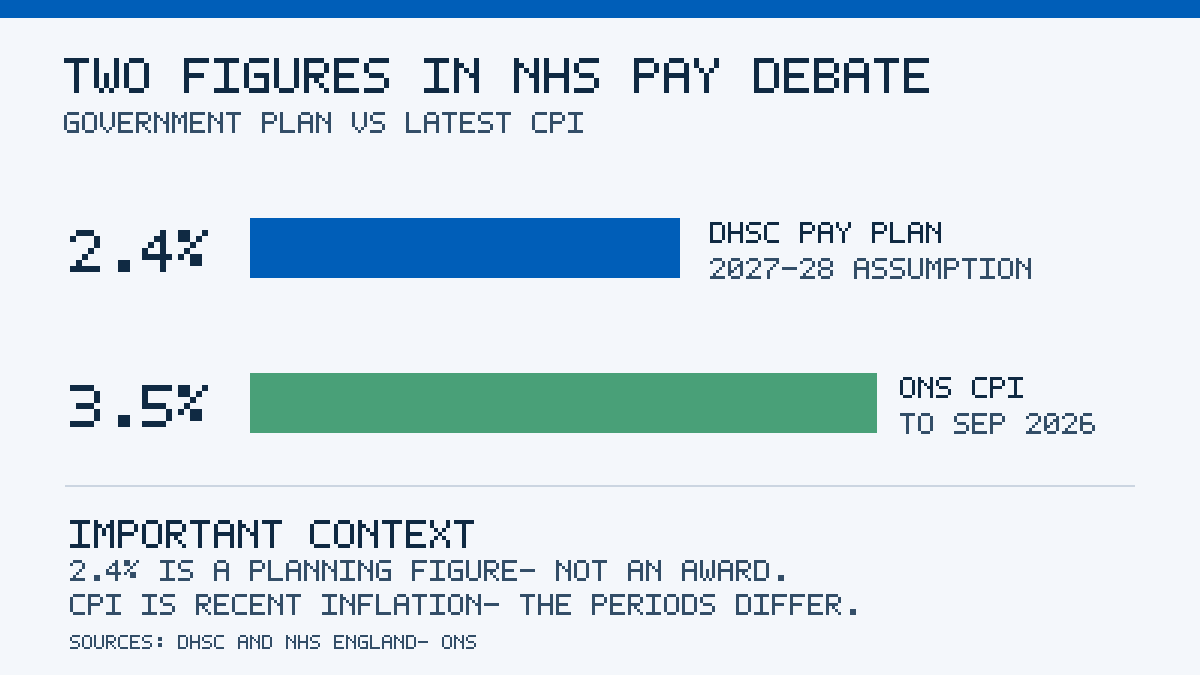
The distinction matters because the strike concerns negotiations now, while the 2.4% figure relates to a future pay round still under review. The BMA says action can be avoided if the Health Secretary commits to adequately funded formal talks on pay and working conditions. NHS Employers says discussions are ongoing and has called on the union to return to the table.
What we don’t know yet
The planned action is not yet a final account of how individual services will operate. The BMA says formal strike notices will follow, and hospital trusts have not published a common schedule of affected appointments, operations or staffing arrangements. The scale of disruption will depend on local plans and on whether the parties reach an agreement before 25 November.
The DDRB has not made a recommendation for 2027–28, and the Government has not announced a final award for that round. The 2.4% planning assumption could therefore change through the review and decision process. The BMA’s 25% estimate is also a union claim; readers will need the underlying pay series and calculation to assess how it is derived.
The next development to watch is whether the Government and BMA move from their current discussions to formal, funded negotiations before the union issues its formal notices. The BMA says that commitment could avert the walkout.
Sources
- BMA announcement
- NHS Employers update and response
- Government pay evidence
- ONS inflation release
- Reuters report