

Would Sacking Carrick Fix Man United’s Deeper Problems?

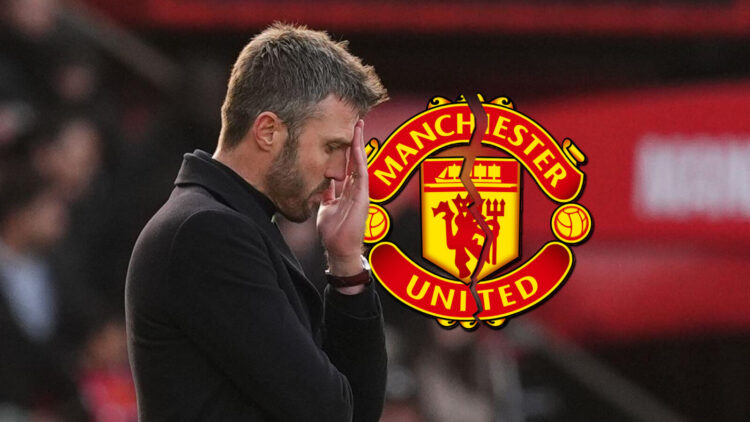
Manchester United are considering Michael Carrick’s future after another damaging run of results, but the club’s history of changing managers raises a bigger question: is the manager really the problem, or is something deeper broken at Old Trafford?
Manchester United have reached another familiar crossroads. Results have deteriorated, players are questioning decisions, supporters are frustrated, and the manager’s future is under scrutiny.
Following Sunday’s 3-0 defeat to Bournemouth, the club’s hierarchy held discussions about Michael Carrick’s position. United have gone eight matches without a win across all competitions and slipped to 16th in the Premier League.
Carrick’s position is becoming increasingly difficult to defend. However, before Manchester United dismiss another manager, the club must confront an uncomfortable question: will sacking Carrick solve the problems that have repeatedly undermined the team since Sir Alex Ferguson retired?
The club’s history suggests that replacing the manager alone may not be enough.
Seven permanent managers, but where is the lasting change?
Since Ferguson retired in 2013, Manchester United have appointed David Moyes, Louis van Gaal, Jose Mourinho, Ole Gunnar Solskjaer, Erik ten Hag, Ruben Amorim and now Carrick as permanent managers.
Each arrived with expectations of restoring United to the top of English and European football. Some won trophies, others secured Champions League qualification, and several enjoyed promising starts.
Yet none has reproduced Ferguson’s sustained success.
Mourinho won the Europa League and League Cup, while Ten Hag delivered the League Cup and FA Cup. Solskjaer brought renewed optimism and guided United to a second-place league finish in 2021.
However, their achievements did not establish a period of sustained dominance.
The cycle has become difficult to ignore. A manager arrives, the team improves, expectations rise, results deteriorate, and pressure builds for another change.
United then begin again, often with a different tactical philosophy and another rebuilding project.
That raises a fundamental question about the club’s decision-making. If successive managers with different approaches have struggled to restore consistent success, can the problem reasonably be attributed to the person in the dugout alone?
Ronaldo raised the alarm before leaving Old Trafford
Cristiano Ronaldo offered one of the most prominent criticisms of United’s internal problems before his departure in 2022.
In his interview with Piers Morgan, the Portuguese forward said he felt betrayed by the club and argued that United had made no meaningful progress since Ferguson’s retirement.
“Nothing had changed,” Ronaldo said, describing his perception of the club’s development.
He also criticised the Glazer family’s involvement, arguing that the owners were more concerned with commercial interests than the sporting side of the business.
Ronaldo’s comments were controversial, particularly because he also challenged then-manager Erik ten Hag. His own conduct and relationship with the manager contributed to his eventual departure.
Nevertheless, his broader criticism raised questions about the club’s direction, facilities, leadership and ability to compete consistently at the highest level.
Four years later, United are confronting another managerial crisis.
Ronaldo’s claims should not be treated as proof that every subsequent failure has the same cause. However, his central question remains relevant: what has actually changed at Manchester United beyond the names of the managers?
When players begin questioning the leadership
The latest crisis has also exposed tensions between Carrick and members of his squad.
Earlier in October, defender Lisandro Martínez publicly criticised director of football Jason Wilcox following United’s 2-0 Champions League defeat to Atletico Madrid. Reports subsequently said the defender was fined over his public comments.
His intervention brought the club’s recruitment and leadership decisions into the debate, suggesting that the frustration surrounding United’s performances extends beyond the manager.
Then came the 4-1 defeat to Como.
Captain Bruno Fernandes questioned Carrick’s tactical approach, particularly the decision not to press opponents man-to-man.
“It’s a decision from the staff to not press man to man and sometimes leave space behind,” Fernandes said.
He also argued that United needed to be braver when pressing high and putting opponents under pressure.
Carrick responded by emphasising that tactics alone could not compensate for players failing to run and work hard.
Fernandes was subsequently left on the bench for the Bournemouth match, although Carrick insisted the decision was based on footballing reasons rather than punishment.
These incidents do not establish that Carrick has lost the dressing room. They do, however, reveal a club struggling to keep discussions about its shortcomings away from public view.
When players question recruitment decisions and tactical instructions, the club must establish whether the problem lies with management, squad performance, recruitment or a combination of all three.
Sacking Carrick without addressing those questions could leave the underlying tensions unresolved.
Would another manager change anything?
There is a reasonable argument for dismissing Carrick.
Manchester United’s results are unacceptable for a club with its resources and ambitions. A manager must be accountable for performances, tactical decisions, team selection and the ability to motivate players.
Carrick cannot escape that responsibility simply because his predecessors also struggled.
However, accountability must extend beyond the manager.
United need a coherent recruitment strategy, consistent football leadership and a clear playing philosophy that survives changes in the dugout. They must also determine whether their squad possesses the quality, balance and mentality required to execute that philosophy.
Otherwise, a new appointment could bring another short-lived improvement before the same problems return.
Former United manager Ten Hag recently argued that dismissing Carrick would not be the solution, while criticising the club’s leadership over his own departure and the support he received.
His view deserves consideration, although his own experience at Old Trafford inevitably informs his perspective.
Ultimately, retaining Carrick simply to avoid another managerial change would be as misguided as dismissing him in the hope that a new face would automatically restore the club.
Manchester United must look beyond Carrick
Carrick’s earlier success earned him the permanent job. His recent results have placed that appointment in serious jeopardy.
The club must decide whether he can reverse the decline, but it should also examine the decisions that have repeatedly left managers struggling to build lasting success.
Ferguson’s retirement marked the end of an extraordinary era. More than a decade later, United are still searching for a stable path forward.
The problem is not that every manager appointed since 2013 has been blameless. They have made mistakes, and some have failed to meet reasonable expectations.
The problem is that repeated dismissals have not delivered the sustained improvement the club needs.
Sacking Carrick might change the man in the dugout, but unless Manchester United address the deeper issues surrounding recruitment, leadership, squad performance and long-term planning, another managerial appointment could become another chapter in the same story.