

Rahul Gandhi defamation case: Sultanpur court acquits him

Illustration: an imagined district courtroom, not the Sultanpur hearing.
The Rahul Gandhi defamation case over remarks about Amit Shah in 2018 ended with an acquittal in a special court in Sultanpur, Uttar Pradesh. Rahul Gandhi, India’s Leader of the Opposition in the Lok Sabha, was cleared on Monday in a criminal complaint brought by local Bharatiya Janata Party (BJP) leader Vijay Mishra.
Gandhi’s lawyer confirmed the acquittal. Mishra’s counsel, Santosh Pandey, told the Indian Express that he would study the written order before advising whether to challenge it. The order itself was not available in the reports reviewed.
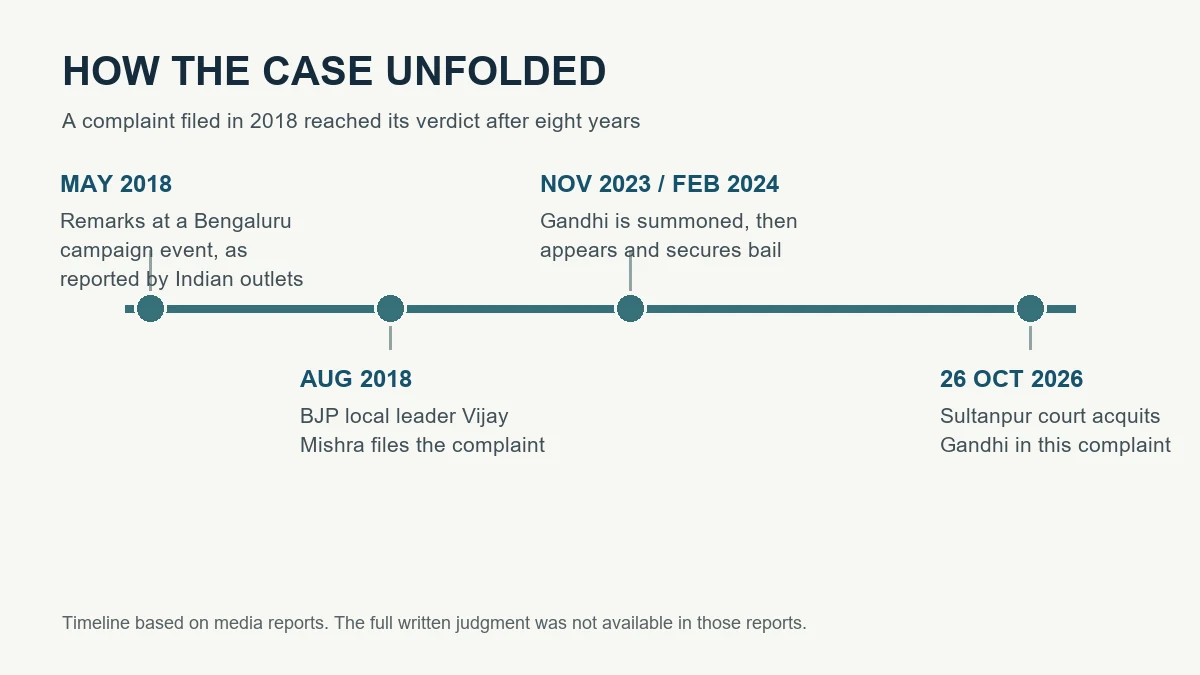
Timeline of the Rahul Gandhi defamation case
The complaint followed a speech Gandhi made during the 2018 Karnataka election campaign. The case then moved through several years of proceedings before the Sultanpur court delivered its verdict.
- May 2018: Gandhi’s remarks about the BJP’s then president, Amit Shah, were made at a campaign event in Bengaluru, according to the case timeline reported by the New Indian Express.
- August 2018: Mishra, then a local BJP office-holder, filed a criminal defamation complaint in Sultanpur.
- November 2023: The court summoned Gandhi to face the case.
- February 2024: Gandhi appeared in court and secured bail.
- 26 October 2026: The court acquitted him after hearing the case.
Why the complaint mattered
The case arose from Gandhi’s remarks during a heated state election campaign, when he referred to Shah as a person accused in a murder case. The comment concerned the 2005 Sohrabuddin Sheikh encounter case. Shah was discharged by a special Central Bureau of Investigation court in 2014, as Bar and Bench reported; that earlier decision is distinct from the question the Sultanpur court had to decide about the defamation complaint.
The complaint was filed under India’s criminal defamation provisions by Mishra, who said the remarks harmed him and other BJP workers. It was not a case brought by Shah himself. That difference is central to the verdict: the complainant’s eligibility to bring the case was one of the questions the court considered, alongside whether the remark was defamatory.
The Indian Express quoted Mishra’s lawyer, Santosh Pandey, as saying the court accepted the recording submitted as evidence but did not find Mishra to be an aggrieved person or Gandhi’s statement to be defamatory. Pandey said he had not yet studied the full judgment. The outcome therefore clears Gandhi of this complaint, while the court’s precise reasoning remains subject to the written order.
This is separate from Gandhi’s other defamation case
The Sultanpur acquittal does not resolve a different criminal defamation case over Gandhi’s 2019 “Modi surname” remark. A Gujarat court convicted him in that case in 2023 and imposed a two-year sentence; the Supreme Court later stayed that conviction. The two cases involve different remarks, complainants and court proceedings.
That distinction matters because headlines about an acquittal can be read too broadly. Monday’s decision applies to Mishra’s complaint about the 2018 Amit Shah remarks. It does not erase the separate case or establish a general ruling on every political statement made during an election campaign.
What we don’t know yet
The full Sultanpur judgment has not been reproduced in the reports reviewed, so the detailed legal reasoning and the exact grounds for acquittal remain unclear. Mishra’s lawyer said he would obtain and examine the order before consulting his client about a possible challenge. No appeal had been confirmed in the reporting available after the verdict.
The next development to watch is whether Mishra files a challenge once he has reviewed the written decision. Until then, the acquittal is confirmed, but the final procedural position and the court’s full explanation are not.
Sources
- Indian Express — courtroom reporting and lawyers’ accounts of the verdict.
- Bar and Bench — case background and the reported decision.
- New Indian Express — case timeline and earlier proceedings.
- ThePrint — report on the court’s ruling and complaint.