

Police begin election security training for 10,000 officers


Illustration: Police officers attend a training session on election security ahead of the 2027 polls.
The Nigeria Police Force and the Nigeria Police Trust Fund began election security training in Abuja on Friday, 23 October, with a target of 10,000 officers ahead of the 2027 polls. The five-day first phase includes officers from 18 states and the Federal Capital Territory, and covers crowd control, conflict prevention, human rights and lawful responses to election incidents, according to Voice of Nigeria.
The scale matters, but the 10,000 figure is a training target, not a confirmed count of officers who will be deployed on polling day. INEC’s timetable sets the presidential and National Assembly election for 16 January 2027, leaving the police a little under three months from the training launch to prepare for the vote. INEC timetable
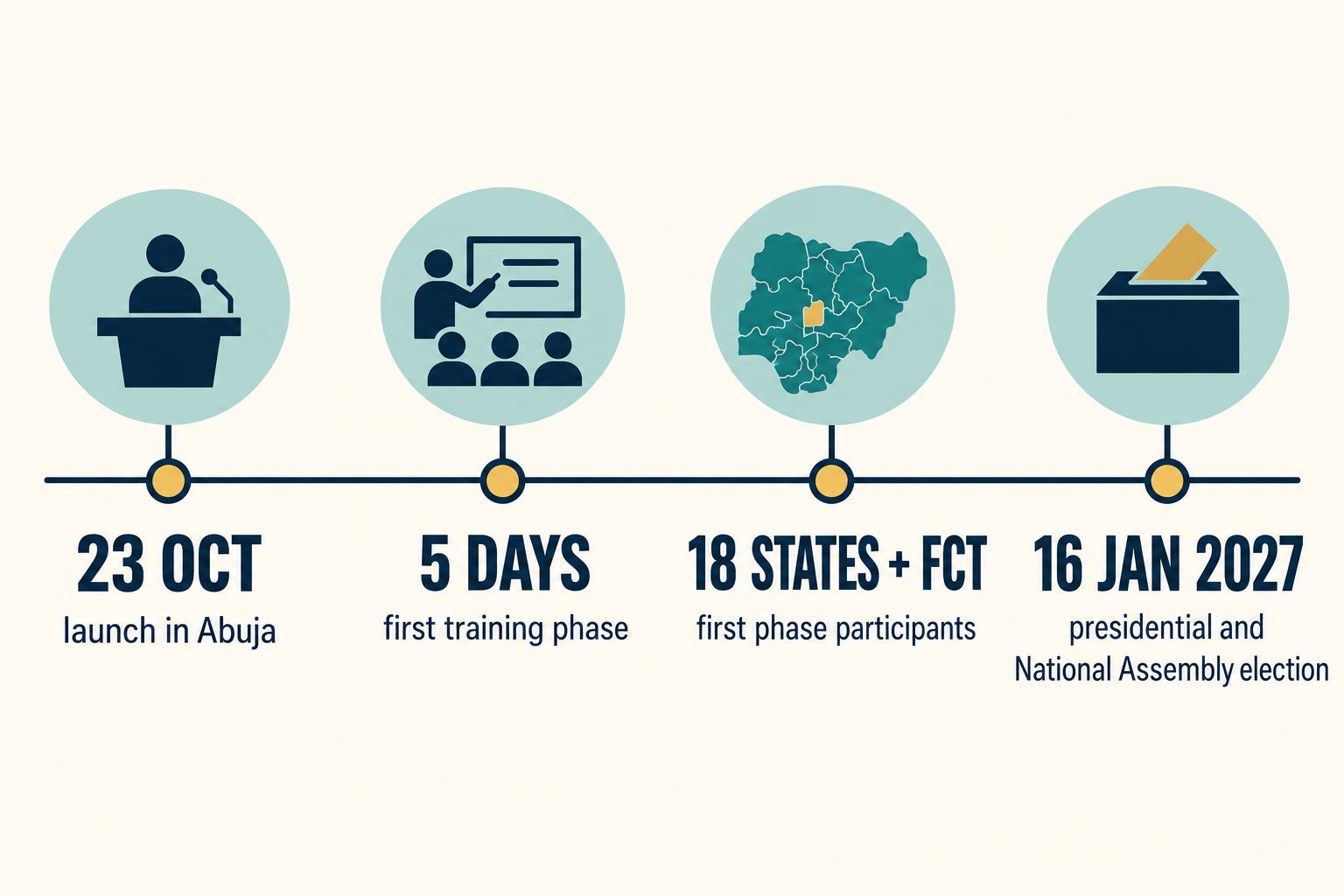
Election security training and the 10,000 target
Police Inspector-General Olatunji Disu and NPTF Executive Secretary Mohammed Sheidu announced the programme at the Nigeria Police Resource Centre in Jabi, Abuja. The Police Trust Fund is working with the Force on the training, which is intended to prepare officers for election security duties across Nigeria.
The number describes the programme’s overall target. The reported first phase brings officers from 18 states and the FCT into the five-day course; it does not show how many will come from each state or how many will later serve at polling units. Those details matter because a national total on its own cannot tell voters what security arrangements to expect in their ward.
A separate ThisDay report also said the trainees were drawn from police formations across the federation. Both reports place the programme’s launch in Abuja on 23 October, but neither gives a state-by-state allocation for the eventual 10,000-person target.
What the election security training covers
The course includes election security management, crowd control, conflict prevention, rules of engagement, intelligence gathering, human rights and lawful handling of election-related incidents, Voice of Nigeria reported. Those topics are meant to guide how officers respond when a campaign event, polling unit or collation centre becomes tense.
Training can set common standards for officers from different commands. Its value on election day will depend on whether those standards shape decisions on the ground: how police protect voters and electoral staff, respond to threats, and avoid favouring a party or candidate. The Inspector-General warned trainees to remain neutral and accountable, according to the report.
For wider context on the role of security agencies in reducing election violence, see CrispNG’s Peace Accord explainer.
The programme comes as parties campaign for a national vote. INEC lists 16 January 2027 for the presidential and National Assembly election, then 6 February for governorship and State House of Assembly elections. That makes election security a series of assignments across different dates, rather than a single polling-day operation. INEC election dates
Accountability still needs a working channel
Disu said the Force planned to create a dedicated 24-hour complaints line for reports of misconduct by officers assigned to election duties. That could give voters and election workers a direct way to report intimidation, partisan behaviour or other abuses, but the line was announced as a plan; no number or launch date was provided in the reports.
Until the Force publishes the contact and explains how complaints will be handled, the public cannot know who will answer calls, how reports will be logged, or what response a complainant should expect. A number of trained officers and a complaints line are useful commitments only when people can see where they apply and what happens after a report is made.
What we don’t know yet
The police and NPTF have not publicly detailed the remaining training phases, how the target of 10,000 officers will be divided among states, or the number of officers who will be assigned to polling and collation locations. The available reports also do not say whether training will include simulations at those sites or how commanders will assess officers after the course.
The planned complaints line has no published number, and no public timetable explains when it will become active. These gaps leave a clear test for the coming months: whether police commands publish deployment and complaint procedures before election day, so voters know what to expect and where to raise concerns.
For now, voters can use INEC’s election calendar to track the next confirmed national date: presidential and National Assembly voting on 16 January 2027.