
By Ernen Kaanti
A new initiative aimed at dismantling the barriers between academic research, journalism and society, AmplifyITT, has been officially launched, with media professionals and academics calling for deliberate efforts to ensure that valuable research findings do not remain trapped in university libraries while critical national conversations and policy decisions proceed without their contributions.
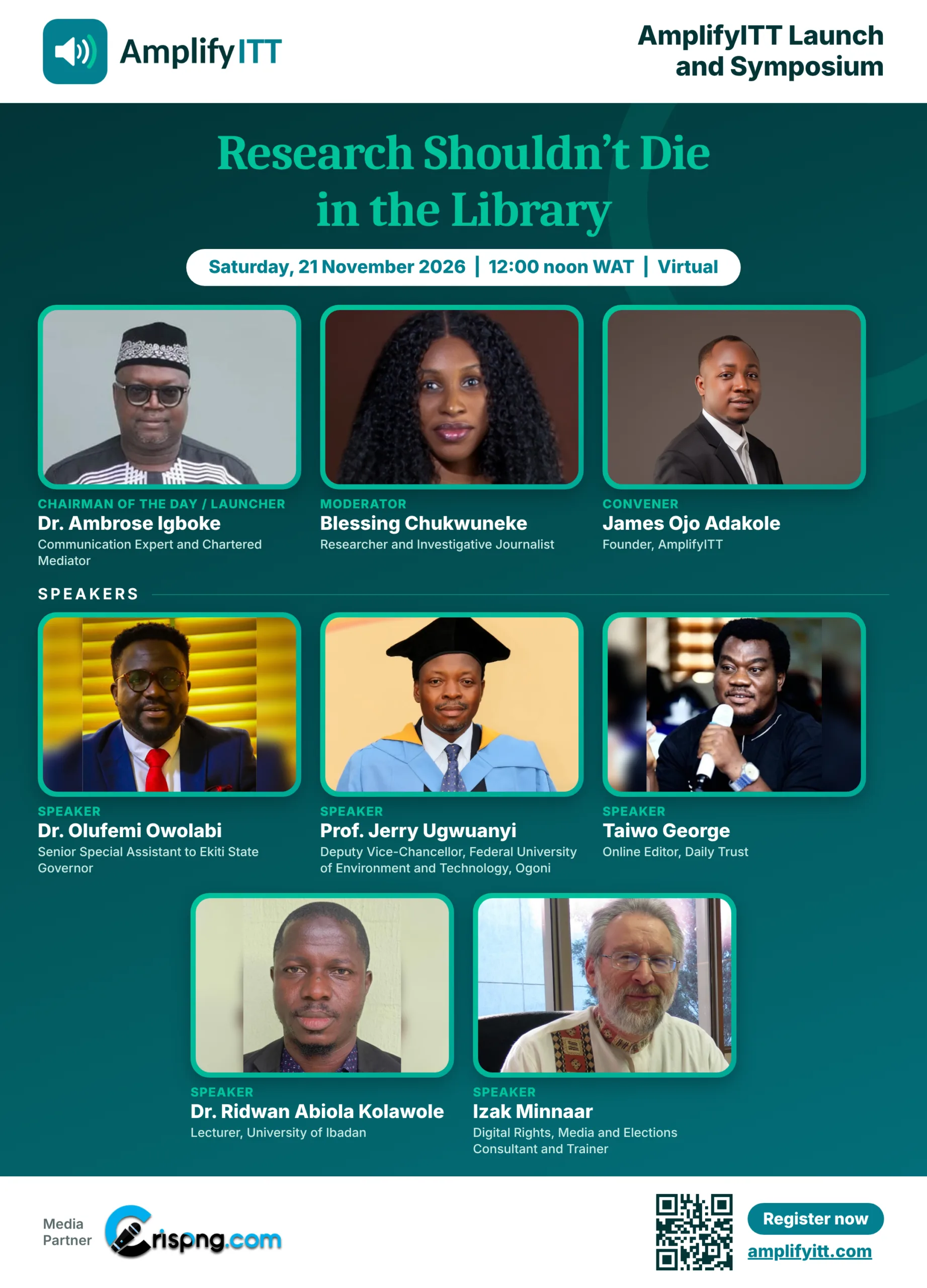
The initiative, founded by James Ojo Adakole, was unveiled on Saturday, November 21, 2026, during its maiden virtual symposium, themed “Research Shouldn’t Die in the Library.”
The symposium brought together journalists, academics, communication experts and public affairs analysts to examine how academic research could be translated into accessible public information, influence policymaking and contribute to meaningful societal development.
At the event, Dr. Ambrose Igboke, chairman of the symposium and the official launcher of the initiative, commended Adakole for conceiving what he described as an important intervention in addressing the disconnect between academic knowledge and public understanding.
He challenged journalists to move beyond conventional news gathering and deliberately identify, investigate and publish relevant academic research findings for public consumption, particularly findings capable of informing policymakers, government institutions and other organisations responsible for shaping society.
Igboke warned against allowing the enormous intellectual investments of researchers to become confined to academic institutions, insisting that research should serve a wider public purpose.
He maintained that the value of academic research should not be measured solely by its publication or acceptance within university circles but also by its ability to influence public conversations, improve institutional decisions and address real-life challenges.
Igboke, a communication expert, media and public relations consultant and global public affairs analyst, also chairs the Chartered Institute of Chartered Mediators and Conciliators of Nigeria and the Guild of Public Affairs Analysts of Nigeria, Enugu State.
Speaking as the guest speaker, Professor Jerry Ugwuanyi, Deputy Vice-Chancellor of the Federal University of Environment and Technology, Ogoni, challenged journalists and academics to establish stronger working relationships to close the communication gap between academic researchers and the general public.
He stressed the need for a deliberate partnership that would enable journalists to identify relevant research, interpret complex academic findings and communicate them in formats that ordinary citizens and policymakers could understand and apply.
Other speakers reinforced the argument that the relationship between journalism and academia must evolve beyond occasional interactions if research is to become a meaningful instrument of public enlightenment and national development.
Among them were Dr. Olufemi Owolabi, a senior lecturer and Special Assistant to the Governor of Ekiti State; Taiwo George, online editor with Daily Trust; Dr. Ridwan Abiola Kolawole, a lecturer at the University of Ibadan; and Izak Minnaar, a South African journalist, digital media and elections consultant and trainer.
The speakers unanimously underscored the pivotal role of journalists in ensuring that research findings escape the confines of academic institutions and become accessible resources for public education, governance and policy formulation.
They argued that while academics possess the expertise to generate evidence-based knowledge, journalists have the professional responsibility to translate such knowledge into compelling narratives that connect with the wider society.
Their contributions further highlighted the need for sustained collaboration between researchers and media practitioners, particularly in an era when public debates and government decisions increasingly require credible information, reliable evidence and informed analysis.
Bridging the Knowledge Gap
In introducing AmplifyITT, its founder, James Ojo Adakole, described the initiative as a product of his commitment to bridging the longstanding gap between research, journalism and society.
He explained that the platform was conceived to make valuable research findings more accessible, engaging and impactful, rather than allowing important academic discoveries to remain largely inaccessible to people who could benefit from them.
The maiden symposium provided an opportunity to interrogate the responsibilities of both journalists and academics in ensuring that research contributes meaningfully to public discourse and the formulation of policies.
At the heart of the discussions was a fundamental concern: societies cannot fully benefit from the intellectual resources generated within their universities when the findings remain disconnected from the people, institutions and policymakers whose decisions they could influence.
The launch of AmplifyITT therefore signals an attempt to redefine the relationship between knowledge production and public communication.
Beyond celebrating academic research, the initiative seeks to encourage a culture in which journalists actively engage scholarly work, researchers communicate beyond academic circles and policymakers recognise research as an essential resource for effective governance.
The symposium’s central message was unmistakable: research must not merely be conducted, documented and archived; it must be communicated, understood and applied.
For a society confronted by complex governance, economic, educational and developmental challenges, the ability to connect academic knowledge with public decision-making could prove indispensable.
With its maiden symposium, AmplifyITT has placed an important question before Nigeria’s media and academic communities: What is the value of research that never reaches the people it was meant to serve?