

Saturn Has a Second Giant Shape Hiding at Its Bottom, and Scientists Just Found It

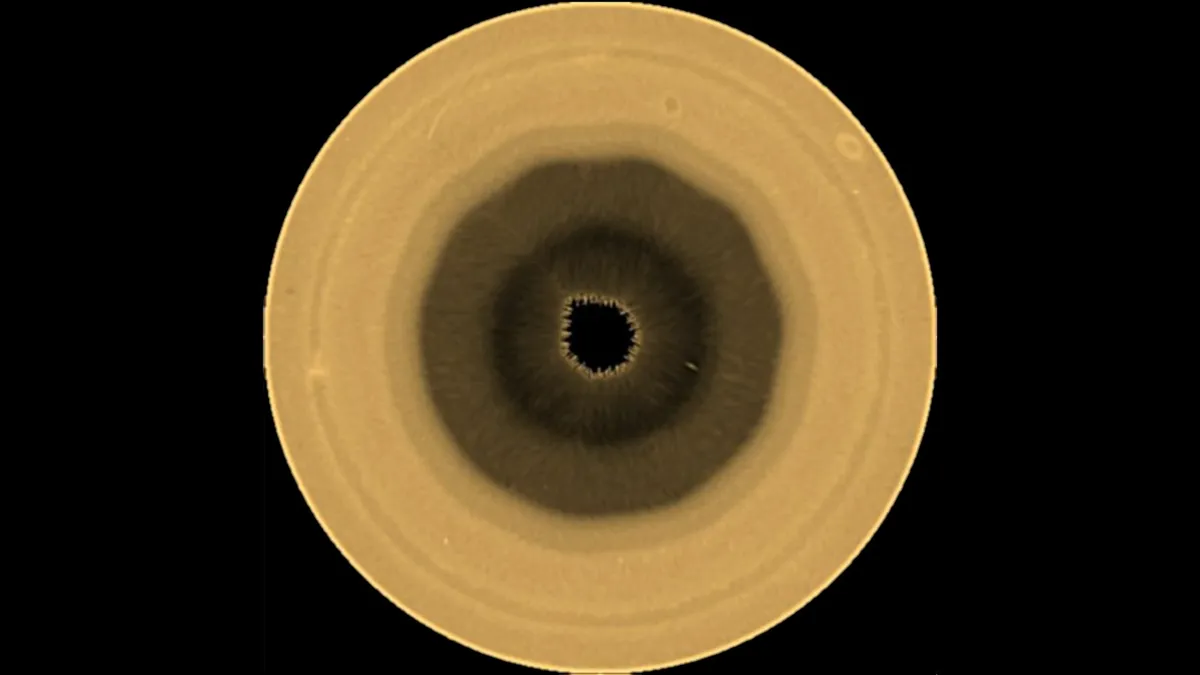
Saturn’s south pole as captured by the Hubble Space Telescope in August 2025. (Image credit: NASA, ESA, A. Sánchez-Lavega (Basque Country University, EHU))
A colossal 10-sided cloud pattern has been sitting at Saturn’s south pole, possibly for decades, without anyone on Earth being able to see it.
Here is what that actually means, in plain English.
If you strip away the jargon, here is the discovery in one sentence: Saturn has a giant, geometric weather pattern spinning slowly around its south pole, shaped roughly like a 10-sided figure, and it is so large that more than 13 Earths could fit across it side by side.
Scientists already knew Saturn had something similar at its north pole. That one is shaped like a hexagon, six sides, and it has been there, largely unchanged, since it was first spotted in data from NASA’s Voyager spacecraft in the early 1980s. What nobody knew, until now, is that the south pole has its own version, and it has ten sides instead of six.
Why Did It Take This Long to Find?
This is not a story about scientists missing something obvious. For more than a decade, from 2012 to 2023, the way Saturn tilts on its axis meant the south pole was simply not visible from Earth. Imagine trying to check if someone has a scar on the back of their head while they only ever face away from you occasionally, and for years at a time they are turned completely the other way. That is roughly the situation astronomers were in.
Once Saturn’s tilt shifted enough for the south pole to come back into view, the Hubble Space Telescope was able to photograph it properly for the first time since the hexagon’s discovery decades earlier. And there it was: a shape nobody had documented before.
What Actually Is This Shape, in Plain Terms?
Think of it like a slow, giant whirlpool of clouds, except instead of forming a smooth circle, it settles into a repeating pattern of straight edges, ten of them, each one roughly the length of a cross-country flight. It is not a solid object and it is not something you could stand on. It is a pattern in the flow of Saturn’s atmosphere, similar to how a fast-moving river can develop regular ripples or bends instead of flowing in a perfectly straight line.
The whole structure barely seems to move to a human eye. It takes about 800 days, more than two years, just to complete a single full rotation around the pole.
Why Should Anyone Outside of Astronomy Care?
Because it changes something scientists thought they understood. For decades, Saturn’s hexagon was treated as a one-of-a-kind oddity, a strange exception that did not seem to have a match anywhere else in the solar system. Finding a second, different-shaped structure at the opposite pole of the same planet suggests these polygon-shaped weather patterns might be a more general rule of how planetary atmospheres behave, not a freak accident.
There is also a genuinely human moment buried in this story. The researchers had specifically gone looking for a southern match to the hexagon before, in earlier years, and found nothing. When it finally showed up in the 2023 images, the lead scientist described being caught off guard by it, despite having looked for exactly this kind of thing before.
What Happens Next
Unlike the hexagon, which has kept a steady, unchanging appearance for decades, the decagon’s brightness varies unevenly across its shape, which suggests it might still be settling into its final form. Scientists now want to watch it over the next several years to see whether it breaks apart or becomes more stable, particularly as sunlight increases over that part of Saturn heading toward 2032.
Frequently Asked Questions
What did astronomers discover at Saturn’s south pole?
A massive, ten-sided cloud pattern, nicknamed a decagon, spinning slowly around Saturn’s south pole. It is roughly 104,000 miles wide.
Is this similar to Saturn’s hexagon?
Yes. Saturn’s north pole has had a six-sided cloud pattern, called the hexagon, since it was discovered in the 1980s. The newly found decagon is a similar kind of structure at the opposite pole, but with ten sides instead of six.
Why wasn’t the decagon found earlier?
Saturn’s tilt kept its south pole hidden from view on Earth between 2012 and 2023. Once that view returned, the Hubble Space Telescope was able to photograph the pole properly and the pattern was visible for the first time.
Is the decagon a solid structure?
No. It is a pattern formed within Saturn’s atmosphere, similar to how a wave or current can settle into a repeating shape rather than flowing smoothly.
How fast does the decagon move?
It takes roughly 800 days, more than two years, to complete one full rotation around Saturn’s south pole.
Could the decagon disappear or change shape
Possibly. Scientists say its uneven brightness suggests it may still be evolving, unlike the more stable hexagon, and they plan to keep watching it in the coming years.
If Hubble captured the decagon in 2023, why is this being reported as news now?
Because the images alone were not a public discovery. Scientists spent time analyzing the data, running simulations, and completing peer review before publishing the findings on September 2, 2026, in Science Advances. The gap between capturing data and publishing a confirmed study is normal in astronomy.