

How the Rosetta Stone helped decipher hieroglyphs

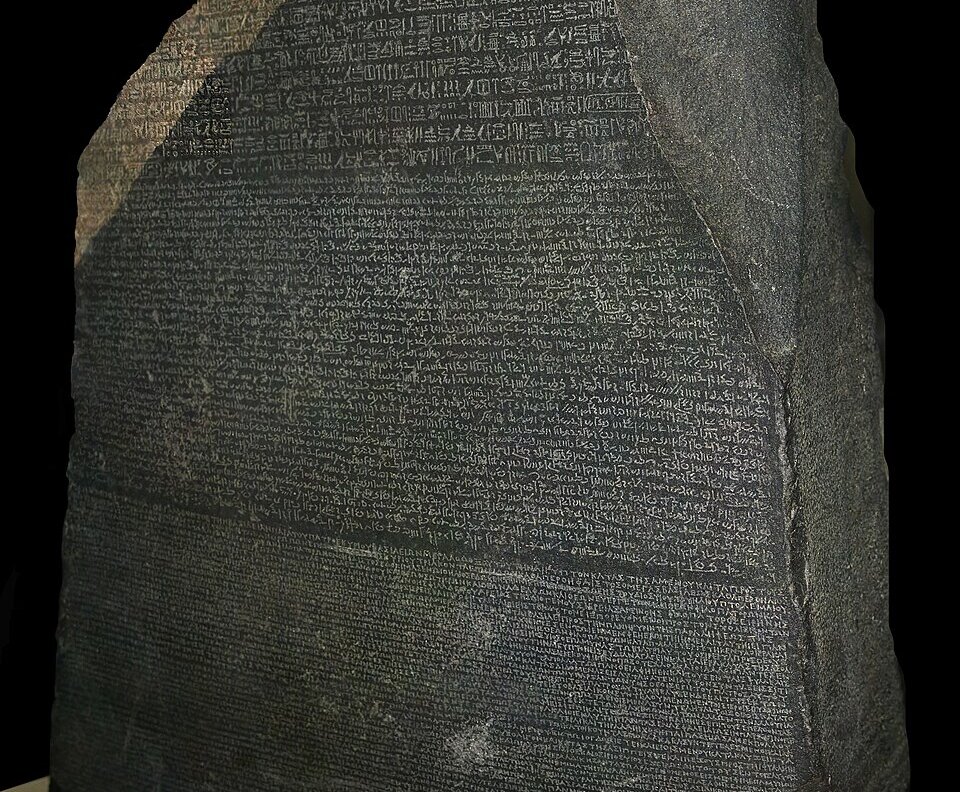
The Rosetta Stone, photographed at the British Museum on 21 November 2007. Photo: © Hans Hillewaert, via Wikimedia Commons; CC BY-SA 4.0. Resized and cropped for display; the image remains under the same licence.

The Rosetta Stone is a surviving fragment of an Egyptian decree carved in 196 BC. Its hieroglyphic, Demotic and Greek inscriptions gave scholars equivalent texts to compare, helping them work out how Egyptian hieroglyphs represented language. Because Ancient Greek could already be read, it supplied a meaning against which they could test the Egyptian signs.
Key facts
- Object: part of a larger inscribed slab, or stela, made of granodiorite.
- Original message: a priestly decree supporting King Ptolemy V, issued in 196 BC.
- Writing: hieroglyphs at the top, Demotic in the middle and Ancient Greek below.
- Discovery: French troops found the fragment near Rashid, known to them as Rosetta, in July 1799.
- Decipherment: Thomas Young made important phonetic identifications; Jean-François Champollion announced a breakthrough in 1822 and developed his explanation further in 1824.
What the Rosetta Stone actually says
The decree concerns the relationship between the royal court and Egypt’s temples. It praises Ptolemy V, records benefits associated with his rule and sets out religious honours for him. Its original purpose was to circulate an agreement about authority and worship.
In the Budge translation, the priests describe gifts of money and grain to temples, reductions or cancellation of dues, and releases from punishment. The document also celebrates the suppression of rebellion. These are claims made by a text honouring the king, which gives its account a clear political purpose.
The religious instructions turn that praise into repeated public action. Statues of the king were to receive ritual attention, while festivals and priestly titles would maintain his place within temple life. Support for religious institutions and recognition of royal power appear together in the decree.
The closing instruction explains why the message was repeated in different scripts: copies were to be set up in temples. For a reader studying the object, that ending supplies an unusually useful clue. It identifies the different inscriptions as versions of one decree, rather than unrelated passages collected on a single slab.
Three scripts to compare
A script is a system for writing language. Hieroglyphs use recognisable images as signs, while Demotic has a cursive appearance. The Greek inscription uses a writing system that European scholars studying the stone could already understand.
| Position | Script | Role in the decree |
|---|---|---|
| Upper section | Egyptian hieroglyphs | A formal inscription suitable for a religious monument |
| Middle section | Demotic | An Egyptian script used for everyday documents |
| Lower section | Ancient Greek | The language of the Greco-Macedonian rulers’ administration |
The British Museum account explains the functions of these scripts. The arrangement reflects the different written traditions operating in Ptolemaic Egypt. For decipherment, it created a way to move from a readable version towards writing whose signs had lost their established interpretation.
Equivalent messages still require careful comparison. A royal title can take a different form in another language, and corresponding passages need to be identified before individual signs can be assigned a sound or meaning. Understanding the general subject was only the beginning.
How scholars used names to test the signs
Royal names offered a manageable place to start. In the hieroglyphic section, an oval enclosure called a cartouche marked a royal name. Ptolemy appeared in the Greek decree, giving scholars a candidate to compare with the enclosed Egyptian signs.
The method depended on repeated tests. If a proposed sound value helped explain a name in one inscription, it could be tried against another name elsewhere. A match became more convincing when it worked across different examples, rather than only in a single convenient reading.
The Yale exhibition credits Young with identifying Ptolemy and certain queens’ names by 1819 and recognising a phonetic element in hieroglyphs. It also notes that some of his proposed values were wrong, limiting his explanation of the wider text.
Champollion’s 1822 Lettre à M. Dacier refined the understanding of signs used in foreign rulers’ names. The larger task was to show that sound-writing also belonged to the Egyptian language itself, including names and words from periods before Greek rule.


Why Coptic and other inscriptions mattered
Coptic preserved a later stage of the Egyptian language, written largely with Greek letters. Champollion’s knowledge of it helped him connect signs with Egyptian words and grammatical forms. The stone supplied a comparison; knowledge of the language helped explain what that comparison revealed.
Egyptologist Friedhelm Hoffmann, interviewed by LMU Munich, describes how the recognition of sounds and meaning-signs together made the system intelligible. Hieroglyphic writing could represent the sounds of speech while also using signs that conveyed meaning.
This combination explains why treating every picture as a separate symbolic message led readers astray. An image of an object could participate in writing a word through its sound value. The appearance of a sign alone therefore offered an incomplete guide to its function in a passage.
Yale highlights Champollion’s Précis of 1824 as a decisive development. He applied phonetic readings to Egyptian rulers’ names and recognised Coptic words and grammar in hieroglyphic texts. The 1822 announcement and the fuller 1824 explanation mark stages in a developing argument.
From a reused stone to printed evidence
French troops encountered the stone during work on fortifications near Rashid in July 1799. Officer Pierre-François Bouchard recognised the significance of the inscriptions. The discovery belonged to Napoleon’s invasion of Egypt, rather than a planned excavation of the monument’s original setting.
Copies helped scholars study the writing beyond the place where the stone was held. The Linda Hall exhibition describes early efforts to print directly from the inscribed surface and the distribution of reproductions in Europe. Drawings, prints and casts allowed the evidence to circulate.
After the French defeat in 1801, the stone passed to British forces under the terms of the Alexandria agreement. It reached Britain in 1802 and entered the British Museum. Its movement followed the military struggle over Egypt.
A timeline of the Rosetta Stone
- 196 BC: the decree honouring Ptolemy V is issued.
- July 1799: French soldiers find the stone near Rashid.
- 1801: the French surrender leads to its transfer to British forces.
- 1802: the stone arrives in Britain and enters the British Museum.
- 1819: Young’s work includes phonetic identifications of royal names.
- 27 September 1822: Champollion presents his breakthrough to the Académie des Inscriptions et Belles-Lettres in Paris.
- 1824: Champollion publishes his fuller explanation in the Précis.
What remains uncertain and disputed
The original location of the stela remains unknown. Linda Hall’s exhibition explains that the fragment had been reused as building material and was probably already broken when moved to Rosetta. Its surviving shape cannot establish exactly when, how or by whom the damage occurred.
Credit for decipherment also requires distinguishing contributions. Young established important readings; Champollion developed a wider explanation of the writing system. Concentrating on the celebrated 1822 announcement can obscure both the work preceding it and the advances that followed.
The collecting history raises a separate dispute. The British Museum describes the stone’s acquisition through the 1801 agreement. Writing for the American Research Center in Egypt, Egyptologist Foy Scalf places its removal within French and British imperial competition and discusses Egyptian arguments for repatriation.
Those positions concern who should hold the object and how its removal should be judged. Readers exploring that wider context can also consult CrispNG’s Egyptian museum report, which discusses collections and calls for the return of Egyptian antiquities.
Why decipherment mattered beyond one decree
The achievement gave researchers a method to read many Egyptian texts, extending far beyond the message carved for Ptolemy V. Names could be checked across monuments, and words could be compared within passages whose grammar gradually became clearer.
Hoffmann explains that damaged inscriptions and the discovery of unfamiliar words continue to create problems of interpretation. Being able to read a writing system still leaves historians with the work of reconstructing damaged evidence and deciding precisely what a particular passage means.
Frequently asked questions
Why is it called the Rosetta Stone?
The name comes from Rosetta, the French name used for Rashid, near where the fragment was found in 1799. It identifies the discovery place, rather than a title given to the decree in antiquity.
How old is the Rosetta Stone?
The inscription dates to 196 BC, making it more than 2,200 years old. That date concerns the ancient decree, while 1799 marks the fragment’s discovery by French troops.
What broke the Rosetta Stone?
The precise cause and date of the breakage are unknown. The surviving fragment and its reuse in a wall provide evidence of damage and reuse, but they cannot by themselves identify who broke it.
What is controversial about the Rosetta Stone?
Its removal from Egypt during the conflict between French and British forces has made it part of debates about colonial collecting and repatriation. The historical transfer and the question of where the object ought to be held involve different kinds of argument.
Sources and further reading
- British Museum account, the decree, scripts, discovery and acquisition.
- Budge translation, the decree in E. A. Wallis Budge’s The Nile, Notes for Travellers in Egypt, ninth edition, 1905; a historical translation with supplied restorations.
- Yale exhibition, Champollion’s Précis and the stages of decipherment.
- LMU Munich, interview with Egyptologist Friedhelm Hoffmann.
- Linda Hall exhibition, discovery, reproductions and the fragment’s earlier history.
- ARCE study, Foy Scalf on the decree and collecting history.
Last reviewed: 29 October 2026