

Inside Egypt’s $1 billion wonder: How the grand Egyptian museum is redefining history beside the pyramids

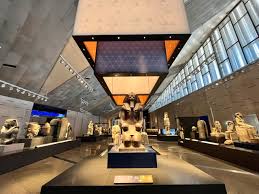
After more than two decades of anticipation, the Grand Egyptian Museum (GEM) has finally opened its monumental doors near the Great Pyramids of Giza — and it’s already being hailed as one of the most ambitious cultural landmarks of the 21st century. Costing an estimated $1 billion and covering 470,000 square meters, the GEM isn’t just a museum; it’s a statement — a fusion of Egypt’s 7,000-year history with modern architectural genius.
Touted as the largest archaeological museum in the world dedicated to a single civilization, the GEM brings together more than 100,000 artifacts, showcasing the brilliance of Egypt’s ancient dynasties — from pre-dynastic times to the Greek and Roman eras.
Among the museum’s most anticipated attractions is the complete collection from King Tutankhamun’s tomb, displayed together for the first time since its discovery by Howard Carter in 1922. Visitors will see the young pharaoh’s iconic gold mask, his throne, chariots, and even personal belongings — meticulously restored and preserved by Egyptian conservators.
Dr. Tarek Tawfik, President of the International Association of Egyptologists and a key figure behind the museum’s vision, said his goal was to recreate the sense of awe Carter must have felt upon first opening Tutankhamun’s tomb. “We wanted visitors to experience it exactly as he did — complete, authentic, and breathtaking,” he noted.
An Architectural Marvel Beside the Pyramids
The museum’s grandeur begins at its entrance — a pyramid-shaped façade carved from translucent alabaster, engraved with hieroglyphs that glimmer in the sunlight. Inside, a colossal 11-meter statue of Ramses II greets guests, flanked by a 3,200-year-old suspended obelisk, setting the tone for what lies beyond.
A six-story Grand Staircase, lined with statues of Egypt’s legendary kings and queens, guides visitors upward to exhibition halls offering panoramic views of the nearby Giza pyramids — a perfect blend of the ancient and the modern.
Beyond its breathtaking design, the museum embraces 21st-century technology. Mixed-reality and multimedia displays allow visitors to explore ancient Egypt in new ways, appealing to younger audiences used to digital experiences. “We’re speaking the language of Gen Z,” said Ahmed Ghoneim, the museum’s CEO. “This is heritage meeting innovation.”
A New Era for Egyptology and Tourism
For Egypt, the opening of the GEM symbolizes more than a cultural milestone — it’s an economic revival strategy. After years of challenges from political unrest, the pandemic, and regional crises, the government hopes the museum will attract 8 million visitors annually, doubling the record 15.7 million tourists who visited the country in 2024.
“This is Egypt’s gift to the world,” said Sherif Fathy, the Minister of Tourism and Antiquities. “It celebrates our past while shaping our future.”
Renowned archaeologist Dr. Zahi Hawass sees the GEM as a proud moment for Egyptian scholars. “It proves that we are equals to any international Egyptologist,” he said, adding that the museum strengthens Egypt’s call for the return of cultural treasures like the Rosetta Stone, Nefertiti’s bust, and the Dendera Zodiac.
These iconic artifacts, currently housed in London, Berlin, and Paris, have long been subjects of repatriation debates. With GEM’s opening, Egyptian experts argue that the nation now has the facilities and expertise to care for its own heritage — and to tell its story in its own voice.
The Experience Awaits
Tourists from around the world are already flocking to Giza for the full public opening on November 4, 2025. From Tutankhamun’s treasures to the 4,500-year-old Khufu funerary boat, every exhibit is a portal into an ancient world that continues to captivate generations.
Spanish tourist Raúl summed up the global excitement: “It’s a once-in-a-lifetime opportunity to see the story of humanity’s oldest civilization unfold under one roof.”
The Grand Egyptian Museum is not just a museum — it’s a living narrative of Egypt’s eternal relationship with history, artistry, and identity.
FAQs
Q1: What is the Grand Egyptian Museum (GEM)?
The GEM is the world’s largest archaeological museum, located near the Giza Pyramids in Cairo. It houses over 100,000 ancient Egyptian artifacts.
Q2: What makes the GEM unique?
It showcases the complete Tutankhamun collection for the first time in history, alongside interactive exhibits and advanced conservation facilities.
Q3: When was the Grand Egyptian Museum officially opened?
The GEM officially opened to the public on November 1, 2025, after more than two decades of construction.
Q4: How much did it cost to build the GEM?
The total cost is estimated at $1 billion, making it one of the largest cultural investments in Africa.
Q5: Why is the museum significant to Egypt’s tourism?
The GEM is expected to attract up to 8 million visitors per year, significantly boosting Egypt’s tourism and global cultural profile.