

Nidal Hasan: The Army psychiatrist sentenced to death over 2009 Fort Hood shooting

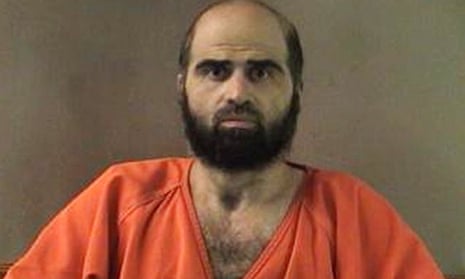
Nidal Hasan was once an Army psychiatrist whose job involved treating American soldiers dealing with the psychological effects of military service.
Today, the former US Army major is on military death row after being convicted of killing 13 people in a 2009 shooting at Fort Hood, Texas.
More than a decade after a military court sentenced him to death, Hasan is again in the spotlight after US President Donald Trump approved his execution by an Army firing squad.
The decision, announced by the Pentagon, could lead to the first US military execution since 1961.
But who is Nidal Hasan, and how did an Army psychiatrist end up on death row?
Who is Nidal Hasan?
Nidal Malik Hasan was born on September 8, 1970, in Arlington County, Virginia, to Palestinian immigrant parents.
He later pursued a career in medicine and joined the US Army, eventually becoming a psychiatrist.
Hasan earned a bachelor’s degree in biochemistry from Virginia Tech before attending the Uniformed Services University of the Health Sciences, where he trained as a military doctor.
He graduated from medical school in 2003 and completed psychiatric training at Walter Reed Army Medical Center in Washington, DC.
His work focused in part on soldiers dealing with combat-related stress and other mental health challenges.
In May 2009, Hasan was promoted from captain to major.
Several months later, he was transferred to Fort Hood, a major US Army installation in Texas that served as a staging point for troops deploying to Iraq and Afghanistan.
What happened at Fort Hood?
On November 5, 2009, Hasan opened fire at a Soldier Readiness Center at Fort Hood.
The attack killed 13 people and wounded 32 others, making it one of the deadliest attacks ever recorded at a US military installation.
Most of those killed and wounded were soldiers.
Hasan was eventually shot by a civilian police officer responding to the attack. He survived but was left paralysed from the waist down.
He was arrested and charged with multiple counts of murder and attempted murder.
The attack immediately raised questions about Hasan’s background, his views about US military operations and his contact with extremist figures.
Investigators found that he had exchanged emails with Anwar al-Awlaki, an American-born radical cleric who was later killed in a US drone strike in Yemen.
The US government ultimately did not prosecute Hasan under a terrorism charge. His military case proceeded as a capital murder prosecution.
Why did Hasan say he carried out the attack?
Hasan did not deny being responsible for the shooting.
During his court-martial, he argued that he had acted to protect Muslims from American military operations in Afghanistan.
He had previously expressed opposition to the wars in Iraq and Afghanistan and was facing deployment to Afghanistan himself around the time of the attack.
Those views became a major part of the prosecution’s case and the public discussion surrounding the shooting.
However, the military jury convicted him of the murders and attempted murders regardless of his stated justification.
The unusual trial
Hasan’s court-martial in 2013 attracted considerable attention because of the way he conducted his defence.
He chose to represent himself despite facing the death penalty.
His defence lawyers remained available as standby counsel, but Hasan largely controlled his own case.
He did not attempt to deny that he was the gunman.
He also called no witnesses in his defence and presented little evidence compared with the prosecution.
His decision to represent himself led his court-appointed lawyers to raise concerns that he was effectively seeking a death sentence.
On August 23, 2013, a military jury convicted Hasan of 13 counts of premeditated murder and 32 counts of attempted premeditated murder.
Five days later, the same jury sentenced him to death.
The sentence also resulted in his dismissal from the US Army and the loss of his military pay and benefits.
Hasan’s years on death row
Hasan was transferred to the US Disciplinary Barracks at Fort Leavenworth, Kansas, after his conviction.
He has remained there on military death row for more than a decade.
Death sentences in the US military justice system automatically go through multiple layers of review, meaning that a sentence does not immediately result in an execution.
Hasan’s legal challenges continued for years.
According to recent reports, the US Supreme Court rejected his final appeal in March 2025, leaving presidential authorisation as a key step before the sentence could be carried out.
Trump approves firing squad execution
That step came on October 5, 2026.
The Pentagon said Defence Secretary Pete Hegseth recommended that Hasan be executed by an Army firing squad and Trump approved the recommendation.
The Secretary of the Army is expected to determine the time and place of the execution.
The decision is historically significant because the US military has not carried out an execution since 1961.
If carried out, Hasan’s execution would therefore mark the return of the US military’s use of the death penalty after more than six decades.
It would also be an unusual case because firing squad executions have been extremely rare in the US military.
From military doctor to death row inmate
Hasan’s case represents a dramatic change in the life of a man who once served inside the same military system that ultimately convicted him.
He trained as a doctor, became an Army psychiatrist and worked with soldiers experiencing psychological difficulties linked to military service.
In 2009, however, he became the perpetrator of an attack on fellow service members at Fort Hood.
The military court later found him guilty of 13 murders and 32 attempted murders and sentenced him to death.
Now, 13 years after that sentence, the execution process has moved closer to becoming a reality.
For more than a decade, Hasan has remained on military death row while his case passed through the US military and civilian courts.
Trump’s approval has brought the case back into national attention and opened the way for the US military’s first execution in more than 60 years.
The date of Hasan’s execution has not yet been announced.