

RAF Fairford investigation charges: two distinct allegations


Illustration: a generic airfield setting, not a scene from the RAF Fairford investigation.
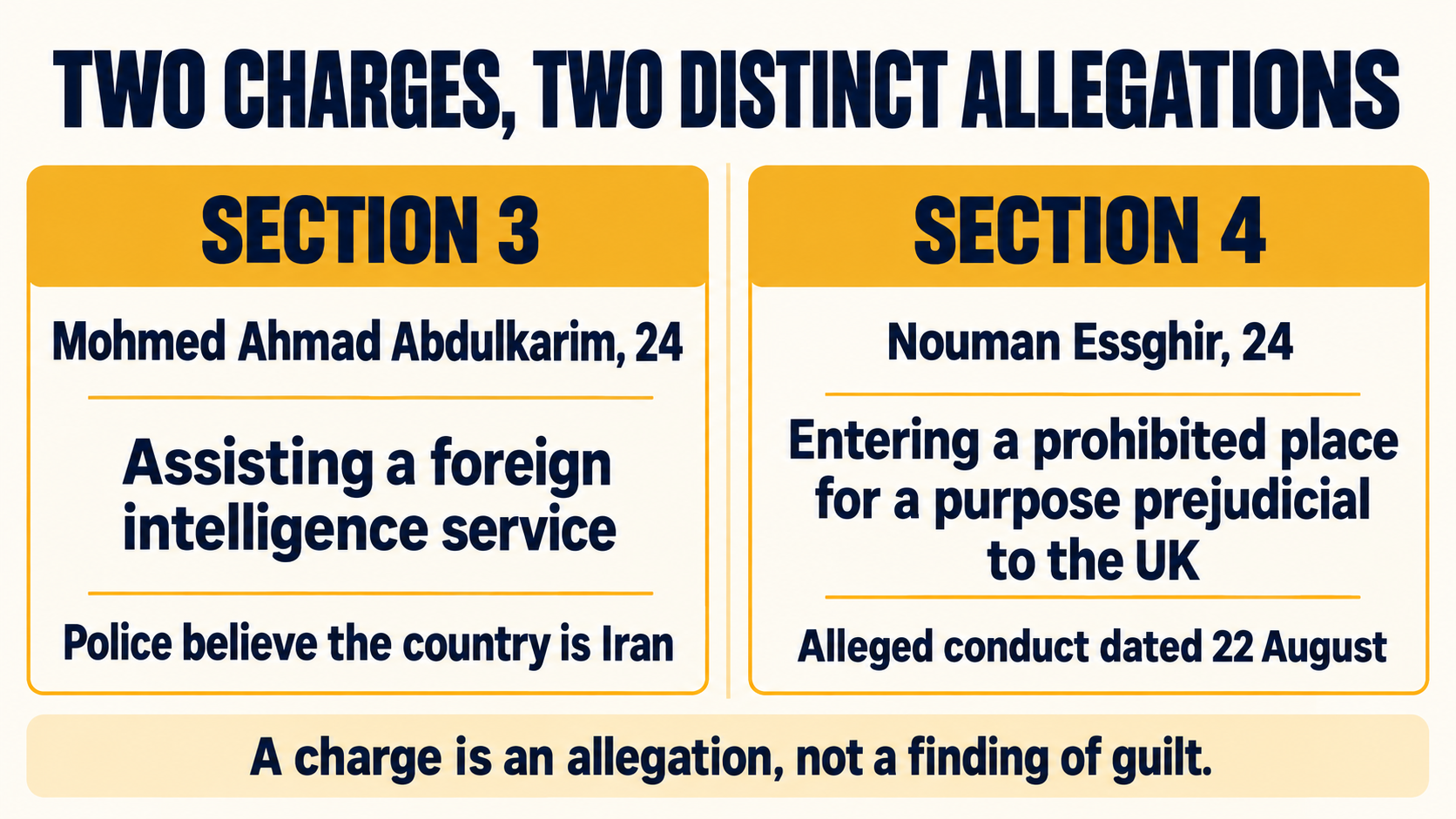
Two men have been charged under different parts of the UK’s National Security Act after a police investigation linked to RAF Fairford in Gloucestershire. The RAF Fairford investigation charges are allegations, and the distinction matters: one man is accused of assisting a foreign intelligence service, while the other faces a separate offence concerning an alleged visit to a prohibited place on a different date.
Counter Terrorism Policing said on 27 October that Mohmed Ahmad Abdulkarim, 24, was charged under Section 3 of the 2023 Act. Police said they believe the foreign country involved in this case is Iran. Nouman Essghir, also 24, was charged under Section 4 over alleged activity on 22 August. Both men were due to appear at Westminster Magistrates’ Court.
RAF Fairford investigation charges are distinct
Section 3 makes it an offence to engage in conduct intended to materially assist a foreign intelligence service in carrying out UK-related activities. The charge against Abdulkarim is an allegation that he assisted such a service; the police statement identifies Iran as their belief about the country involved. It does not establish that the Iranian state directed him, and the allegation has not been tested in court.
Section 4 covers entering, approaching or inspecting a prohibited place for a purpose prejudicial to the safety or interests of the UK, where the person knows or reasonably should know that purpose. Police say Essghir’s alleged conduct took place on 22 August. That is more than a month before the incident that brought officers to Fairford on 27 September. The publicly announced charge does not say the two men acted together or faced the same allegation.
The distinction is important for readers following national security cases: the statute sets out separate offences, and the charges relate to different alleged conduct. A charge is not proof of guilt. Both defendants are entitled to a fair trial and have not been convicted.
From the September arrests to the charges
Police say five men were arrested on 27 September after officers became concerned about vehicles near the Gloucestershire airbase. RAF Fairford is a military base used by the United States Air Force under a longstanding UK-US arrangement. The investigation has since involved further arrests and interviews, but the police have not said that every person arrested is suspected of the same conduct.
Abdulkarim was among those first arrested at the base, according to the police account. Essghir was also arrested there. Counter Terrorism Policing said a 25-year-old dual British-Iranian national, arrested on 1 October and re-arrested on 20 October, was released without charge after questioning on the later arrest; he remains on bail from his earlier arrest. Five other men remain on bail.
The police announcement followed a correction to Abdulkarim’s name: officers said it had initially been published incorrectly and gave the spelling used here. They said the two charged men were due at Westminster Magistrates’ Court on 27 October. Police also said the investigation remained active, so the bail status of other suspects should not be read as a finding about their involvement.
What the law says about the two allegations
The National Security Act 2023 created a set of offences dealing with conduct that the government says may threaten UK security. Section 3 focuses on assistance to a foreign intelligence service. Section 4 focuses on conduct around a protected site when the alleged purpose is prejudicial to UK safety or interests. The provisions have different elements, which prosecutors would need to prove beyond reasonable doubt in any trial.
In this case, the police have disclosed only a short description of the allegations. The published statement does not set out the evidence, the alleged actions said to amount to assistance, or the specific purpose attributed to Essghir. The charges therefore cannot support broader conclusions about what happened at the base or about the role of any other suspect.
What we don’t know yet
At the time of the police statement, the outcome of the first court appearance was not yet known. No detailed evidence, plea, timetable for a trial or court ruling had been made public in the sources reviewed for this report. The proceedings may clarify how prosecutors say each offence was committed.
Police say they believe Iran is the country connected to the Section 3 allegation; that is an investigative assessment, not a court finding. DW reported that Iran has denied involvement. The public record also does not explain whether the alleged 22 August conduct is connected to the September arrests, or what investigators believe the five men still on bail may have done.
The next development to watch is the court record from Westminster Magistrates’ Court and any further statement from police or prosecutors. Until evidence is presented and tested, the two charges remain allegations.
Sources
- Police announcement on the arrests, charges and bail status.
- BBC report on the distinct charges and court appearance.
- DW report on police suspicions and Iran’s denial.
- Section 3 and Section 4 of the National Security Act 2023.