

Ceuta border crisis: Spain deploys military after thousands of migrants cross from Morocco, at least 9 dead

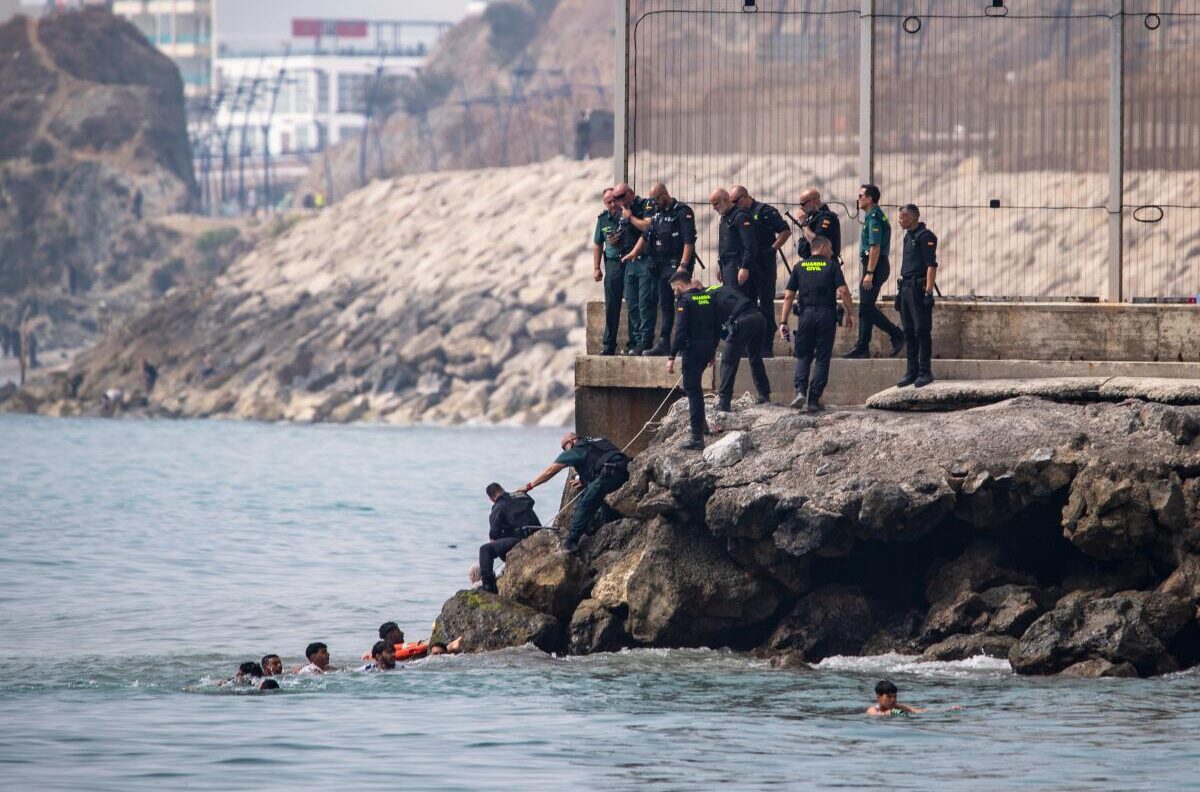
Migrants try to cross into the Spanish enclave of Ceuta from Morocco, Thursday.Image Credit: Antonio Sempere/Associated Press
Spain has deployed its military to the North African enclave of Ceuta after thousands of migrants crossed into the Spanish territory from neighboring Morocco, triggering one of the country’s biggest border emergencies in recent years. Authorities confirmed that at least nine people died during the crossings, while thousands more overwhelmed border security in scenes that have drawn comparisons to Europe’s previous migration crises.
The sudden influx prompted local officials in Ceuta to request a national emergency and military intervention as security forces struggled to manage the unprecedented number of arrivals. Spain’s central government responded by authorizing the Armed Forces to assist the Civil Guard in restoring order, with Prime Minister Pedro Sánchez scheduled to visit the territory alongside Interior Minister Fernando Grande-Marlaska.
The developments have renewed debate over European migration policy, border security, and humanitarian concerns as authorities work to determine what triggered the latest surge.
Thousands Cross Into Ceuta in Hours
The crisis unfolded on Thursday as large groups of migrants crossed from Morocco into Ceuta through multiple routes, including swimming around coastal breakwaters and entering through the Tarajal border area.
Video footage from the enclave showed crowds of mostly young men making their way onto Spanish soil, though women and children were also among those crossing. Many carried only basic belongings, while others used inflatable rings or swimming equipment to navigate the dangerous journey across the water.
According to officials and local security representatives, the sheer number of arrivals quickly overwhelmed existing border controls.
Rachid Sbihi, who heads an association representing Spain’s Civil Guard officers in Ceuta, described the situation as “absolute chaos,” saying authorities were unable to determine exactly how many people had entered because the border had effectively collapsed under the pressure.
Spain Sends Military to Reinforce Border Security
Following urgent appeals from Ceuta’s regional government, Spain announced the deployment of military personnel to support security operations across the enclave.
The Armed Forces will work alongside the Civil Guard to maintain public order and reinforce border security while authorities process those who entered the territory.
Ceuta’s regional president, Juan Jesús Vivas, had earlier appealed to Madrid to declare a national emergency, arguing that local resources were no longer sufficient to manage the escalating situation. He also requested additional police officers and army support to secure the border and protect residents.
Spain’s Interior Ministry declined to classify the migration surge as a national security emergency under existing legislation but confirmed that government agencies were coordinating an emergency response.
At Least Nine Dead During Dangerous Crossing
Authorities confirmed that at least nine migrants died during Thursday’s mass crossing.
Officials have not yet disclosed the precise circumstances surrounding each death, although reports indicated that bodies were recovered from the water near the crossing routes.
The tragedy adds to the growing number of fatalities recorded along migration routes leading to Ceuta, where dangerous sea crossings continue to claim lives each year.
Humanitarian organizations have repeatedly warned that migrants attempting to reach the Spanish territory face significant risks due to strong currents, overcrowded routes, and limited rescue opportunities.
Morocco and Spain Coordinate Response
Spanish officials said Morocco is cooperating to contain the crisis by preventing additional crossings and facilitating the return of migrants who entered Ceuta illegally.
Spain’s Interior Ministry stated that Moroccan security forces were intercepting many individuals before they reached the border while both governments continue discussions aimed at restoring stability.
Moroccan authorities have not publicly explained what triggered the sudden surge in crossings.
The lack of an official explanation has fueled speculation, although no single cause has been confirmed.
READ ALSO
Why Ceuta Is a Major Gateway Into Europe
Ceuta occupies a unique geopolitical position. Although geographically located on the northern coast of Africa, the city is an autonomous territory of Spain and forms part of the European Union’s external border.
For decades, it has served as one of the closest entry points into Europe for migrants seeking economic opportunities, international protection, or a better future.
Migrants commonly attempt to reach Ceuta by swimming from the Moroccan towns of Fnideq or Belyounech, while others try to scale the heavily fortified border fence separating Morocco from Spanish territory.
Because of its strategic location, Ceuta frequently becomes the focus of migration debates across Europe.
Legal Changes Add to Migration Debate
The latest surge comes weeks after Spain’s Supreme Court ruled that migrants arriving by sea cannot automatically be returned without due legal procedures, unlike some individuals intercepted during land crossings.
Local authorities suggested that the ruling may have encouraged more sea crossings.
However, migrant rights advocates argue that many migrants would likely have been unaware of the legal decision and caution against linking the ruling directly to the current crisis without evidence.
Echoes of the 2021 Ceuta Crisis
The events have drawn comparisons with the May 2021 migration crisis, when more than 8,000 migrants entered Ceuta within two days, creating one of Spain’s most significant border emergencies in modern history.
That crisis developed into a diplomatic dispute after Morocco was accused of easing border controls following disagreements with Spain over the treatment of a Western Sahara political leader.
While no similar diplomatic trigger has been identified this time, the scale of the latest crossings has again placed Spain’s immigration policies under intense political scrutiny.
Political Pressure Mounts on Pedro Sánchez
The crisis presents another major challenge for Prime Minister Pedro Sánchez as migration continues to dominate political discussions across Spain and the European Union.
Authorities are working to strengthen border security, expand humanitarian assistance, and coordinate with Moroccan officials to manage the situation.
With thousands of migrants already inside Ceuta and investigations continuing into the circumstances surrounding the deadly crossings, European leaders are expected to closely monitor developments in one of the continent’s most sensitive migration corridors.
FAQ
What is happening in Ceuta?
Spain is dealing with a major migration crisis after thousands of migrants crossed from Morocco into the Spanish enclave of Ceuta. The government has deployed military forces to help restore order.
Why did Spain deploy the military to Ceuta?
The military was sent to reinforce the Civil Guard after local authorities said border security had been overwhelmed by the sudden influx of migrants.
How many people died during the Ceuta border crisis?
Spanish authorities confirmed that at least nine people died during the mass crossings on July 30, 2026.
Where is Ceuta located?
Ceuta is an autonomous Spanish city on the northern coast of Africa, sharing a land border with Morocco while remaining part of Spain and the European Union.
Why are migrants crossing into Ceuta?
Many migrants view Ceuta as one of the closest entry points into Europe, hoping to find better economic opportunities, safety, or asylum.
How do migrants reach Ceuta?
Migrants often swim from nearby Moroccan coastal towns such as Fnideq and Belyounech or attempt to cross the border fence separating Morocco from Ceuta.
What caused the latest Ceuta migration surge?
Authorities have not identified a single cause. Investigations are ongoing, although recent legal rulings, migration pressures, and regional conditions are being discussed as possible contributing factors.
Is Morocco cooperating with Spain?
Yes. Spain says Moroccan authorities are helping prevent further crossings and are coordinating efforts to return migrants who entered illegally.
Who is Juan Jesús Vivas?
Juan Jesús Vivas is the President of Ceuta’s regional government. He requested military support and additional security resources during the crisis.
Who is Pedro Sánchez?
Pedro Sánchez is Spain’s Prime Minister and is leading the national government’s response to the Ceuta migration emergency.
Has Ceuta experienced similar migration crises before?
Yes. In May 2021, more than 8,000 migrants entered Ceuta within two days, creating one of Spain’s largest migration emergencies in recent history.
What is the Tarajal border?
The Tarajal border crossing is the main land border between Morocco and the Spanish enclave of Ceuta. It is one of Europe’s busiest and most closely monitored migration routes.
Why is Ceuta important to Europe?
As part of Spain and the European Union, Ceuta represents one of the EU’s external borders, making it strategically important for migration management and border security.
What happens to migrants who enter Ceuta illegally?
Migrants are processed under Spanish and European immigration laws. Authorities may provide humanitarian assistance while determining asylum eligibility or return procedures.
Will Spain increase border security after this crisis?
The Spanish government has already deployed military personnel and is expected to review additional border security measures in coordination with Moroccan authorities and European partners.