

France’s First Human Shamonda Case: What We Know About Public Risk

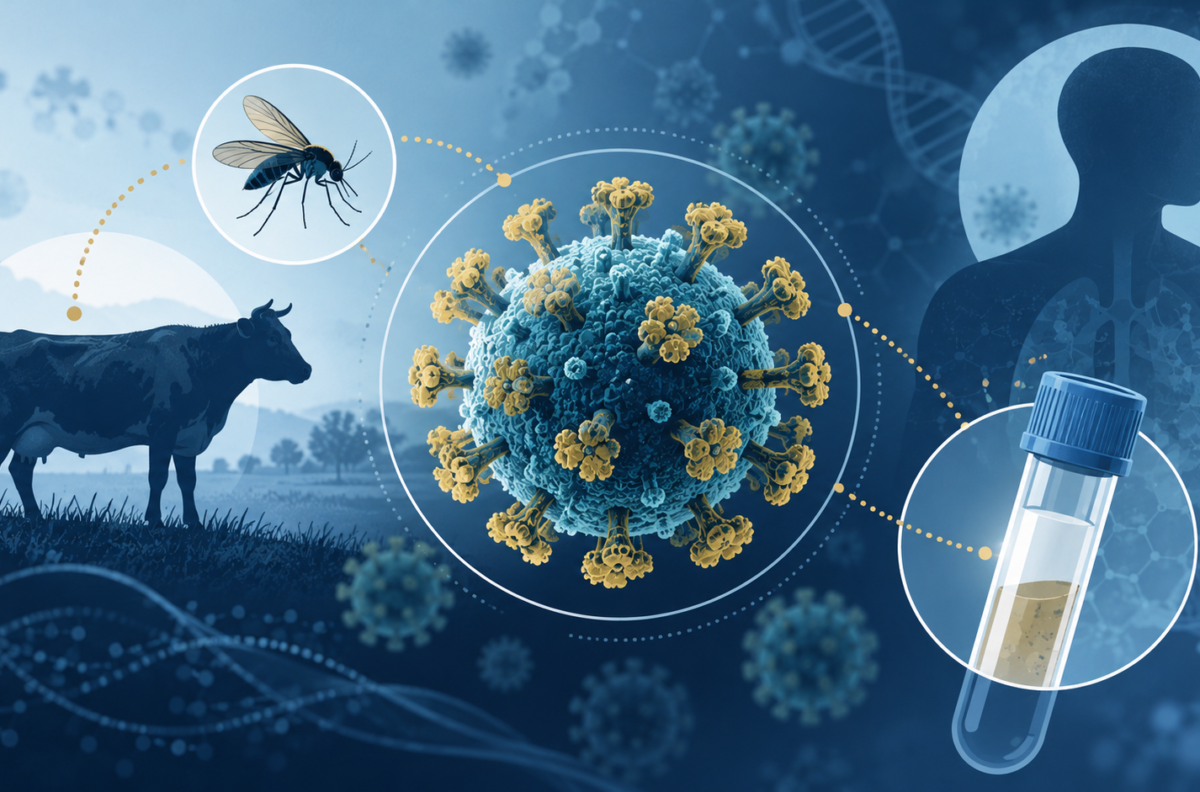
AI-generated illustration; it does not depict the patient or a specific event.
France’s first human Shamonda virus case marks the first documented infection in a person, but it does not show that wider human spread is under way. The finding matters because it changes what scientists know about the virus without establishing an outbreak.
The patient was severely immunocompromised and receiving treatment for a serious illness at the Hospices Civils de Lyon. The patient died in early October. French authorities say no health risk to the general population has been identified on current evidence; the European Centre for Disease Prevention and Control (ECDC) says investigations into how the infection happened and whether the virus caused or contributed to the death are continuing.
Human Shamonda virus case: what is confirmed?
France’s agriculture ministry, reporting jointly with health authorities, says this is the first documented and reported human detection of Shamonda virus. The patient had a severe immune deficiency and a serious underlying illness. Authorities are carrying out clinical, laboratory and epidemiological investigations, with human, animal and environmental experts involved.
There is an important distinction between detecting the virus in a person and establishing what role it played in that person’s death. The French ministry says complications affecting the patient’s brain were very likely linked to the infection. ECDC says investigators are still assessing whether the virus caused or contributed to the death. The cause should therefore not be presented as settled.
France has notified the World Health Organization and ECDC. Both the national investigation and the European response are continuing.
How might the patient have been infected?
The French ministry’s current hypothesis is that the patient was infected by a bite from a Culicoides biting midge in eastern France, where the virus had circulated among animals in spring and summer 2026. That is a working explanation, not a confirmed route: ECDC says how the infection was acquired remains under investigation.
Shamonda virus is usually transmitted among animals by biting midges. France’s agriculture ministry identifies cattle as the most common hosts, while some small ruminants and horses have also been detected with infection. The reported case does not establish whether people can pass the virus to one another, how often infection might occur in humans, or what the consequences would be for people without severe immune problems.

Does the human Shamonda virus case mean a public outbreak?
A first documented infection is a signal for investigation, not proof of sustained spread. The French ministry says no risk to the general population has been identified so far. That assessment reflects current knowledge and may be updated as the investigation finds out more.
The case involved a patient whose serious illness and severe immunodeficiency made them more vulnerable to infection and complications than the general population, ECDC says. This limits what can be inferred about the risk to other people. One case cannot show whether the virus can spread between people or cause similar illness in healthier patients.
The animal outbreak already spans much of Europe
The human detection follows Shamonda virus being identified in European farm animals for the first time in summer 2026. ECDC says animal infections have since been detected in Austria, Belgium, France, Germany, Ireland, Italy, Liechtenstein, Luxembourg, the Netherlands, Portugal, Spain and Switzerland, as well as Jersey. It says clinical signs in animals were reported from June and the virus was identified in late July.
This animal spread is relevant to surveillance, but it should not be confused with evidence of human spread. ECDC says the virus typically moves between animals through infected biting midges; the specific midge species involved in the human case is still unknown. The French agriculture ministry says the virus is not currently classified as a disease subject to EU animal-health controls, and that no vaccine or antiviral treatment is available for animals.
What health agencies need to establish next
The investigation must clarify how the patient became infected, whether the suspected midge route is supported by evidence, and whether any additional human infections are found. It also needs to assess the relationship between infection, the patient’s neurological complications and the death without treating those as automatically equivalent.
ECDC says it is working with French authorities and European partners, and with the relevant EU reference laboratory to strengthen testing capacity and help member states identify any other potential cases. Those steps are consistent with a cautious surveillance response while the evidence remains limited.
For readers, the most useful indicators to watch are official updates on the investigation, any additional confirmed human detections, and whether health agencies revise their current risk assessment. For now, authorities report one documented human case and say no general-population risk has been identified. That is a limited, present-tense assessment—not a guarantee about what future investigation may find.
Sources
- French Ministry of Agriculture and Ministry of Health: first documented human detection, current risk assessment and investigation status
- European Centre for Disease Prevention and Control: case details, unresolved questions and European animal detections
- French Ministry of Agriculture: Shamonda virus in livestock, transmission and animal-health information
- Associated Press: independent report on the French authorities’ announcement