

Bulgaria runoff vote: low turnout sets up 1 Nov contest

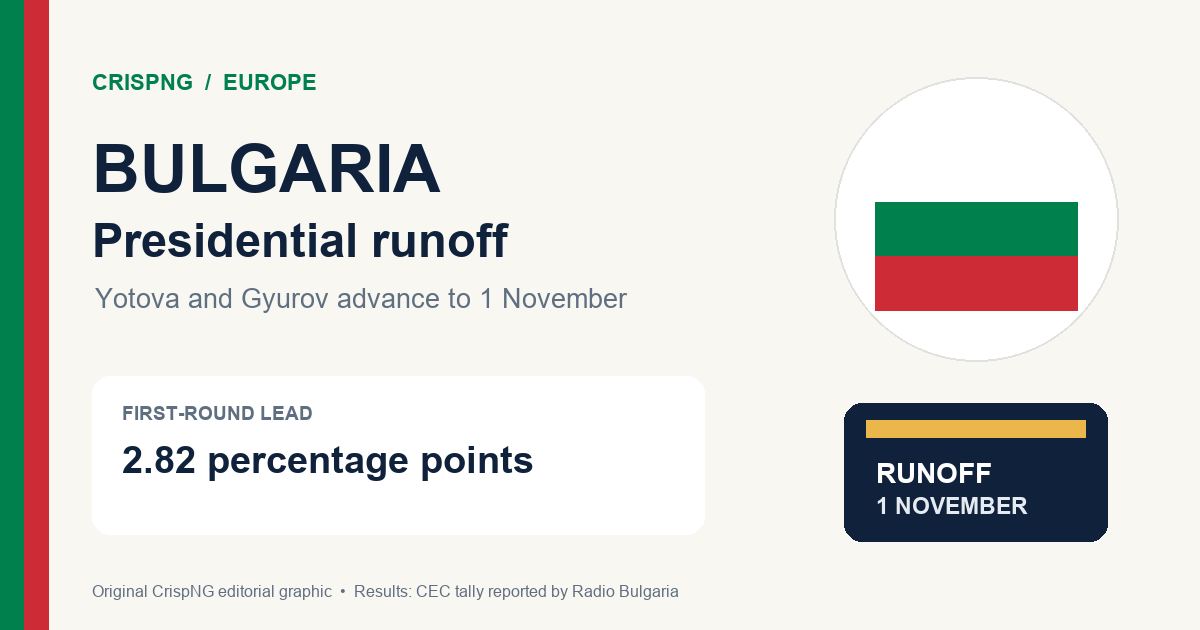
Yotova and Gyurov advance to Bulgaria’s 1 November presidential runoff. Graphic: CrispNG.
Bulgaria’s runoff vote for president is set for 1 November after incumbent Iliana Yotova led the first-round count but fell short of the threshold for an outright win. The close result gives former caretaker prime minister Andrey Gyurov a week to turn his unexpectedly strong showing into a challenge to the incumbent.
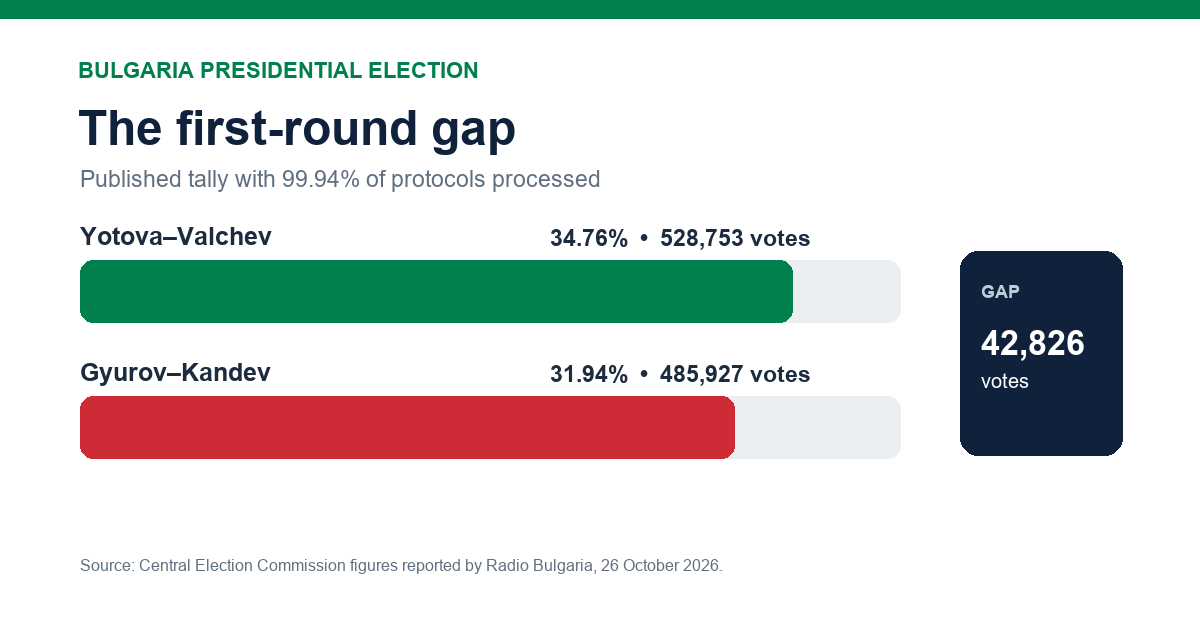
With 99.94% of polling-station protocols processed, the Central Election Commission’s figures put Yotova and running mate Kiril Valchev on 528,753 votes, or 34.76%. Gyurov and Georgi Kandev had 485,927 votes, or 31.94%: a gap of 42,826 votes and about 2.8 percentage points. The figures were reported by Radio Bulgaria from the commission’s count.
Why the Bulgaria runoff vote is required
Bulgaria’s constitution sets two conditions for winning in the first round: a ticket must receive more than half of valid votes, and more than half of eligible voters must take part. Neither condition was met. The constitution provides for a second round within seven days between the two leading tickets; the date, 1 November, was set by parliament before voting began.
Turnout was about 22%, according to polling agencies cited by the Associated Press. That is far below the constitutional participation threshold, so even a larger lead for either ticket would not have settled the contest on Sunday. In the runoff, the constitution says the ticket winning more votes is elected; it does not repeat the first-round turnout condition.
The low participation is also a political signal, although it does not identify a single cause. The AP reported that observers linked voter apathy to mistrust in politicians, while Prime Minister Rumen Radev said many people may have stayed home because they thought the result was already decided. Those are explanations offered by observers and a political leader, not a finding about every non-voter.
Two different claims on Bulgaria’s direction
Yotova is running as an independent and has the backing of Progressive Bulgaria and the Socialist Party, according to the AP. Gyurov, a former caretaker prime minister and economist, is backed by the reformist opposition. He performed more strongly than pre-election expectations cited by the AP suggested, narrowing the first-round contest to fewer than three percentage points.
The presidency is directly elected for a five-year term. The office represents Bulgaria in international relations and has constitutional responsibilities that include appointing a caretaker government in certain circumstances when parliament cannot form a cabinet. It is not a substitute for parliament or the government, but the result will decide who occupies a post with a visible role in national politics and foreign affairs. The constitutional provisions are set out by the National Assembly.
That makes the next vote relevant beyond the candidates’ personal fortunes. Yotova’s win would retain an incumbent backed by parties aligned with the current governing camp; a Gyurov victory would put the presidency in the hands of the opposition-backed candidate. The result alone will not determine Bulgaria’s laws or cabinet programme, which remain shaped by parliament and the government.
What we don’t know yet
The commission’s result page was still based on 99.94% of precinct protocols in the latest detailed figures, so the final certified vote totals may change slightly. The approximately 22% turnout figure cited in early reporting is not a final certified participation rate. The available reports do not establish why individual voters stayed away or how first-round supporters of the other 25 tickets will vote next Sunday.
Nor is it yet clear whether the first-round gap will hold once parties make endorsements and the two campaigns focus on voters who did not support either leading ticket. The next concrete milestone is the runoff on 1 November, when voters choose between Yotova and Gyurov.
Sources
- CEC election results — official results portal.
- Radio Bulgaria — CEC tally at 99.94% of protocols.
- Associated Press — turnout estimates, candidate profiles and campaign context.
- Bulgarian constitution — presidential election rules and powers.
- Parliament’s election schedule — first round and runoff dates.