

Who was Abu-Bilal al-Minuki? Inside the US-Nigeria operation that killed ISIS’ alleged global deputy

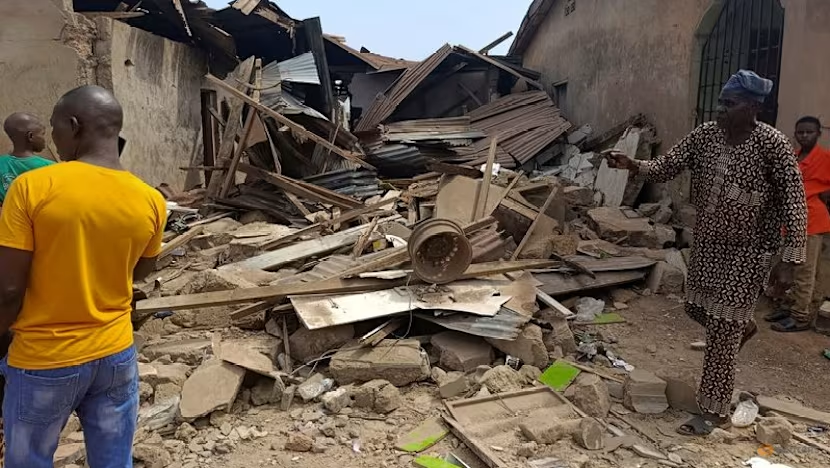
Residents inspect the damage after US forces had launched a strike against Islamic State militants in Nigeria at the request of Nigeria’s government, in Offa, Kwara State, Nigeria, Dec 26, 2025. (File photo: Reuters/Abdullahi Dare Akogun)
A joint military operation carried out by the United States and Nigeria has reportedly killed Abu-Bilal al-Minuki, a senior commander described by US President as the “second in command of ISIS globally” and one of the world’s most active terrorists.
The operation, conducted in Nigeria’s volatile Lake Chad Basin region, marks one of the most significant counterterrorism strikes in West Africa in recent years. Nigerian authorities and US officials said the raid targeted al-Minuki’s fortified hideout in Borno State after months of intelligence gathering and surveillance.
The development has renewed global attention on the growing strength of ISIL-linked groups across sub-Saharan Africa, especially in Nigeria, where extremist violence continues to threaten civilians and regional stability.
Abu-Bilal al-Minuki: Who Is He?
Abu-Bilal al-Minuki was believed to be a high-ranking leader within ISIL’s African operations and a senior figure in the Islamic State West Africa Province (ISWAP), the extremist faction that emerged after Boko Haram pledged allegiance to ISIL in 2015.
According to Nigerian military sources and US officials, al-Minuki previously operated as a senior Boko Haram commander before rising through the ranks of ISIL’s international structure. Washington officially designated him a “Specially Designated Global Terrorist” in 2023 due to his alleged role in coordinating attacks and financing extremist operations across West Africa and the Sahel.
Security analysts believe his nickname “al-Minuki” likely originated from Mainok, a town in Borno State, following a regional naming tradition tied to hometown identity.
Authorities linked him to multiple deadly operations, including attacks on civilians, assaults on minority communities, and the infamous 2018 Dapchi schoolgirls kidnapping in northeastern Nigeria.
How the Joint US-Nigeria Operation Unfolded
Nigerian military officials said the operation began shortly after midnight on Saturday in the Lake Chad Basin, a difficult terrain shared by Nigeria, Chad, Niger, and Cameroon.
The region has long served as a stronghold for extremist groups such as Boko Haram and ISWAP due to its vast waterways, islands, and swamplands that provide cover from military surveillance.
According to reports, intelligence services tracked al-Minuki’s movements for months before launching the strike on his heavily fortified compound in Metele, Borno State.
President Tinubu described the mission as a “daring joint operation” that delivered a “heavy blow” to ISIL’s global network.
US President Trump also praised the mission, saying American and Nigerian forces “flawlessly executed a meticulously planned and very complex mission” that eliminated a major terrorist threat.
READ ALSO
Strait of Hormuz crisis deepens as Trump and Xi hold emergency talks over Iran war, oil prices surge
Why Abu-Bilal al-Minuki Was Considered Dangerous
Counterterrorism experts say al-Minuki’s influence extended beyond Nigeria. US authorities alleged that he helped coordinate ISIL-linked operations across the Sahel region, which includes countries battling growing insurgencies and political instability.
The US State Department previously identified him as part of ISIL’s “General Directorate of Provinces,” a global administrative structure responsible for funding, logistics, and operational coordination.
His death is being viewed as a major symbolic and strategic setback for ISIL’s African branch, which has become increasingly active as extremist attacks decline in parts of the Middle East.
Reports indicate that nearly 90 percent of ISIL attacks globally now occur in sub-Saharan Africa, with Nigeria-based militants accounting for a large share of those incidents.
Growing US-Nigeria Security Cooperation
The successful strike also highlights expanding military cooperation between Nigeria and the United States in combating terrorism.
In recent years, both countries have increased intelligence sharing, aerial surveillance, and counterterrorism operations targeting extremist groups in northern Nigeria and the broader Sahel region.
Last Christmas, US and Nigerian forces reportedly conducted a joint airstrike in Sokoto State against ISIL-linked fighters.
President Tinubu recently defended Nigeria’s international security partnerships, stating that modern security threats require “pragmatic cooperation and partnerships” rather than isolated action.
The Nigerian military emphasised that the latest mission recorded “zero casualties or loss of assets,” describing it as evidence of improving operational coordination between both nations.
What Happens Next After al-Minuki’s Death?
While security officials have celebrated the operation as a major victory, analysts caution that extremist groups often regroup after leadership losses.
ISWAP and Boko Haram remain active in parts of northeastern Nigeria despite years of military offensives. Experts say dismantling command structures, funding networks, and recruitment pipelines will be critical to weakening the insurgency long term.
Nevertheless, the elimination of a figure as senior as Abu-Bilal al-Minuki could disrupt operational planning and reduce the group’s ability to coordinate attacks across West Africa.
For residents of Nigeria’s conflict-affected northeast, the operation represents another important step in the ongoing fight against terrorism and insurgency.
FAQ
Who was Abu-Bilal al-Minuki?
Abu-Bilal al-Minuki was a senior ISIL-linked commander believed to be one of the top leaders within the Islamic State’s African operations. He reportedly served within ISIL’s General Directorate of Provinces and previously operated as a Boko Haram commander.
How was Abu-Bilal al-Minuki killed?
He was killed during a joint military operation conducted by Nigerian and US forces in the Lake Chad Basin region of northeastern Nigeria after months of intelligence gathering.
Where was Abu-Bilal al-Minuki killed?
The operation reportedly took place in Metele, Borno State, located within the Lake Chad Basin region shared by Nigeria, Chad, Niger, and Cameroon.
Why was Abu-Bilal al-Minuki important?
US officials described him as the “second in command of ISIS globally” and a key figure coordinating extremist activities across West Africa and the Sahel.
Was Abu-Bilal al-Minuki connected to Boko Haram?
Yes. Reports indicate that he was previously a senior Boko Haram commander before aligning with ISIL after Boko Haram pledged allegiance to the terrorist organization in 2015.
What is ISWAP?
ISWAP stands for Islamic State West Africa Province. It is an ISIL-affiliated extremist group operating mainly in Nigeria and neighboring countries around the Lake Chad Basin.
Why is the Lake Chad Basin significant?
The Lake Chad Basin has become a major hotspot for extremist activities because of its difficult terrain, porous borders, and limited government control in some areas.
Why are the US and Nigeria working together?
The US and Nigeria have expanded security cooperation to combat terrorism, intelligence threats, and extremist violence affecting West Africa and international security interests.
Did Donald Trump comment on the operation?
Yes. President Donald Trump praised the operation and described al-Minuki as one of the world’s most active terrorists.
Is ISIS still active in Africa?
Yes. Security experts say sub-Saharan Africa now accounts for the majority of ISIL-related attacks globally, with Nigeria remaining one of the group’s strongest operational bases.