

A Nigerian Physics Teacher Now Helps Build The Machines That Print Every Modern Microchip

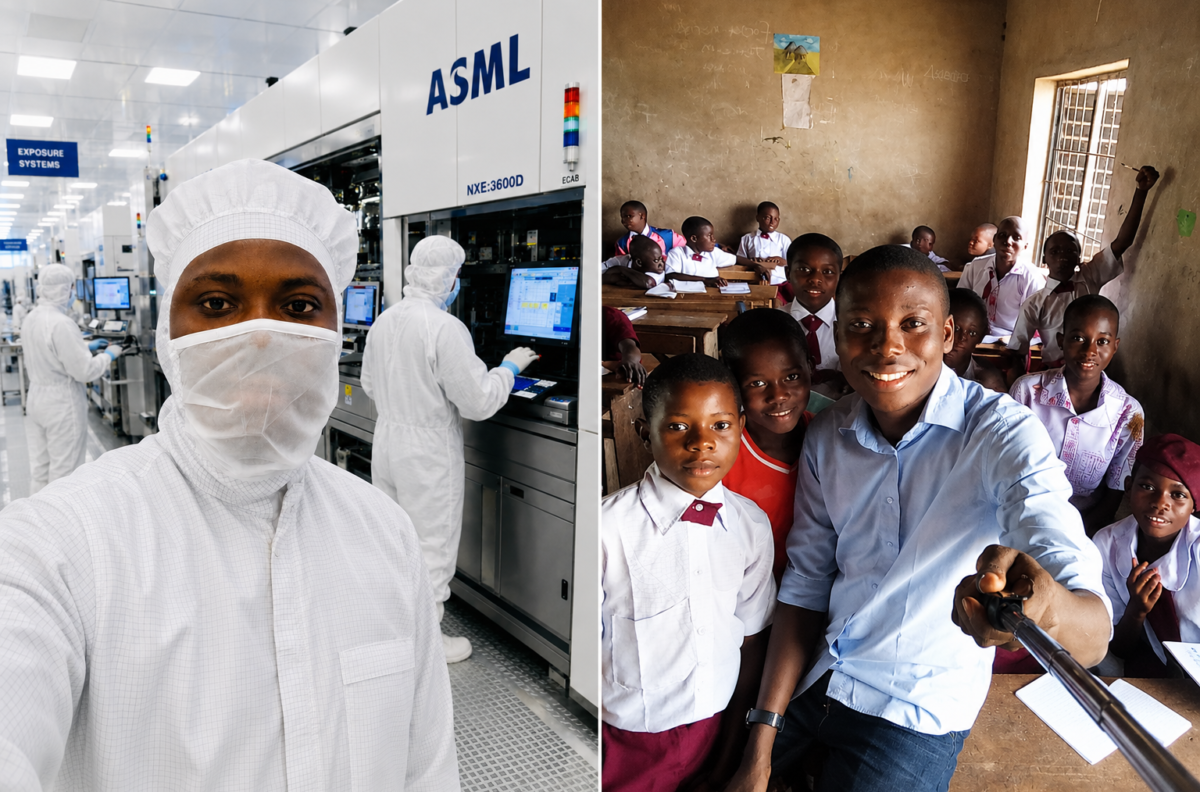
Wale Adejimi’s viral thread reads like a simple migration success story: Nigeria to Germany to the Netherlands to America. But the part that got skipped over is the more interesting one, what his job in semiconductor lithography actually involves, and why it puts him inside one of the most guarded technology supply chains on earth.
A Nigerian-born professional who once taught Physics and Mathematics in a Nigerian classroom has gone viral after describing, in a single thread on X, how a university scholarship eventually placed him inside the semiconductor industry in the United States. What made Wale Adejimi’s story spread was its simplicity: one result led to one opportunity, which led to another, until a former secondary school teacher found himself working with some of the most advanced machines ever built.
What most of the reactions to his post did not touch on is what that job actually involves, and why it matters far beyond one man’s career path.
From A Nigerian Classroom To A German Scholarship
Adejimi, writing on X on September 4, 2026, traced his path back to a First Class degree that earned him a scholarship to Germany. It was there, working in photonics, the branch of physics dealing with the generation and control of light, that his career pivoted toward semiconductors. From Germany his path moved to the Netherlands, and eventually to the United States, where he now works with advanced semiconductor lithography systems.
He was blunt about the fact that none of this came from privilege. He described simply taking school seriously and applying for every opportunity available, without knowing in advance which one would matter.
What Lithography Engineering Actually Involves
This is the part of the story worth slowing down on. Semiconductor lithography is the process used to print the microscopic circuit patterns onto silicon wafers that eventually become the chips inside every phone, laptop, car and data centre on the planet. The machines that perform this task are not built anywhere. The Netherlands, where Adejimi’s career passed through, is home to the world’s dominant maker of these systems, whose extreme ultraviolet lithography machines are widely regarded as the single most complex pieces of commercial equipment ever manufactured, involving optics precise enough to focus light onto a target smaller than a virus.
Engineers in this field typically fall into a few broad tracks: some design and refine the optical and mechanical systems inside the machines, some install and calibrate the machines at chip factories around the world, a process that can take months per system, and others troubleshoot and maintain them once they are running in production. All of it requires a mix of physics, precision engineering and extreme attention to detail, since a fault measured in nanometres can ruin an entire batch of chips.
It is also, quietly, one of the most geopolitically sensitive corners of the tech industry. Export restrictions on advanced lithography equipment have become a recurring flashpoint in trade tensions between major economies in recent years, precisely because so few companies and so few countries can build this technology at all. Working inside that supply chain, even in a technical role, places someone at the centre of decisions that affect entire national economies.
Adejimi’s post was not just a career update. It carried a direct message aimed at young Nigerians from ordinary backgrounds, urging them to apply for scholarships and take exams seriously, since it is impossible to know in advance which effort will change everything. He put it simply: “Excellence can take you to places you cannot currently imagine.”
Reactions poured in from Nigerians who saw their own ambitions reflected in his story, alongside others who pointed out that physics and mathematics graduates are often overlooked in Nigeria in favour of longer engineering degrees, despite offering a faster route into cutting-edge, in-demand fields abroad.
Adejimi’s story fits into a wider, ongoing pattern of Nigerian professionals moving into highly specialised technical fields abroad, often starting from academic paths, physics, mathematics, pure sciences, that are undervalued at home but function as a direct pipeline into advanced global industries once paired with the right opportunity. His trajectory through three countries before landing in the US also reflects how migration for skilled professionals rarely follows a straight line, and how a single scholarship decision taken years earlier can end up reshaping an entire career.
Frequently Asked Questions
What does a semiconductor lithography engineer do?
Lithography engineers work on the machines used to print microscopic circuit patterns onto silicon wafers, the core process behind manufacturing computer chips. Depending on their specialisation, they may design, install, calibrate or maintain these systems.
Why is semiconductor lithography considered a sensitive industry?
Very few companies and countries in the world can manufacture advanced lithography equipment, which has made the technology a frequent subject of export restrictions and trade tensions between major economies.