

Oyo rep, others discuss how Nigeria can make progress

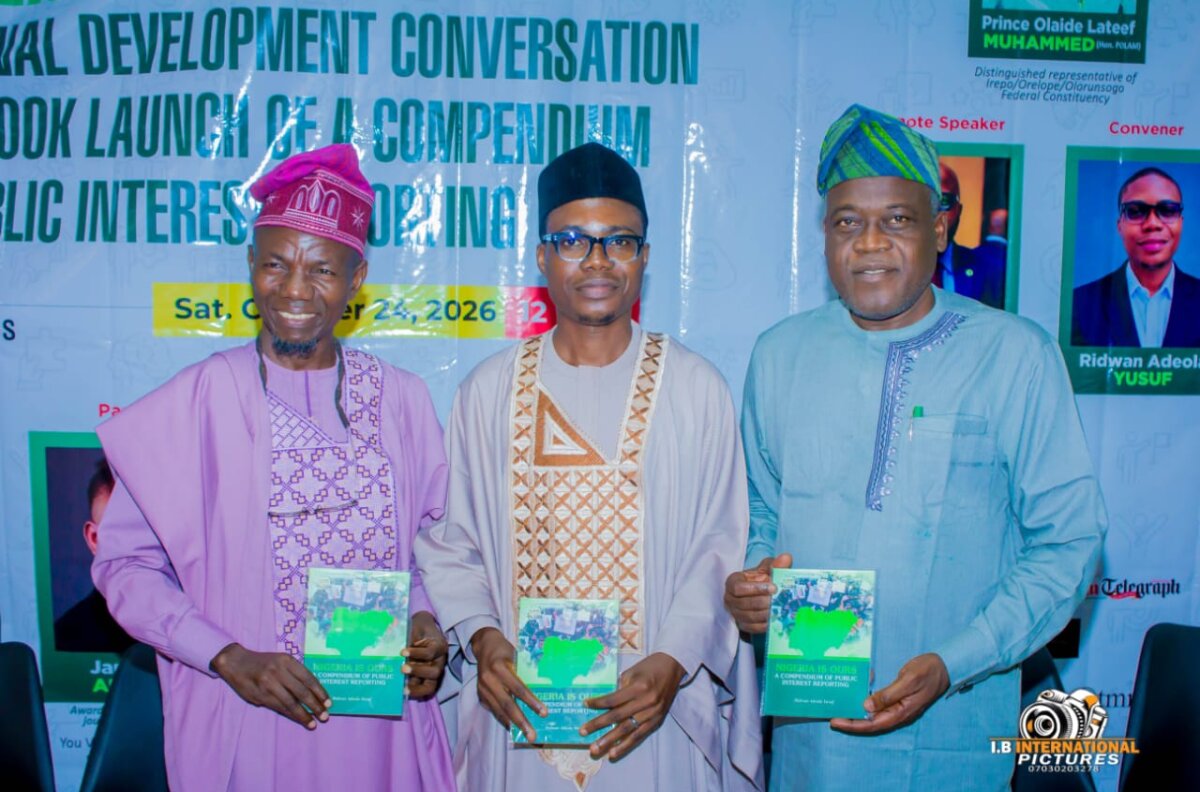
At a Lagos gathering where a top lawmaker, journalists, security entrepreneurs, and technology experts shared a stage, one message ran through the day: Nigeria’s progress depends on how it leads, how its citizens participate, and how it keeps people safe.
The occasion was the public presentation of Nigeria Is Ours: A Compendium of Public Interest Reporting, held on Saturday, October 24. The book is by Ridwan Adeola Yusuf, a multi-award-winning journalist from Kishi, Oyo State. The event also included a National Development Conversation on the theme “Reimagining Leadership, Citizenship and Security for National Development.”
“The National Assembly should not be a battlefield”
Hon. Prince Olaide Lateef Muhammed, who represents Irepo/Orelope/Olorunsogo Federal Constituency of Oyo State in the House of Representatives, used the platform to defend the working relationship between the legislature and the executive.
Muhammed, vice chairman of the House Committee on Pensions and a chieftain of the ruling All Progressives Congress (APC), commended President Bola Ahmed Tinubu’s reforms. He described him as a visionary leader and said the Renewed Hope Agenda was placing Nigeria on the path to growth.
He also rejected the claim that the 10th National Assembly is a rubber-stamp legislature, saying its “harmonious and productive” relationship with the executive was misunderstood.
“The truth is that legislative arm should not be a battlefield. So, it doesn’t mean that because we are peaceful and that we are cordial with the executive that we are rubber stamp,” he said.
“We have already passed so many important and critical legislations since June 2023, and if that is what we can be achieving with that kind of understanding, then the country is on the right path. As the title of this programme says: Nigeria is Ours.”
Investing in young people
Earlier, in his welcome address, Prince Adesegun Ogungbayi, chairman of MIMS Educational Resources Limited, urged Nigerians to invest in young people through quality education, mentorship and access to learning resources.
He said national development rested on rethinking leadership, citizenship and security. “Reimagining Nigeria requires three shifts: Reimagining Leadership as service, not position; Reimagining Citizenship as participation, not lamentation; and Reimagining Security as a collective duty,” he said.
Ogungbayi illustrated his point with the story of a struggling secondary school student he mentored. The young man had nearly given up because of financial hardship and a lack of encouragement, until he received mentorship and learning resources through MIMS. He has since graduated, found employment and begun contributing to national development. He was at the event as a volunteer.
“That experience taught me a lifelong lesson, and it is the philosophy that drives everything we do at MIMS: When you invest in one young Nigerian, you secure the future of the entire nation,” Ogungbayi said.
He praised Yusuf for bringing young people and senior citizens together, and for producing a compendium covering education, governance, healthcare, security, technology and civil liberties. “In an era of sensationalism, he chose substance. In an era of noise, he chose facts. This publication is not just a book; it is a mirror and a map for our nation,” he said.
Addressing the secondary school and tertiary students present, he urged them to pursue academic excellence, good character and strong values. “Do not wait till you are 40 to start building Nigeria. Start now,” he said, adding that young Nigerians are not only future leaders but also present ambassadors of hope.
The panel: citizens, security and the media
The panel brought together Dr Jide Johnson, Timothy Avele, Tope Balogun and James Ojo Adakole.
Ojo, an award-winning public interest journalist and researcher, focused on the media’s role in encouraging active citizenship. He said citizens can take part in governance in four ways: political, economic, social and cultural participation.
Drawing on his latest research in the International Journal of Sub-Saharan African Research (IJSSAR), he said many Nigerian youths do not know their representatives at the ward, local government, state House of Assembly, House of Representatives or Senate levels. The study also found that agitation for good governance is loud online, while offline political involvement is low.
“What does this asymmetry show us? It clearly indicates there is a gap between the Nigeria of our dreams and what we need to do to achieve it,” he said. “Therefore, the media must enlighten citizens about their civic duties and rights. The media should also play its watchdog role well.”
He added that, as agenda setters, the media should promote issue-based conversations by spotlighting key societal issues and giving citizens a platform to contribute.
On security, Avele, CEO of Agent X Security Group, proposed a technology-driven answer to Nigeria’s kidnap-for-ransom crisis. He introduced Panic-X, which he said is free for all Nigerian citizens and visitors. The tool works as a personal safety companion, offering instant panic-button alerts, real-time GPS location sharing and rapid emergency response coordination through users’ mobile phones.
Balogun Tope Abdulrazaq, the Action Alliance (AA) governorship candidate in the 2023 election, said the primary responsibility of government is to provide comfort and improve people’s well-being. He urged governments at all levels to invest in security to reduce criminal tendencies to the barest minimum, noting that “jobs would have been created as a better route to getting them engaged.”
Johnson, director of Special Programmes at the Nigerian Institute of Journalism (NIJ), called for deeper civic engagement. He stressed the need for citizens to take an active interest in governance and understand their responsibilities. He also called for bridging the gap between leaders and citizens through accountability, constructive public dialogue and a shared commitment to national development.
AI and the Nigerian newsroom
The event also featured a session on artificial intelligence by Salisu Ibrahim, author of How AI Can Enhance, Not Replace Our Works. He said AI is becoming an integral part of daily life, with local innovators deploying it to solve even highly specific household problems. He advised business owners to adopt locally developed AI solutions to bridge the gap between local resource constraints and global efficiency.
“Tech firms are not just importing Western AI; they are actively building solutions calibrated to local market needs,” he said.
In education, he said AI acts as a personalised equaliser by turning complex research into accessible insights. He also commended Nigerian newsrooms for building specialised tools to combat misinformation at scale during critical election periods, citing the Dubawa Chatbot, ChatJourno and SparkAI.
The event was attended by media professionals, academics, students, public affairs commentators and other stakeholders. It gave participants from different backgrounds a chance to exchange ideas and reflect on their shared responsibility for building a better Nigeria.