

The distribution of food, cash, clothing and other gifts during political campaigns is a common feature of election seasons in Nigeria. Political parties and candidates may share items at rallies, community meetings and campaign visits, sometimes describing them as support for residents or campaign souvenirs.
However, the practice raises an important legal question: Is a politician allowed to give voters food and gifts during an election campaign, or does it amount to vote-buying?
The answer depends on the circumstances surrounding the distribution, the intention behind it and whether the gifts are being used to influence how people vote. Nigeria’s electoral laws prohibit certain forms of inducement and bribery in connection with elections.
The important distinction is that giving out food or gifts is not automatically an electoral offence simply because it happens during a campaign. The law focuses on whether the benefit is corruptly offered to influence a person’s vote or secure electoral support. A candidate handing out food at a public event, for instance, does not by itself prove that vote-buying has taken place. The purpose and circumstances of the distribution matter.
What Does the Electoral Act 2026 Say About Giving Voters Gifts?
The Electoral Act 2026 contains provisions that prohibit bribery and other forms of inducement during elections.
Under Section 125(1)(a), a person commits electoral bribery if they directly or indirectly make a gift, loan, offer, promise or agreement to induce someone to secure the election of a candidate or influence a voter’s decision.
This means that food, rice, cooking oil, clothing, cash, household items and other benefits can become instruments of electoral bribery when they are offered in exchange for votes or to influence how people vote.
The law also covers indirect arrangements. A candidate does not have to personally hand over the gifts before an offence can occur. Someone distributing items on the candidate’s behalf may also be involved in an offence.
Section 125(6) further provides that a candidate is deemed to have committed an offence if the bribery was carried out with their knowledge and consent.
Can a Politician Distribute Rice, Food and Other Items at a Campaign Rally?
The law does not automatically classify every distribution of food or campaign materials at a political gathering as vote-buying.
The circumstances surrounding the distribution are important. For instance, there is a difference between giving attendees refreshments at a campaign event and distributing food packages on the condition that recipients support a particular candidate.
Where a politician or campaign representative offers food, money or other gifts to persuade people to vote for a candidate, the distribution may amount to electoral bribery.
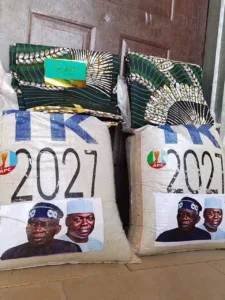
The same applies if recipients are told that they must vote for a particular party or candidate to receive the items.
However, the mere presence of food distribution at a rally does not, on its own, establish that an electoral offence has occurred. Investigators would need to establish the relevant facts, including the intention behind the offer and whether it was connected to securing votes.
READ ALSO
Electoral Thuggery: Why Nigeria Rarely Punishes Political Sponsors
Can Voters Be Arrested for Collecting Food or Gifts From Politicians?
Yes, voters can also face legal consequences if they knowingly accept gifts in exchange for their votes.
Section 125(2) of the Electoral Act 2026 states that a voter commits bribery if, before or during an election, they receive, agree or contract to receive money, gifts, loans or other valuable consideration for voting or agreeing to vote for a particular candidate, or for refusing to vote.
This means the law does not only target politicians and campaign officials who offer inducements. It also covers voters who accept benefits in exchange for their electoral decisions.
A voter who receives food at a public gathering without agreeing to vote for a particular candidate is not automatically guilty of bribery. The connection between the gift and the intended vote is a relevant part of the offence.
What Are the Penalties for Giving Out Gifts to Buy Votes?
The Electoral Act 2026 provides penalties for electoral bribery.
Under Section 125(1), a person convicted of bribery faces a maximum fine of ₦2 million, imprisonment for up to 12 months, or both.
Section 125(4) also provides that a person who commits the offence of bribery is liable, on conviction, to a maximum fine of ₦500,000 or imprisonment for up to 12 months, or both.
The Act separately addresses the buying and selling of votes under Section 22(c). A person who buys or offers to buy votes, or sells or offers to sell votes, faces a fine of at least ₦5 million, imprisonment for at least two years, or both. The provision also makes the person ineligible to stand for election in Nigeria for at least 10 years.
The precise offence established by the evidence will determine the applicable provision and penalty.

What Is the Difference Between Campaign Gifts and Vote-Buying?
The main difference is whether the gift is being used to influence a person’s electoral choice.
A campaign may provide refreshments to people attending a rally or distribute branded items such as T-shirts, caps and other campaign materials. Such activities do not automatically amount to bribery.
However, when a candidate or their representative gives people money, food or other benefits in return for votes, the arrangement can constitute electoral bribery.
The distinction is important because not every gift distributed during an election season is illegal, but using gifts to secure votes is prohibited.
Can INEC Punish Politicians Who Distribute Food During Campaigns?
The Independent National Electoral Commission (INEC) is responsible for administering and monitoring elections in Nigeria, including enforcing relevant electoral regulations.
However, allegations that a candidate distributed food or money to influence voters must be investigated based on the available evidence. The distribution itself should not automatically be treated as proof of a crime.
Evidence may include recorded promises, statements linking the gifts to voting, witness accounts, videos and other information showing the intention behind the distribution.
Members of the public who witness suspected electoral offences can report them to the appropriate authorities for investigation.