

How Does AfCFTA Work? Tariffs, Rules of Origin and Trade


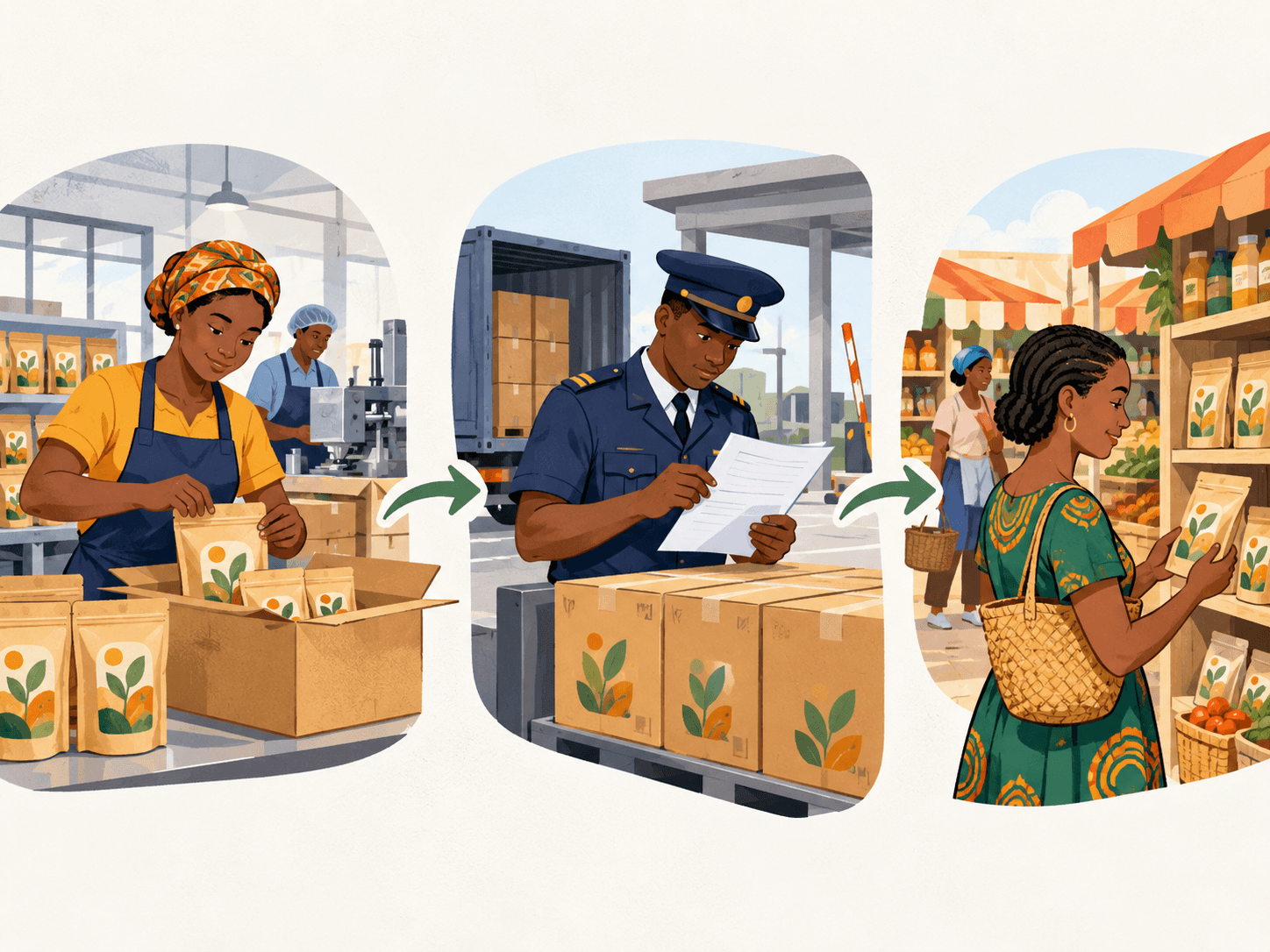
Illustration: traders review a cross-border shipment at an African port.
The African Continental Free Trade Area (AfCFTA) is a continent-wide trade agreement that gives participating countries a shared framework for trading goods and services. It works through negotiated rules, product-specific tariff concessions, rules of origin and national customs procedures, so a business checks the product and destination country before claiming a preference.
AfCFTA at a glance
- Purpose: create a single African market for goods and services and deepen economic integration, as set out in the African Union overview.
- Agreement signed: 21 March 2018 in Kigali, Rwanda, according to the AU treaty record.
- Agreement entered into force: 30 May 2019, as recorded in the AU overview.
- Trading began: 1 January 2021 under the AfCFTA regime, according to the AU timeline.
- Core checks for goods: participating countries, an applicable tariff concession, qualifying origin and customs documentation.
- Services: countries negotiate market access in covered service sectors under a separate protocol.
What is AfCFTA?
AfCFTA is the African Continental Free Trade Area, a trade agreement among African Union member states. The African Union adopted the project as part of Agenda 2063, its long-term development framework. The agreement aims to expand trade between African countries, improve Africa’s position in global trade and support regional production networks.
The legal framework covers trade in goods, trade in services and dispute settlement, alongside protocols on investment, intellectual property rights and competition policy. The African Union’s agreement text sets out the parties’ obligations, while the AfCFTA Secretariat provides legal instruments and practical tools for implementation. A current tralac guide, updated in September 2026, tracks the agreement’s expanding legal architecture, including digital trade and women and youth in trade.
AfCFTA works alongside existing regional economic communities such as ECOWAS, the East African Community and the Southern African Development Community. The AU describes these regional economic communities as pillars of continental integration on its REC overview. AfCFTA adds a wider framework that can connect regional supply chains.
READ ALSO: African Union vs ECOWAS: What Is the Difference?
How does AfCFTA work for goods?
A tariff is a customs duty charged on an imported product. Under AfCFTA, countries negotiate tariff concessions that reduce or remove duties on covered products over agreed schedules. A preference applies to a specific product moving between eligible state parties when its schedule and origin conditions are met.
The AfCFTA Secretariat’s operational instruments include the e-Tariff Book, which organises tariff concessions for trade and customs authorities. Its e-Tariff Book page explains that schedules offered by customs unions move through agreement and nationalisation before traders use them. That sequence makes the product’s tariff line and the importing country’s applicable schedule essential checks.
In practice, a trader, customs broker or freight forwarder identifies the product’s customs classification, checks the destination country’s schedule, confirms the rate in force and prepares the required origin and shipment documents. The AfCFTA preference then works through each country’s customs administration and border procedures.
What are AfCFTA rules of origin?
Rules of origin determine where a product counts as having been made for trade purposes. They distinguish goods that qualify for AfCFTA treatment from goods that pass through a state party after production elsewhere. The rules also support local and regional manufacturing by linking a tariff preference to the product’s origin.
The Secretariat’s origin rules manual describes the procedures for determining a good’s origin status and administering the rules. Depending on the product, the test can relate to where it was wholly obtained, how much local or regional value it contains, or whether it underwent a specified production process. Each product category has its own rule, so businesses apply the product-specific test to verify whether their goods qualify.
A business should keep clear records of materials, suppliers, production steps and costs, then follow the certificate or proof-of-origin procedure used by the exporting and importing authorities. The United Nations Development Programme’s 2026 rules-of-origin guide compares AfCFTA with regional regimes and uses examples from fisheries, cocoa, cosmetics, apparel and motor vehicles. Its central practical lesson is to compare the product rule and eligible regime before setting a price or choosing a route.
How can a business check whether a product qualifies?
Exporters can use a practical sequence before a shipment leaves:
- Identify the product: confirm its customs classification with a customs professional or the relevant authority.
- Confirm the trading partners: check that the exporting and importing countries participate in the agreement for the transaction concerned.
- Check the tariff schedule: search the current AfCFTA e-Tariff Book and confirm the concession for the product and destination.
- Test the origin rule: compare the product’s materials and manufacturing steps with the rule for its tariff line.
- Prepare proof and customs papers: follow the certificate-of-origin and clearance requirements used by the responsible authorities.
- Check border measures: review product standards, licences, sanitary rules, transit needs and other import requirements.
This checklist helps a business make an informed decision; customs authorities determine the treatment for a specific declaration. A freight forwarder, customs broker or trade agency can help confirm the classification and paperwork for the shipment.
How does AfCFTA cover services and trade barriers?
AfCFTA also covers trade in services. A service provider checks the relevant service sector and the market-access commitments made by the destination country. The agreement’s services framework addresses areas such as professional, financial, communications, transport and tourism services through negotiation and implementation by state parties.
Trade barriers also include delays, inconsistent paperwork, border procedures and other measures that raise the time or cost of trade. The Secretariat lists a continental mechanism for reporting and addressing non-tariff barriers, alongside customs and trade facilitation tools. The Secretariat’s tools also include the Pan-African Payments and Settlement System, developed with Afreximbank to support cross-border payments in African currencies.
These systems address separate parts of a transaction: tariff schedules set customs duties, origin rules establish eligibility, border procedures govern clearance and payment infrastructure supports settlement. Businesses benefit from checking each layer for their product, route and customer.
What does AfCFTA mean for Nigerian businesses?
Nigerian producers and service firms can use AfCFTA as a route to customers across participating African markets. A food processor, textile maker, cosmetics company or software provider starts with the rules for its sector and destination, then checks customs classification, origin requirements, schedules and border standards.
For goods, the largest planning task often sits before dispatch: establish the correct tariff line, document production and materials, and confirm the preference’s availability at both ends of the route. For services, the provider checks market-access commitments, licensing and the rules that govern the profession or sector in the destination country.
AfCFTA also creates a reason to assess regional sourcing. A manufacturer may compare suppliers across several African markets, while a logistics company can map routes that connect ports, roads and border posts. These decisions depend on commercial costs, product quality, reliability and regulations as well as tariff treatment.
READ ALSO: ECOWAS Brown Card explained: Why Nigeria’s 2026 Lagos Meeting matters for West African Motorists
What AfCFTA can change for trade
The agreement offers a shared framework for lowering tariff barriers, simplifying trade and linking production across national markets. The African Union also identifies industrial development, agricultural development, food security and regional value chains among its objectives. Those goals describe the agreement’s direction; a company’s result depends on practical implementation and its own market.
Rules of origin, tariff schedules and customs procedures give businesses a way to apply the agreement to a shipment. National authorities, customs administrations and trading partners carry out much of the daily implementation, while the Secretariat maintains continental instruments and information.
READ ALSO: African Union AfCFTA Internship 2026: Eligibility, Benefits and How to Apply
AfCFTA: frequently asked questions
What does AfCFTA stand for?
AfCFTA stands for the African Continental Free Trade Area. It is the trade agreement and framework designed to deepen trade and economic integration among African countries.
When did AfCFTA trading begin?
Trading under the AfCFTA regime began on 1 January 2021, after the agreement entered into force in May 2019. Countries continue to implement schedules and instruments through their national systems.
Does AfCFTA remove every tariff?
AfCFTA provides for progressive tariff liberalisation through negotiated schedules. A business checks the product line, destination market and origin rule to confirm the treatment that applies to a shipment.
How can Nigerian businesses use AfCFTA?
Nigerian businesses can assess export markets, verify the product’s origin and tariff schedule, and prepare the documents required by customs authorities. Service firms check the destination country’s commitments and sector rules.
What are AfCFTA rules of origin?
They are product-specific criteria that determine whether a good qualifies as originating in an AfCFTA state party. The AfCFTA Secretariat’s manual explains how authorities apply and administer those criteria.
Last reviewed: 2 November 2026