

Berlin Conference explained: what it agreed about Africa

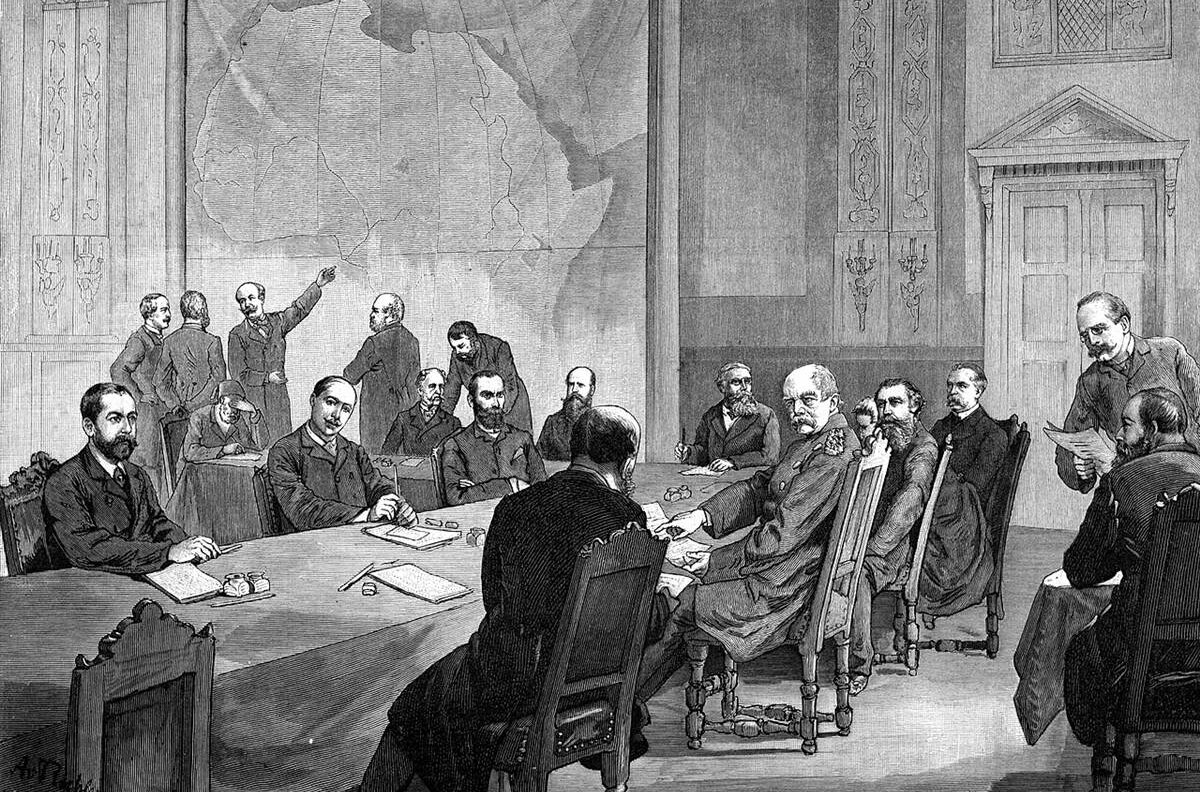
Historical illustration of Berlin Conference delegates in 1884 by Adalbert von Roessler, published in Über Land und Meer. Public domain; Wikimedia Commons.
The Berlin Conference of 1884–85 brought together representatives of 14 states to agree rules for trade, navigation and colonial claims in Africa. Its General Act opened commerce in a defined central African zone, addressed access to the Congo and Niger rivers, and set conditions for further coastal occupations. It helped organise European expansion, while the detailed drawing of most colonial boundaries came later.
Key facts
- Dates: 15 November 1884 to 26 February 1885.
- Location: Berlin, hosted by German chancellor Otto von Bismarck.
- Participants: 14 states; no African representatives were consulted.
- Main document: the General Act, dated 26 February 1885.
- Essential distinction: rules for colonial claims and commerce differed from agreements fixing particular borders.
Why was the Berlin Conference held?
Rival ambitions around the Congo brought commercial access and territorial claims into conflict. Governments wanted opportunities for their merchants while preventing competitors from closing important routes. Bismarck hosted negotiations intended to manage those rivalries between the powers.
The participants were Germany, Austria-Hungary, Belgium, Denmark, France, Britain, Italy, the Netherlands, Portugal, Russia, Spain, Sweden-Norway, the Ottoman Empire and the United States. The German archive, which holds the original Act, confirms both the membership and the exclusion of African representatives.
Colonial expansion had already begun. Berlin gave the competing governments a shared diplomatic framework; it also treated decisions about African territories as matters they could arrange among themselves.
What did the General Act actually say?
The General Act separates several kinds of agreement. Reading them individually makes the conference easier to understand than the familiar image of rulers simply cutting up a continental map.
1. Commerce in a defined free-trade zone
Article 1 described an area covering the Congo basin, an adjoining Atlantic coastal strip and a zone extending east towards the Indian Ocean. Its geographical descriptions established where the commercial arrangements would apply.
Within that area, the Act promised equal access for traders of different nationalities. Article 4 exempted imported merchandise from import and transit duties, subject to a possible review after 20 years. Article 5 prohibited commercial monopolies and favours by powers exercising sovereignty there.
The provisions distinguished access to commerce from ownership of territory. A government could assert authority over an area while accepting obligations towards foreign merchants. That combination helps explain why free-trade language could sit alongside colonial ambitions.
2. Navigation on the Congo and Niger
Separate chapters covered the two river systems. Article 13 provided equal commercial navigation on the Congo for merchant ships of all nations. The Niger chapter applied a comparable principle of access.
The Act also considered practical obstacles to river traffic. It addressed harbour services, pilotage, charges and transport links around stretches that boats could not use. Its concern extended beyond a line on a map to the movement of passengers and goods.
For the Niger, Britain and France undertook responsibilities in waters under their sovereignty or protection. These clauses concerned trade routes and the obligations of controlling powers. They gave no complete specification of the boundaries of a future Nigeria or other modern state.
3. Notification of coastal claims
Article 34 required a power taking additional territory on Africa’s coast, or assuming a protectorate there, to notify the other signatories. The purpose was to give those governments an opportunity to assert any competing claims.
Notification therefore operated between the signatory powers. It told rival governments about an asserted acquisition. The clause provided no equivalent seat at the negotiating table for the African communities whose territory was involved.
4. Authority behind an occupation
Article 35 required sufficient authority in occupied coastal regions to protect existing rights and, where applicable, freedom of trade and transit. Together, Articles 34 and 35 became associated with the principle called effective occupation.
The wording matters: both articles refer expressly to the coast. Describing them as a detailed instruction to occupy every part of the African interior gives the text a reach and precision it lacks. Later colonial practice and legal arguments went beyond these brief clauses.
Consider a hypothetical coastal claim. Sending the other powers a diplomatic notice would address Article 34. Providing authority adequate to protect the specified rights would raise the separate question in Article 35. Neither step, by itself, supplies a surveyed boundary or establishes that the inhabitants accepted foreign rule.
5. Anti-slave-trade and humanitarian promises
Article 6 committed powers exercising sovereignty or influence in the relevant territories to protect inhabitants, improve their welfare and help suppress slavery and the slave trade. It also addressed religious liberty and protection for missions and scientific activity.
Article 9 prohibited using the conventional Congo basin as a market or transit route for the slave trade. Signatories promised to use their available means to end that trade and punish those engaged in it.
These promises need to be read alongside the subsequent record of colonial rule. Historian Trevor Getz describes the violent expansion and exploitation that followed, including Leopold II’s Congo regime. Humanitarian language in an agreement tells us what governments promised; accounts of administration and coercion reveal what people experienced.
Did Berlin draw Africa’s borders?
The conference produced a framework for dealings among the powers rather than a finished set of territorial boundaries. Particular borders emerged through later bilateral agreements and colonial expansion. Recognising that sequence helps identify who made a given territorial decision, when it happened and which communities it affected.
Three different questions therefore need separate answers: what rules did governments accept at Berlin; which territories did they later claim; and how did those claims become boundaries and systems of rule? A single conference date cannot answer all of them.
Nigeria illustrates the importance of the later administrative history. The National Archives records that Northern and Southern Nigeria were amalgamated in 1914 to form the Colony and Protectorate of Nigeria, almost three decades after Berlin. CrispNG’s federalism debate, an opinion article by Jerome-Mario Utomi, explores arguments about that later union and its political legacy.
How did Leopold II’s Congo fit in?
The diplomatic recognition of Leopold II’s Congo project formed part of the negotiations surrounding the conference. The German archive distinguishes those arrangements from the General Act itself: recognition occurred alongside the proceedings, rather than through a clause awarding him the Congo in the Act.
That distinction prevents two separate records from being collapsed into one. The Act concerns commerce, navigation and other obligations; diplomatic recognition concerns the status of the territorial organisation associated with Leopold. A history of the Congo needs both.
What historians and sources disagree on
The main interpretative debate concerns how much explanatory weight to give Berlin. Some accounts emphasise its symbolic and legal importance as a moment when outsiders arranged Africa’s future without African representation. Others stress the limited scope of the clauses and the expansion already under way.
In Craven’s study, international-law scholar Matthew Craven examines this division between legal and historical accounts. He argues for closer attention to the economic logic of the free-trade arrangements, rather than measuring the conference solely by whether particular clauses directly ordered later conquests.
These approaches ask different questions. An agreement can have limited instructions about territorial acquisition while helping create conditions for expansion. Explaining that relationship requires examining the treaty, later government decisions and the experiences of African societies together.
How to read a map from the conference period
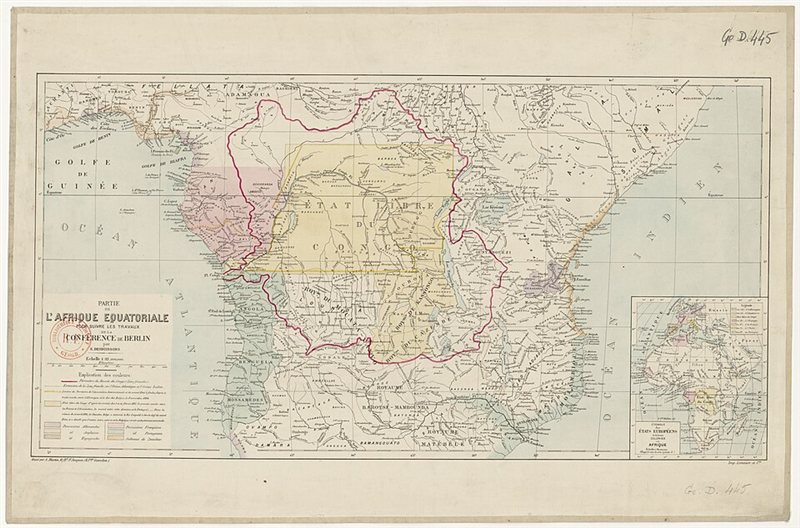
A period map records the information, labels and claims its maker chose to display. Check its date, author and legend before treating a coloured area as proof of settled control. A map prepared to accompany discussions can show how Europeans represented Africa without proving that its boundaries were agreed by everyone concerned.
The 1885 map below, by Edouard Desbuissons, places equatorial Africa and the Congo at the centre of the discussion. Read it as a historical document, alongside the treaty’s geographical descriptions, rather than as a complete record of African political authority.

Frequently asked questions
Why is it also called the Congo Conference?
The Congo basin was central to the meeting’s agenda, especially its trade and river-navigation arrangements. The name highlights that focus, while Berlin Conference identifies the place where the delegates met.
Did African leaders agree to the conference’s decisions?
No African representatives were consulted in the conference proceedings. The agreement records arrangements between the participating powers; it provides no basis for treating those arrangements as collective African consent.
Did the conference give the whole Congo to Belgium?
The arrangements surrounding Leopold II’s Congo project concerned his control of the Congo Free State. Calling this simply a grant to Belgium blurs the distinction between Leopold’s position and the Belgian state, and between recognition outside the Act and the treaty’s written provisions.
Did the Berlin Conference end slavery?
The Act contained commitments against slavery and the slave trade in the territories it described. Those commitments should be assessed against subsequent conduct: a written promise of protection alone establishes neither its enforcement nor the end of exploitation.
Sources and further reading
- General Act, 26 February 1885, especially Articles 1–6, 9, 13–16, 26–35; transcription hosted by South African History Online.
- German archive, Political Archive of the Federal Foreign Office, account of the conference and its original treaty.
- Craven’s study, Matthew Craven, “Between Law and History: the Berlin Conference of 1884–85 and the Logic of Free Trade”, London Review of International Law, 3(1), 2015, pp. 31–59.
- Trevor Getz, “The Berlin Conference”, OER Project.
- National Archives, colonial administration records guidance for Nigeria.
Featured illustration: Adalbert von Roessler, 1884, published in Über Land und Meer; public domain, via Wikimedia Commons. This is a historical drawing.

Last reviewed: 26 October 2026