

Will it snow this winter? What El Niño means for the 2026-27 US winter forecast

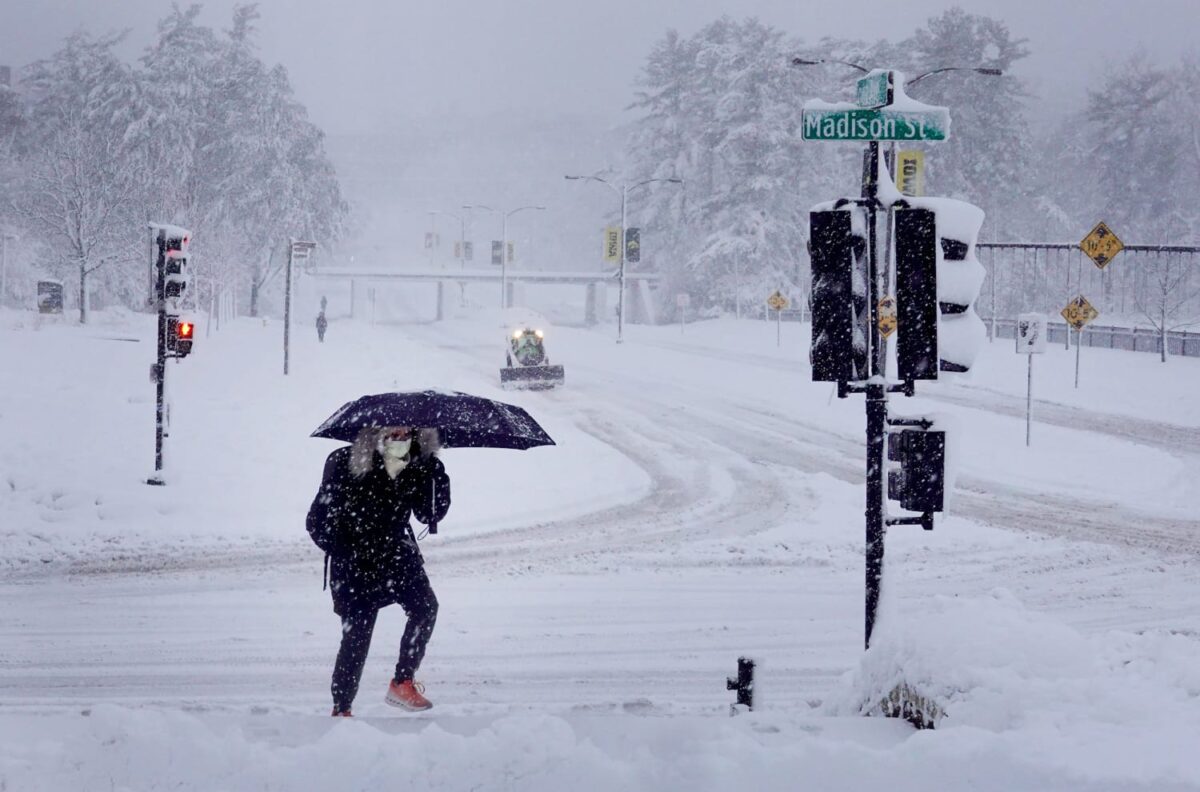
A pedestrian navigates a snow-covered sidewalk in Iowa City, Iowa. Credit: Scott Olson/Getty Images
The arrival of autumn is already turning attention toward one of the biggest questions of the next few months: Will it snow this winter?
For much of the United States, the answer is unlikely to be as simple as a nationwide yes or no.
The emerging outlook for the 2026-27 winter season points toward a generally warmer-than-normal pattern across large parts of the country, while precipitation is expected to vary considerably by region. That does not mean snow is disappearing. Cold-air outbreaks can still occur, and parts of the northern US are expected to see snowfall even if the broader seasonal pattern does not favor an exceptionally snowy winter.
The major factor behind the outlook is El Niño, a climate pattern in the tropical Pacific that is expected to remain influential into early 2027.
What will winter 2026-27 look like?
The latest seasonal outlooks suggest that much of the US could experience warmer-than-average temperatures during the coming winter.
NOAA’s Climate Prediction Center expects the warmer pattern to extend into the November-December-January period, with large portions of the country leaning toward above-normal temperatures.
Precipitation is more complicated.
Parts of the South are leaning toward wetter-than-average conditions, while northern areas are expected to be generally drier and warmer. That broad divide could have a significant effect on where snow develops and how long it remains on the ground.
The seasonal forecast does not predict individual snowstorms months in advance. Instead, it identifies broad patterns that can influence the overall winter.
Will it snow in the US this winter?
Yes, snow is still expected in parts of the United States during the 2026-27 winter.
A warmer seasonal outlook does not mean every day will be warm or that snow cannot fall. Weather systems can still bring Arctic or Canadian air southward, creating short periods of freezing temperatures and snowfall.
Meteorologists cited by Nexstar said the overall pattern does not favor a particularly snowy season across much of the northern United States, but occasional cold outbreaks can still produce snow.
That distinction is important when interpreting long-range winter forecasts. A seasonal temperature forecast describes the average tendency over a large period, not the weather on every individual day.
Why El Niño matters for winter snow
The developing El Niño is one of the most important factors behind the 2026-27 winter outlook.
El Niño occurs when sea-surface temperatures in parts of the central and eastern tropical Pacific become unusually warm, altering atmospheric circulation around the world.
Its effects on US winter weather can vary by region.
Broadly, El Niño winters tend to favor a wetter and cooler pattern across parts of the southern United States, while portions of the northern US can experience warmer and drier conditions.
That pattern does not automatically determine whether an individual city will receive snow.
Snow requires the right combination of moisture and sufficiently cold air. A region can receive above-average precipitation but still see much of it fall as rain if temperatures remain too high.
Which parts of the US could see more snow?
The northern United States remains the region where snowfall is most likely to occur, particularly because cold air can still periodically move into the area.
However, the current seasonal pattern does not point toward unusually snowy conditions across the entire northern tier.
The Plains and Midwest could experience periods of snow when colder air arrives, even if their overall winter temperatures average above normal.
Meanwhile, wetter conditions expected across portions of the South could create opportunities for winter precipitation when temperatures briefly fall low enough.
This is why a warmer winter does not necessarily mean a snow-free winter.
What the Farmers’ Almanac says about snow
The Farmers’ Almanac has released its own extended outlook for the 2026-27 winter, describing the season with the phrase “snow, sleet and surprises.”
Its regional forecast anticipates snowy precipitation across the Upper Plains and Midwest. It also projects wet conditions across the Gulf and southern East Coast, with wetter conditions farther south and coastal storms affecting New England.
The Old Farmer’s Almanac, meanwhile, presents a somewhat different picture.
Its forecast emphasizes mild conditions across much of the country, with colder conditions specifically highlighted for the Ohio Valley and southern New England. Hawaii is expected to be cooler than normal under the publication’s outlook.
The differences illustrate why long-range winter predictions can vary significantly depending on the forecasting method being used.
READ ALSO
Kelvin wave explained: Why a slow-moving Pacific phenomenon could raise California sea levels
Can you trust long-range snow forecasts?
Long-range forecasts can provide useful information about broad seasonal patterns, but they cannot reliably tell people exactly when or where a major snowstorm will happen months ahead.
The National Weather Service also publishes seasonal outlooks, but its forecasts are designed around broad temperature and precipitation probabilities rather than individual storms.
NOAA officials have emphasized that predicting a specific winter storm far in advance is not currently possible.
That means a headline predicting a particular city will receive a certain amount of snow months from now should be treated differently from a seasonal forecast showing a general tendency toward warmer, colder, wetter or drier conditions.
The Farmers’ Almanac and Old Farmer’s Almanac also use their own forecasting approaches. The source report noted research suggesting that only around half of Farmers’ Almanac forecasts examined in one analysis were correct, despite the publication’s claim of an 80% accuracy rate.
Why a warm winter can still produce major snowstorms
One of the easiest mistakes to make when reading a seasonal forecast is assuming that “warmer than normal” means “no snow.”
The two are not mutually exclusive.
A winter can have an overall average temperature above normal while still experiencing several extremely cold days.
Those short cold periods can coincide with moisture moving through the region, producing significant snowfall.
The opposite is also possible. A winter can have substantial precipitation but produce relatively little snow if temperatures remain above freezing.
For people watching the 2026-27 winter, the interaction between temperature, moisture and individual storm systems will ultimately determine how much snow falls locally.
Northern and southern US face different winter patterns
One of the clearest features of the emerging outlook is the contrast between the northern and southern parts of the country.
The northern half is broadly expected to lean warmer and drier, while the southern half is expected to lean cooler and wetter.
That does not mean every state will follow the same pattern.
Weather conditions can change rapidly across relatively short distances, and individual storms can temporarily overwhelm the broader seasonal pattern.
Still, the north-south divide provides a useful framework for understanding why the winter outlook looks different from one region to another.
When will the 2026-27 winter forecast become clearer?
The forecast will become more useful as winter approaches and weather models receive new observations.
Seasonal outlooks are designed to provide probabilities rather than guarantees. Forecast confidence generally improves as the forecast period gets shorter, particularly when meteorologists begin examining specific weather systems.
A storm forecast several days ahead can provide much more detail about snow amounts, timing and locations than a seasonal outlook issued months in advance.
For now, the broad message is that the US is heading toward a winter influenced heavily by El Niño, with warmer-than-normal conditions favored across large areas and significant regional differences in precipitation.
Snow is still part of the forecast — but where it falls, how much accumulates and how long it stays will depend on shorter-term weather patterns that cannot yet be predicted with precision.
Frequently Asked Questions
Will it snow this winter in 2026-27?
Yes. Snow is still expected in parts of the US during winter 2026-27, particularly during periodic cold outbreaks. However, the overall seasonal outlook does not favor unusually snowy conditions across much of the northern United States.
Will winter 2026 be warmer than normal?
Current seasonal forecasts favor warmer-than-normal temperatures across large portions of the US, particularly during the November-December-January period.
What is causing the warm winter forecast?
The developing El Niño is a major factor influencing the 2026-27 winter outlook. The climate pattern can shift atmospheric circulation and alter temperature and precipitation patterns across the US.
Which states will get the most snow this winter?
It is too early to reliably identify individual states or cities that will receive the most snow. Northern states remain more likely to experience snow because of their colder climate, but seasonal forecasts cannot accurately predict individual snowstorms months in advance.
Will there be snow in the South?
Snow is possible in parts of the southern US when sufficiently cold air arrives. The current outlook favors cooler and wetter conditions across parts of the South, but precipitation does not automatically mean snow.
Is El Niño good for snow?
El Niño can increase the likelihood of wetter and cooler conditions across parts of the southern US, which can create opportunities for winter precipitation. Whether that precipitation falls as snow depends heavily on temperatures during individual weather events.
What does the Farmers’ Almanac predict for winter 2026-27?
The Farmers’ Almanac describes the coming season as “snow, sleet and surprises.” Its outlook calls for snowy precipitation in the Upper Plains and Midwest, wetter conditions in parts of the South and Gulf, and coastal storms in New England.
Can the weather forecast change before winter?
Yes. Seasonal forecasts are updated as new atmospheric and ocean observations become available. A seasonal outlook describes broad probabilities and should not be treated as a fixed prediction for every location.