

Kelvin wave explained: Why a slow-moving Pacific phenomenon could raise California sea levels

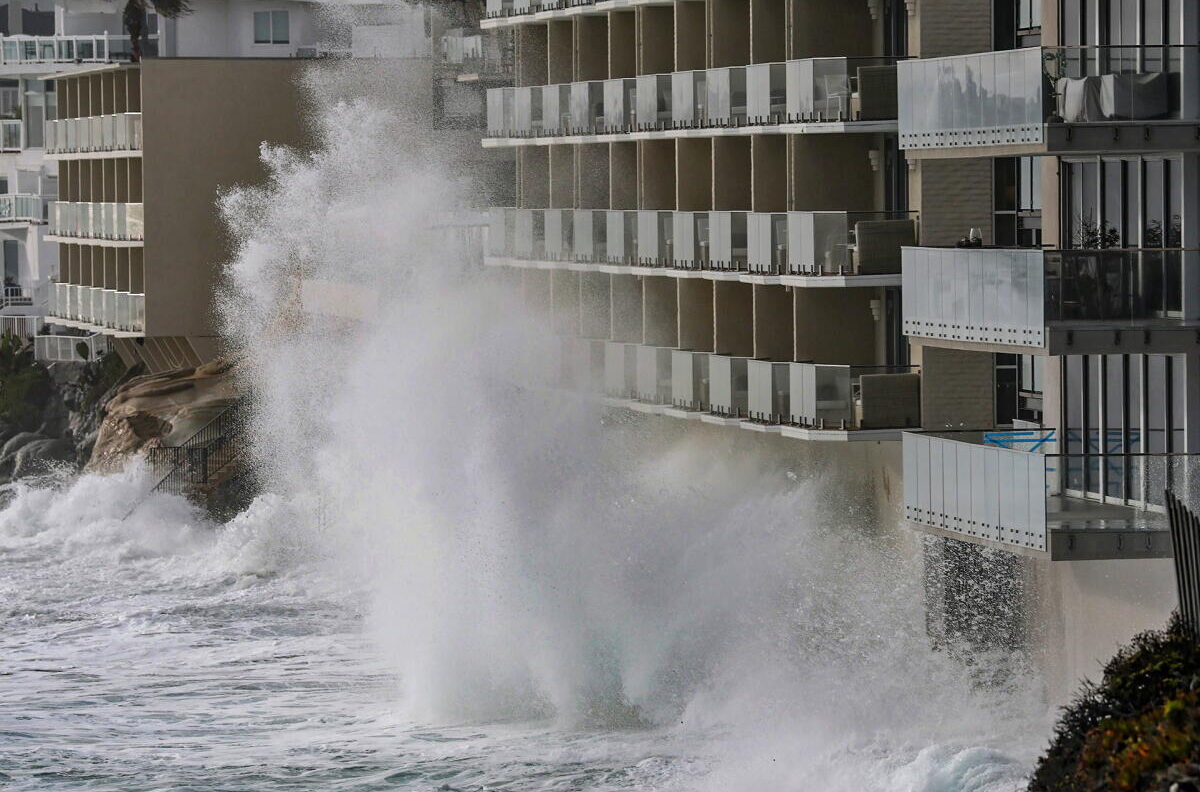
Waves from Hurricane Marie crash into a seawall at the Surf and Sand Hotel in Laguna Beach earlier this month. (Don Leach / Daily Pilot)
A slow-moving ocean phenomenon stretching across the Pacific is drawing attention as scientists warn that the 2026 El Niño could push coastal sea levels higher and increase the risk of flooding along California.
Known as a Kelvin wave, the phenomenon is not the kind of wave seen breaking at the beach. It is a planetary-scale movement of warm ocean water that can travel thousands of miles beneath and across the Pacific. In the current event, scientists are watching its potential interaction with an unusually strong El Niño and the resulting effect on California’s coastline.
The immediate concern is that the arriving warm water could temporarily raise sea levels along parts of the US West Coast by as much as one foot, according to scientists cited in recent reporting. That higher baseline could make coastal flooding and storm surges more damaging when winter storms arrive.
What is a Kelvin wave?
A Kelvin wave is a large-scale ocean wave that travels along the equator, carrying changes in ocean temperature, pressure and sea level.
Unlike ordinary surface waves, Kelvin waves operate on a vastly larger scale. NOAA describes equatorial Kelvin waves as fluctuations associated with changes in winds that propagate eastward along the equator and alter the depth of the ocean’s thermocline, the boundary separating warmer upper water from colder water below.
The waves can take roughly two months to cross the Pacific, according to NOAA’s Physical Sciences Laboratory, with typical speeds around 2.8 metres per second for the first baroclinic mode.
That slow movement is part of what makes the current situation different from a conventional storm. There is no single dramatic wave approaching California. Instead, a huge volume of ocean water is being redistributed over an enormous distance.
Why is the Kelvin wave important in 2026?
The current Kelvin wave is being watched because it is developing alongside El Niño, a climate pattern associated with unusually warm waters in the central and eastern tropical Pacific.
During El Niño, the normally prevailing trade winds weaken. That allows warm water that has accumulated in the western Pacific to move eastward. NOAA notes that this process can trigger Kelvin waves, which travel toward the Americas and can eventually move along the West Coast.
Scientists quoted by The Guardian say one such wave reached the northern tip of South America in late August and has subsequently been moving toward the US West Coast. It could reach California within days, potentially lifting coastal sea levels for months while El Niño persists.
How can a Kelvin wave raise sea levels?
The explanation begins with the movement of warm water.
Under normal Pacific conditions, winds help keep a large amount of warm water concentrated in the western Pacific. When those winds weaken during El Niño, the force holding that water in place is reduced.
The water begins moving eastward.
When the Kelvin wave reaches the eastern Pacific and encounters the coast, the water cannot continue moving east across land. Some of the resulting ocean response is redirected north and south along the coastline.
That process can temporarily raise sea levels.
NOAA says El Niño-related Kelvin waves can travel eastward along the equator and then move up the western coast of the Americas, raising both ocean temperatures and sea levels for several months or longer.
READ ALSO
El Niño 2026: Why California has declared a statewide emergency ahead of major winter storms
Why California is particularly vulnerable
The Kelvin wave is arriving at a time when California’s coastline is already exposed to rising sea levels.
The Guardian reported that global sea levels have risen by roughly eight inches over the past century. A temporary increase associated with a Kelvin wave would be added on top of that longer-term rise.
That matters during high tides and winter storms.
A storm does not need to become dramatically stronger for flooding to worsen if the starting sea level is already higher. Waves and storm surge can reach farther inland when the ocean is elevated.
California scientists have specifically warned about the combination of high tides, storm surge and elevated sea levels during the coming winter.
Kelvin wave vs normal ocean waves
The word “wave” can make the Kelvin wave sound like a giant wall of water travelling toward California.
That is not what scientists mean.
Beach waves are generated by factors such as wind and break as they approach shallow water. A Kelvin wave is a large-scale ocean circulation phenomenon involving changes in sea level, temperature and subsurface ocean structure.
Its dimensions can span thousands of miles, and its movement is measured over weeks and months rather than seconds.
NOAA classifies Kelvin waves as planetary-scale ocean waves and notes their important role in monitoring and predicting El Niño events.
What does the Kelvin wave mean for flooding?
The biggest concern is not the Kelvin wave acting alone.
Instead, scientists are watching what happens when elevated sea levels combine with winter storms and high tides.
The 2026 El Niño is already associated with expectations of increased storm activity and other weather impacts affecting California. If storms arrive while the ocean is temporarily elevated, coastal communities could face a greater risk of inundation and erosion.
NOAA warned earlier in 2026 that El Niño could create a “double whammy” for some coastal communities because higher sea levels could allow high tides and strong surf to push farther inland.
Past strong El Niño years, including 1983, 1998 and 2016, provide scientists with examples of how the phenomenon can affect the US West Coast. However, researchers also stress that every El Niño event is different.
Is the Kelvin wave caused by climate change?
Kelvin waves are natural ocean phenomena and have occurred for thousands of years. They are closely linked to the ocean-atmosphere dynamics behind El Niño.
The concern in 2026 is the combination of a natural Kelvin wave with an already elevated baseline of global and coastal sea levels.
That distinction is important. The existence of the Kelvin wave itself does not mean climate change created it. However, higher long-term sea levels can increase the consequences when temporary ocean fluctuations occur along vulnerable coastlines.
What happens next?
Scientists will continue monitoring the wave, sea-level measurements, ocean temperatures, tides and the development of winter storms.
The timing could be particularly important around periods of exceptionally high tides. If a strong storm coincides with one of those tides while sea levels remain elevated, the risk of coastal flooding could increase.
California has already taken preparatory measures ahead of the expected winter impacts. The state’s emergency planning includes positioning resources and preparing for potential flooding, storms and other hazards.
For residents, the important point is that the Kelvin wave is not a tsunami and is not expected to arrive as one giant wall of water. Its significance lies in its ability to temporarily raise the ocean’s baseline, potentially allowing ordinary high tides, large waves and storm surges to reach areas that would otherwise remain above the water.
Frequently Asked Questions About the Kelvin Wave 2026
What is the Kelvin wave in 2026?
The 2026 Kelvin wave is a large-scale movement of warm ocean water associated with weakened Pacific trade winds during El Niño. It can travel thousands of miles across the Pacific and eventually influence sea levels along the Americas.
Is the Kelvin wave a tsunami?
No. A Kelvin wave is not a tsunami. It is a planetary-scale ocean phenomenon linked to changes in winds, ocean temperature, pressure and sea level.
Will the Kelvin wave hit California?
Scientists expect the current Kelvin wave to influence the California coast as it moves eastward and then northward or southward along the Americas. Its effects are expected to be expressed through elevated sea levels rather than a single crashing wave.
How high can the Kelvin wave raise sea levels?
Scientists cited in the latest reporting estimate that the current event could temporarily raise sea levels along California’s coast by up to about one foot.
How long will the Kelvin wave last?
The effects of the current Kelvin wave could persist for months. Researchers expect the influence of the event to potentially continue through the winter and into early 2027 as El Niño remains active.
Why does El Niño cause Kelvin waves?
During El Niño, Pacific trade winds weaken. This allows warm water that has accumulated in the western Pacific to move eastward, helping generate Kelvin waves that travel toward the eastern Pacific.
Can a Kelvin wave cause flooding?
A Kelvin wave can contribute to coastal flooding by temporarily raising sea levels. The risk becomes greater when elevated sea levels coincide with high tides, storm surge and large waves.
Is the 2026 Kelvin wave dangerous?
The wave itself is not a sudden disaster like a tsunami. The concern is the additional water it can place along the coast, potentially worsening flooding, erosion and storm impacts during an already active El Niño season.