

Trump’s new $1 coin is legal tender, but the US Mint sells it above face value. Here’s what the coin is really worth and whether it may gain value

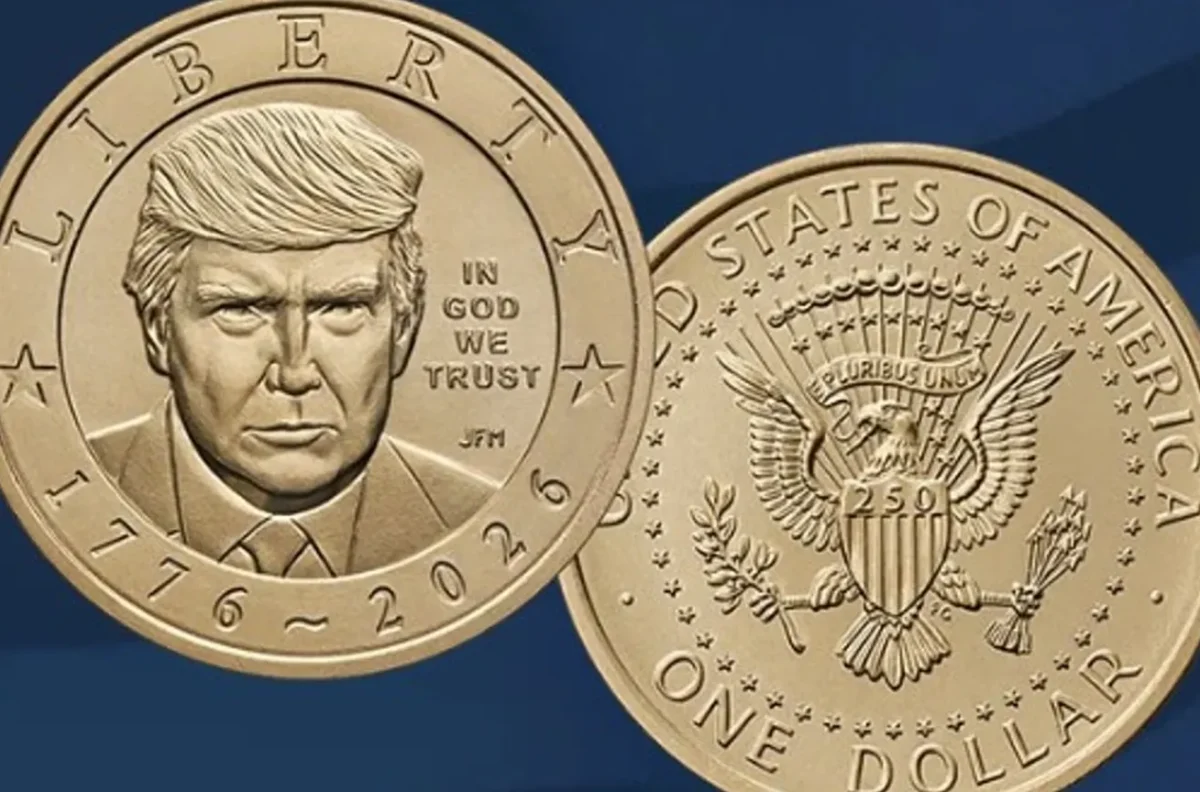
The 2026 Semiquincentennial President Donald J. Trump $1 Coin, 2 September 2026 – Copyright US Mint
The new Donald Trump $1 coin has arrived with an unusual contradiction built into its price tag: the coin is legally worth $1, yet the U.S. Mint is selling it in quantities that cost buyers substantially more than their face value.
The 2026 Semiquincentennial President Donald J. Trump $1 Coin officially went on sale through the U.S. Mint on September 2. The Mint is offering the circulating-quality coins in a 25-coin roll for $61 and a 100-coin bag for $154.50.
That pricing has prompted a basic question among Americans: If the coin says $1 and can legally be used as money, why would anyone pay $2.44 for one in a 25-coin roll or about $1.55 per coin in a 100-coin bag?
The answer comes down to the difference between face value, retail price and collector value.
Is the Trump $1 coin actually worth $1?
Yes. The Trump $1 coin carries a face value of $1, and the U.S. Mint says the coins may be used as legal tender. Federal law recognizes U.S. coins and currency as legal tender for debts, public charges, taxes and dues.
That means one genuine Trump $1 coin does not become a $2.44 coin simply because someone purchased it from the Mint for more than $1.
The distinction is important.
A coin’s face value is the denomination assigned by the government. Its retail price is what a buyer pays to obtain it from a seller. Its collector or market value is what another buyer may be willing to pay for it later.
Those three figures can be very different.
For someone who spends an ordinary Trump $1 coin at face value, the transaction is effectively the same as spending any other $1 coin: the coin is worth $1 toward an eligible payment.
Why does the U.S. Mint charge $61 for 25 coins?
The Mint is not selling the 25 coins individually for $1 each.
Its official product listing prices a roll of 25 circulating-quality Trump $1 coins at $61 and a bag of 100 coins at $154.50. The Mint describes the products as special-edition coin offerings connected to America’s 250th anniversary, or semiquincentennial.
That creates a significant premium over face value.
A 25-coin roll contains $25 in spendable face value but costs $61 from the Mint. A 100-coin bag contains $100 in face value but costs $154.50.
The extra money is not added to the denomination of each coin. Buyers are paying for the Mint’s product packaging, distribution and collectible presentation rather than purchasing $61 worth of currency in a 25-coin roll.
That is why breaking open a roll and spending the coins does not turn $61 into $61 of purchasing power.
Can Americans spend the Trump coin at stores?
They can attempt to use it as money, but legal tender does not mean every private business must accept it.
The Federal Reserve says federal law does not require private businesses, individuals or organizations to accept cash or coins for goods and services. Businesses can establish their own payment policies, subject to applicable state law.
That means a restaurant, retailer or other private business could have a policy that does not accept coins, or does not accept particular forms of cash.
The Trump coin’s legal-tender status still matters, particularly when it comes to debts and government payments. But consumers should not assume that carrying the coin guarantees acceptance at every checkout counter.
The bigger issue: Is the Trump coin a collectible or everyday money?
This is where the new coin becomes unusual.
The Mint calls the Trump dollar a circulating-quality coin, but its product page also markets it as a special-edition issue connected to the nation’s 250th anniversary. The coin is made from a copper-based clad composition, weighs 8.1 grams and has a plain edge.
The Mint also says 250,000 coins were struck on July 4 with a special “July 4th” privy mark commemorating America’s 250th anniversary. That feature could make certain versions more interesting to collectors than ordinary examples.
Still, a special design does not automatically mean a coin will appreciate dramatically.
Collectors generally look at factors such as mintage, condition, rarity, demand, varieties and historical significance. A coin being associated with a sitting president or a major national anniversary may generate interest, but future market value depends on what collectors are willing to pay.
READ ALSO
Judge Alvin Hellerstein ruling explained: What it means for Trump 34-count hush money conviction
Could a Trump $1 coin become worth more than $1?
It could, but there is no guarantee.
The strongest distinction to remember is between the government-assigned denomination and the private collector market.
A normal example remains a $1 coin in terms of legal face value. If demand rises and collectors begin paying more for particular examples, the market price could move above $1.
The reverse is also possible.
If large numbers remain available and collector demand is weak, a buyer who paid a premium from the Mint could have difficulty recovering that purchase price on the secondary market.
The Mint currently lists no overall mintage limit for the Trump $1 coin rolls and bags, while the individual product limits are 150,000 rolls and 50,000 bags.
That detail matters for anyone buying the coin primarily as an investment. Scarcity can influence collectible prices, and an unlimited overall mintage designation makes it harder to assume that every example will become rare.
Why the Trump coin is different from an ordinary dollar
The coin is also attracting attention for a reason that goes beyond its price.
Its appearance raises questions about the long-standing rules governing portraits of living people on U.S. coins. The Trump issue is tied to the country’s 250th anniversary, giving the government a historical commemorative framework for the design.
The result is a coin that occupies an unusual position: it carries a normal $1 denomination, is recognized as legal tender, is sold by the Mint at a premium and has a design associated with a sitting president.
That combination is likely to keep the coin in the spotlight among both political observers and numismatists.
What should you do if you find one?
If a Trump $1 coin turns up in your change, there is no requirement to treat it as an investment.
Check the coin’s condition and design before spending it if you are interested in collecting. Pay particular attention to unusual markings, errors or special versions, since those can matter more to collectors than the ordinary issue.
For everyone else, the simplest calculation is the most useful one: the coin’s face value is $1.
Paying more than $1 to obtain it from the Mint does not change that denomination.
And if you buy a roll for $61, you should not think of it as $61 in cash. You have bought $25 in face-value coins for $61, with the difference representing the premium attached to the Mint’s product.
Trump $1 coin: The key numbers Americans should know
The U.S. Mint’s current specifications provide a useful snapshot of the new coin:
- Face value: $1
- Mint: Philadelphia
- Finish: Circulating
- Composition: 6% zinc, 3.5% manganese, 2% nickel, balance copper
- Weight: 8.100 grams
- Diameter: 1.043 inches
- Edge: Plain
- 25-coin roll: $61
- 100-coin bag: $154.50
- Overall mintage limit: None
- Special July 4 privy-marked coins: 250,000 struck
Frequently asked questions about the Trump $1 coin
Can you spend the new Trump $1 coin?
Yes. The U.S. Mint says the coin may be used as legal tender, and federal law recognizes U.S. coins as legal tender for debts, taxes, public charges and dues.
Is the Trump $1 coin worth more than $1?
Its official face value is $1. It could eventually have a higher collector-market value, but that depends on rarity, condition and demand. Paying a premium to buy a roll from the Mint does not change the coin’s $1 face value.
Why does a roll of 25 Trump coins cost $61?
The U.S. Mint sells the 25-coin roll as a special product for $61. The coins inside still have a combined face value of only $25.
Can stores refuse the Trump coin?
Yes. Legal-tender status does not require every private business to accept coins as payment for goods or services. The Federal Reserve says private businesses can establish their own payment policies, subject to applicable law.
Is the Trump coin rare?
Not necessarily. The Mint currently lists no overall mintage limit for the product, though it identifies specific product limits. A special group of 250,000 coins struck July 4 carries a privy mark tied to the 250th anniversary.
Should you keep a Trump $1 coin instead of spending it?
That depends on your interest in collecting. An ordinary coin is still worth $1 as money. Collectors may choose to keep examples in excellent condition or look for special varieties, errors and the July 4 privy-marked version.
Can you use the Trump $1 coin to pay taxes?
U.S. coins are legal tender for taxes under federal law. Whether a particular payment method can be used for a specific transaction can depend on the agency and payment procedure.
Will the Trump $1 coin become valuable in the future?
Nobody can guarantee that. Its future collector value will depend on supply, condition, collector demand and whether particular versions become scarce.