

Sean Brown Supreme Court appeal: what judges must decide


Illustration: an abstract legal file and courthouse, not a scene from the hearing.
The Sean Brown Supreme Court appeal is under way in London, where five justices are hearing the Northern Ireland Secretary’s challenge to a court order requiring a public inquiry into the 1997 killing of GAA official Sean Brown. The Supreme Court’s case page records the hearing as in progress on 27 October. The judges are reviewing whether earlier courts could require that particular form of investigation, not deciding who killed Mr Brown.
The case matters beyond one family because the choice of investigative process for unresolved Troubles-era deaths has been contested in other cases. Irish News reported this month that legal challenges over six other loyalist killings were paused while judges awaited the outcome of the Brown appeal.
How the Sean Brown case reached the Supreme Court
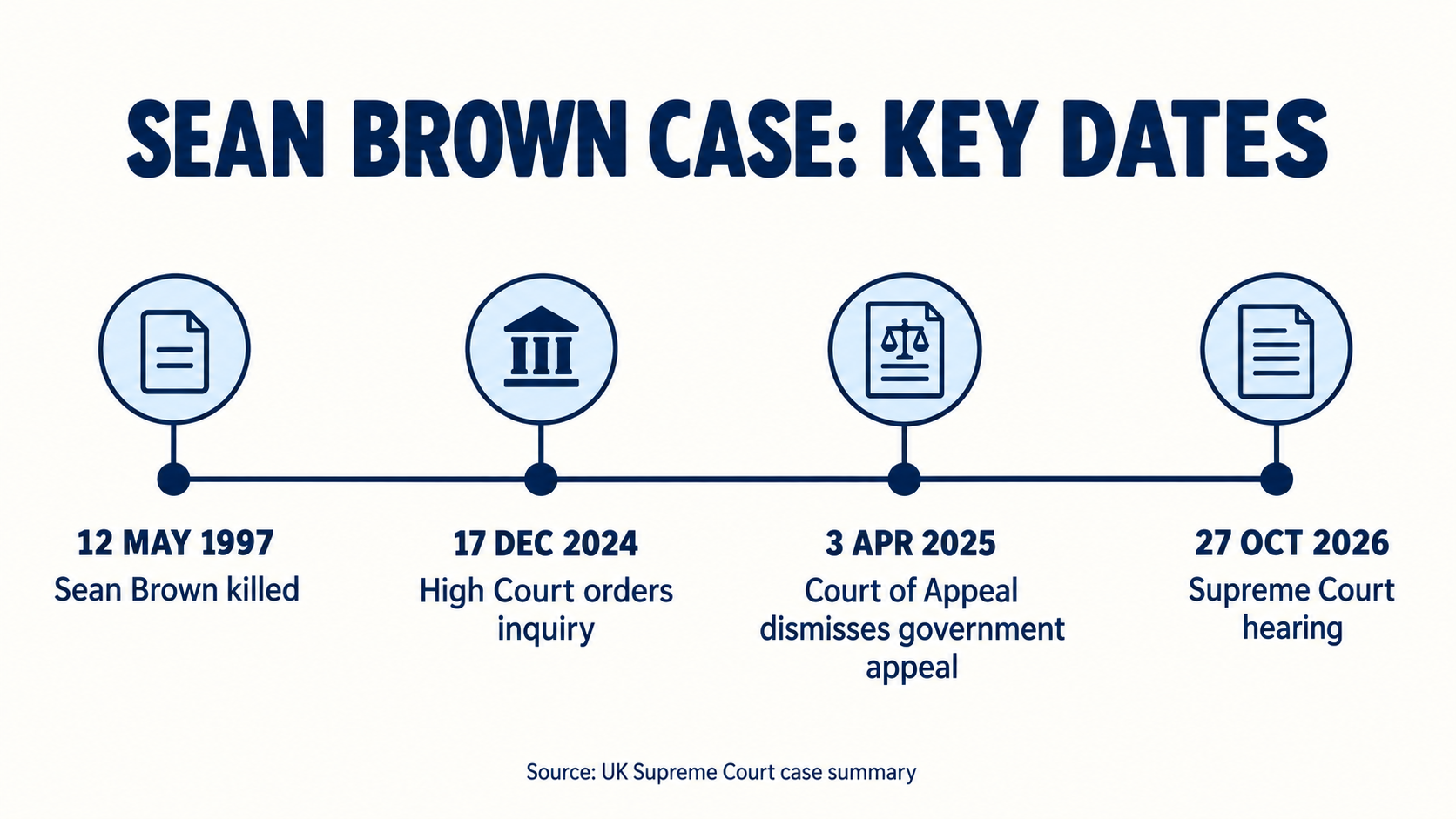
Mr Brown was abducted outside Wolfe Tone GAA club in Bellaghy on 12 May 1997. His body was found in Randalstown, County Antrim, after he had been assaulted and shot. The official case history says the police investigation closed in July 1998 without anyone being charged. It records that a 2024 investigation indicated some individuals linked to the murder were state agents. That is not a finding of criminal guilt.
An inquest began in 2023 but encountered disputes over sensitive material. In early 2024, hearings considered public-interest immunity claims, which can restrict disclosure of information where the state argues release could harm the public interest. The coroner requested that the Northern Ireland Secretary establish a public inquiry. The case summary says the parties agree that an investigation compliant with Article 2 of the European Convention on Human Rights has not yet been completed and should be carried out.
On 17 December 2024, Belfast’s High Court ordered a public inquiry after the Secretary of State declined to establish one. The Court of Appeal dismissed the government’s appeal on 3 April 2025. On 2 May, it made a mandatory order requiring an inquiry, but stayed that order until 2 June. The Supreme Court granted permission to appeal in June 2026 and scheduled a hearing for 27 October 2026.
What the Sean Brown Supreme Court appeal asks
The government’s appeal grounds argue that the Court of Appeal applied the wrong legal standard when it reviewed ministerial advice, crossed the constitutional boundary between judges and ministers, and wrongly treated a public inquiry as the only lawful way to meet the state’s investigative obligation. Those are the appellant’s grounds, not findings by the Supreme Court.
The government has previously said it wants a full, independent investigation that complies with Article 2, the Convention’s right-to-life provision. Its 2025 statement said the case raised constitutional issues and that its appeal would not change its commitment to a human-rights-compliant process. The dispute before the justices is about which mechanism the law allows and who gets to choose it.
The Court of Appeal had found that the Secretary of State acted unlawfully in refusing an inquiry. The Supreme Court must now decide whether that ruling and the order that followed it can stand. A judgment could clarify how far courts may go when ministers’ proposed mechanisms are challenged as unable to meet human-rights duties.
The ruling may also affect other legacy cases. An Irish News report said a High Court judge had deferred legal attempts to secure public inquiries into six other loyalist murders because the Supreme Court’s decision in Brown could inform those cases. The report describes families’ allegations about state involvement in their relatives’ deaths; each claim remains subject to its own evidence and legal process.
What we don’t know yet
The hearing is in progress and the Supreme Court has not announced when it will give judgment. It is not being asked to determine criminal responsibility for Mr Brown’s killing, and the case page does not say that the hearing will settle the underlying allegations about state-agent links.
The outcome will show whether the public inquiry order remains in force, is changed or is set aside. The immediate next development to watch is the Court’s judgment; other families whose cases have been held back are waiting for the legal test it sets.