

Rainbow Coalition: Why Wike Is Clashing With APC Governors Over 2027

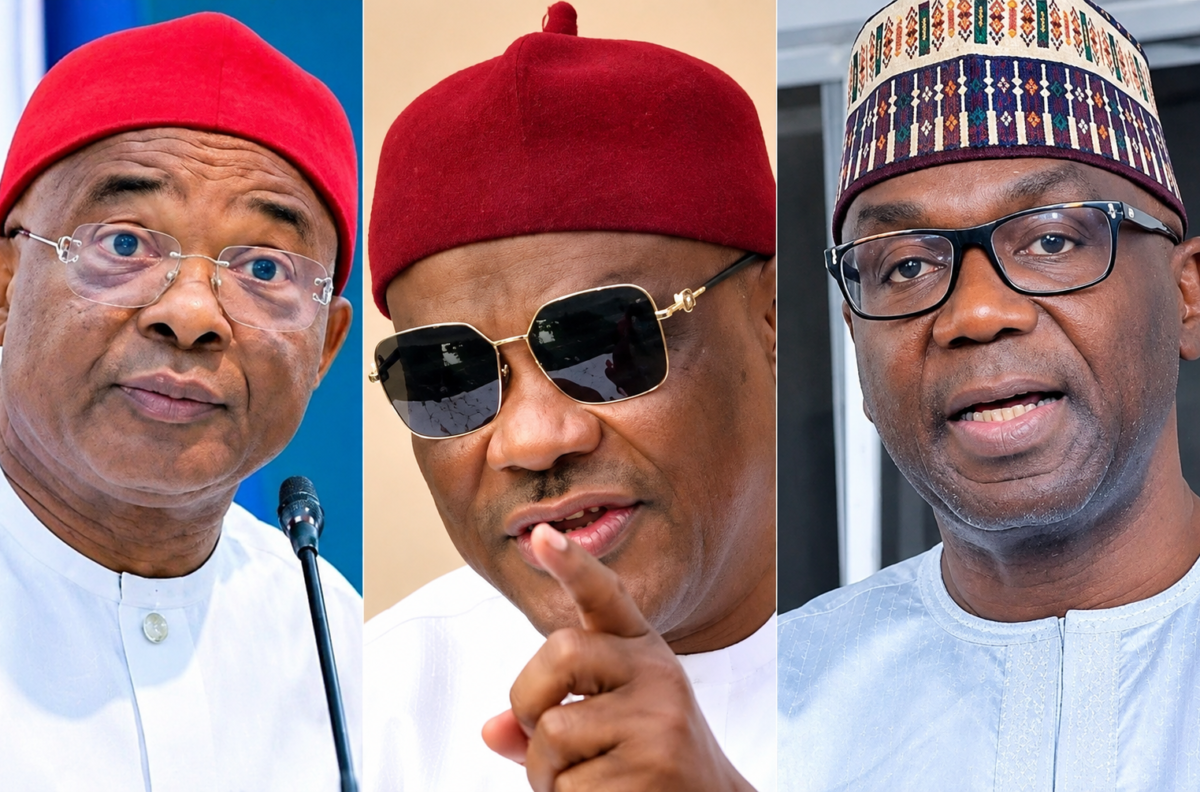
A new political disagreement has emerged between Minister of the Federal Capital Territory, Nyesom Wike, and governors elected on the platform of the All Progressives Congress (APC) over a political arrangement Wike calls the Rainbow Coalition.
The disagreement is not over whether President Bola Tinubu should be supported in the 2027 presidential election. Both sides say they support the president’s re-election.
The dispute is over how that support should be organised and whether a separate, cross-party structure could affect the APC and its candidates in other elections.
The APC Governors’ Forum has rejected any political arrangement it believes could weaken the party, while Wike insists that his coalition is designed specifically to mobilise support for Tinubu and has nothing to do with taking over the APC’s structure.
The disagreement has now become public, with Wike describing the APC governors as “politically lazy” for opposing the arrangement.
What is the Rainbow Coalition?
The Rainbow Coalition is a multi-party political mobilisation platform associated with Wike and other politicians supporting Tinubu’s 2027 re-election bid.
It is not the same thing as the APC and, according to Wike, it is not intended to replace or control the ruling party.
Wike has repeatedly explained that he remains a member of the Peoples Democratic Party (PDP), despite serving as a minister in the APC-led Federal Government and supporting Tinubu.
His position is that politicians from different parties can work together to support the same presidential candidate while their respective parties continue to contest other positions.
In a statement issued through his spokesperson, Lere Olayinka, Wike said the Rainbow Coalition was a platform for politicians from different parties who support Tinubu’s re-election. He also said the PDP remained free to field candidates for governorship, National Assembly and State House of Assembly elections.
That is the central idea behind the coalition: different parties can maintain their identities while cooperating on the presidential election.
Why are APC governors worried?
The APC governors’ concern is that such an arrangement could create a parallel political structure alongside the APC.
At a meeting in Abuja, the governors, through the Chairman of the Progressive Governors Forum and Imo State Governor, Hope Uzodimma, said they would not support any alliance or political arrangement capable of undermining Tinubu’s re-election, weakening the APC or adversely affecting APC candidates.
Uzodimma said the governors’ campaign commitment was to APC candidates at all levels.
This is where the disagreement becomes complicated.
The 2027 election will not involve only the presidential contest. Nigerians will also vote for governors, senators, members of the House of Representatives and state lawmakers.
The APC governors want the party’s machinery to support its candidates across these contests.
But Wike’s position allows politicians from other parties to support Tinubu for president while those parties retain their own candidates for other positions.
That could produce a situation in which politicians cooperate at the presidential level but compete against one another in state and legislative elections.
Why does that matter?
Consider a hypothetical state where a PDP candidate is contesting for governor while an APC candidate is also seeking the same position.
Under Wike’s approach, a PDP politician could support Tinubu for president while backing the PDP candidate for governor.
The APC governor, however, wants the party’s supporters to remain aligned behind APC candidates at all levels.
That is why the governors have referred to the possibility of divided loyalty and competing political interests.
The concern is not necessarily that supporting Tinubu and another party’s candidate is legally impossible. It is about the political consequences of having different campaign structures and candidates operating alongside one another.
Wike says politics is not about one party
Wike has pushed back strongly against the governors’ position.
He argued that supporting Tinubu does not mean he has abandoned the PDP or that other political parties should stop fielding candidates.
He also questioned why APC governors were objecting to his mobilisation efforts when, according to him, politicians have previously supported candidates from one party for one election while backing candidates from another party in another contest.
Wike specifically pointed to the 2023 elections, arguing that voters in states such as Imo, Abia, Enugu and Ebonyi demonstrated that they could vote for candidates from different parties in different contests without being confused.
He cited cases where APC candidates won National Assembly seats even though Tinubu did not receive the same level of presidential support in those states.
His argument is therefore that Nigerian voters are capable of making separate choices for different offices.
Why did Wike call the governors politically lazy?
The disagreement became more personal when Wike criticised the APC governors for opposing the Rainbow Coalition.
Speaking on Arise TV’s Prime Time, he described them as “politically lazy” and questioned their approach to winning elections.
He also challenged Uzodimma to explain APC’s performance in Imo during the 2023 presidential election, arguing that the party’s performance in other elections in the state showed that voters could support different parties for different positions.
Wike’s argument is essentially that political leaders should focus on mobilising actual voters for Tinubu rather than objecting to the structure through which other politicians choose to support him.
The APC governors, on the other hand, see the issue from the standpoint of party organisation and electoral competition.
Is the Rainbow Coalition an APC alliance?
Not according to Wike.
The minister has repeatedly said the coalition has nothing to do with the APC’s internal structure.
He maintains that it is simply a vehicle through which politicians from different parties can mobilise support for Tinubu’s presidential bid.
The APC governors have also said they have not entered into any formal agreement with Wike or any opposition party concerning such an arrangement.
This distinction is important because Wike’s support for Tinubu does not automatically make the PDP an ally of the APC.
Wike remains politically associated with the PDP while serving as a minister appointed by Tinubu. His position is that he can support Tinubu for president without requiring the PDP to abandon its own candidates in other races.
Why is Rivers State particularly important?
The dispute also has a strong Rivers State dimension.
Wike was governor of Rivers State from 2015 to 2023 and remains a major political figure in the state.
The Rainbow Coalition has been particularly associated with his political mobilisation there, and its potential influence over the state’s 2027 voting pattern is part of the wider political calculations.
Former Ekiti State governor Ayo Fayose recently argued that the disagreement should not necessarily be viewed as a threat to Tinubu, saying Wike and the APC governors could simply be pursuing different methods of supporting the president.
But the disagreement illustrates a broader question facing the 2027 election: can politicians support the same presidential candidate while remaining competitors at the state and legislative levels?
What the clash is really about
At its core, the Wike-APC governors dispute is about political control and electoral machinery.
Wike’s approach is to build a broader, cross-party network around Tinubu’s presidential campaign.
The APC governors want the ruling party’s existing structure to remain the main vehicle for the president’s re-election and for the campaigns of APC candidates across the country.
Neither position automatically determines how voters will behave.
But the disagreement shows that supporting the same presidential candidate does not necessarily mean that politicians share the same interests in every other contest.
As the 2027 election approaches, the question will be whether the Rainbow Coalition remains a presidential mobilisation platform or whether its activities begin to influence contests involving APC candidates at the state and legislative levels.
That distinction is likely to remain at the centre of the dispute between Wike and the APC governors.