
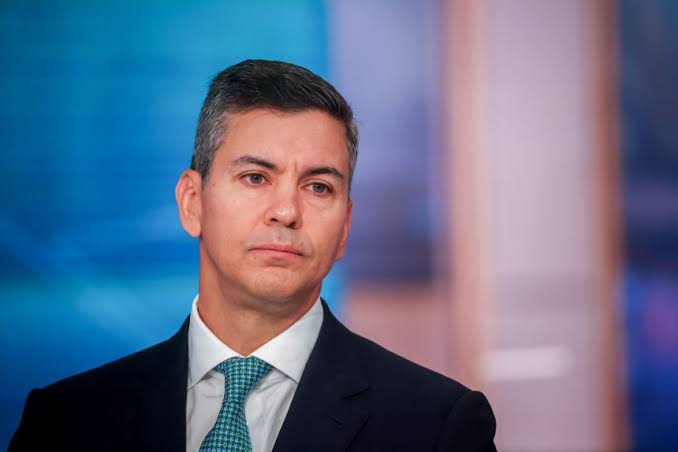
Paraguayan President Santiago Peña has resigned following the collapse of Ueno Bank, a financial crisis that left nearly three million customers unable to access their accounts and triggered protests, criminal investigations and impeachment proceedings.
The collapse of a major bank has plunged Paraguay into one of its biggest political crises in recent years, forcing President Santiago Peña to step down after mounting pressure from lawmakers, protesters and members of his own ruling party.
Peña announced his resignation on Thursday, November 5, 2026, saying he wanted to protect national stability, social peace and democratic institutions.
His departure came as lawmakers prepared to begin impeachment proceedings over allegations linked to the bank’s operations and its relationship with his government.
However, the crisis did not end with his announcement. Paraguay’s lower house subsequently voted unanimously, 78-0, to impeach him, sending the case to the Senate.
How Ueno Bank’s collapse triggered the crisis
Ueno Bank was one of Paraguay’s fastest-growing financial institutions. It expanded rapidly after receiving its banking licence in 2023 and attracted millions of customers through its digital banking services.
The institution reportedly served approximately three million people, representing more than 60% of Paraguay’s adult population.
However, investigations by financial regulators uncovered serious problems with its lending practices and financial records.
According to reports, the bank extended substantial loans to companies linked to its owners. Some of these transactions allegedly exceeded legal lending limits and lacked sufficient collateral.
Regulators also discovered poorly documented loans and expenses that had been wrongly recorded as assets.
After correcting the bank’s financial statements, authorities found that its capital had fallen to less than half the minimum required by law.
The Central Bank of Paraguay subsequently intervened and placed the lender under official management.
The intervention effectively shut down its banking services, leaving customers unable to access their savings through its application, cards and branches.
Why the bank’s collapse affected millions of people
The crisis quickly spread beyond the financial sector because Ueno held substantial public deposits.
Reports indicated that the institution administered approximately $800 million to $850 million in public funds, including money belonging to state pension and health institutions.
Its closure therefore raised concerns about the safety of public resources and the savings of ordinary citizens.
Thousands of customers gathered outside bank branches demanding access to their money. Pensioners, workers and other depositors also joined protests in the capital, Asunción.
The crisis affected employment as well. Approximately 7,000 workers faced uncertainty over their jobs and unpaid salaries connected to the bank and businesses within its parent group.
Authorities have promised to protect eligible depositors through the country’s deposit guarantee system, which is expected to cover most customers.
How the crisis implicated President Santiago Peña
Peña’s connection to the bank’s parent company became a major source of controversy.
The president previously held shares in Grupo Vázquez, the business group that owns Ueno Bank. He reportedly ended his business relationship with the company in March 2025.
However, lawmakers questioned the relationship between his administration, the bank and financial regulators.
Critics also raised concerns about the appointment of Carlos Carvallo, a former head of the financial company that preceded Ueno Bank, as president of the country’s central bank.
Carvallo resigned earlier in the crisis after Peña requested his departure.
Lawmakers accused the president of conflicts of interest, misuse of pension funds and attempts to cover up institutional failures.
Peña denied wrongdoing and stopped short of accepting responsibility for the bank’s collapse.
Meanwhile, authorities detained eight bank executives, while prosecutors brought charges against 27 bank officials and business associates over suspected financial offences.
What happens after Paraguay’s president resigns?
Peña’s resignation has opened the way for Vice President Pedro Alliana to take over the presidency.
However, the political transition also involves constitutional and legislative procedures.
The lower house’s unanimous impeachment vote means the case has moved to the Senate, which must consider the charges.
Alliana is expected to complete the remainder of Peña’s presidential term, which runs until August 2028.
Beyond the leadership change, Paraguay faces the difficult task of restoring public confidence in its banking system, recovering funds and determining who should be held accountable for Ueno Bank’s collapse.
The crisis has also raised questions about financial supervision and the relationship between political leaders and major private businesses.
For millions of affected customers, however, the immediate concern remains the same: recovering access to their savings.