

EU climate resilience plans use a 3°C scenario

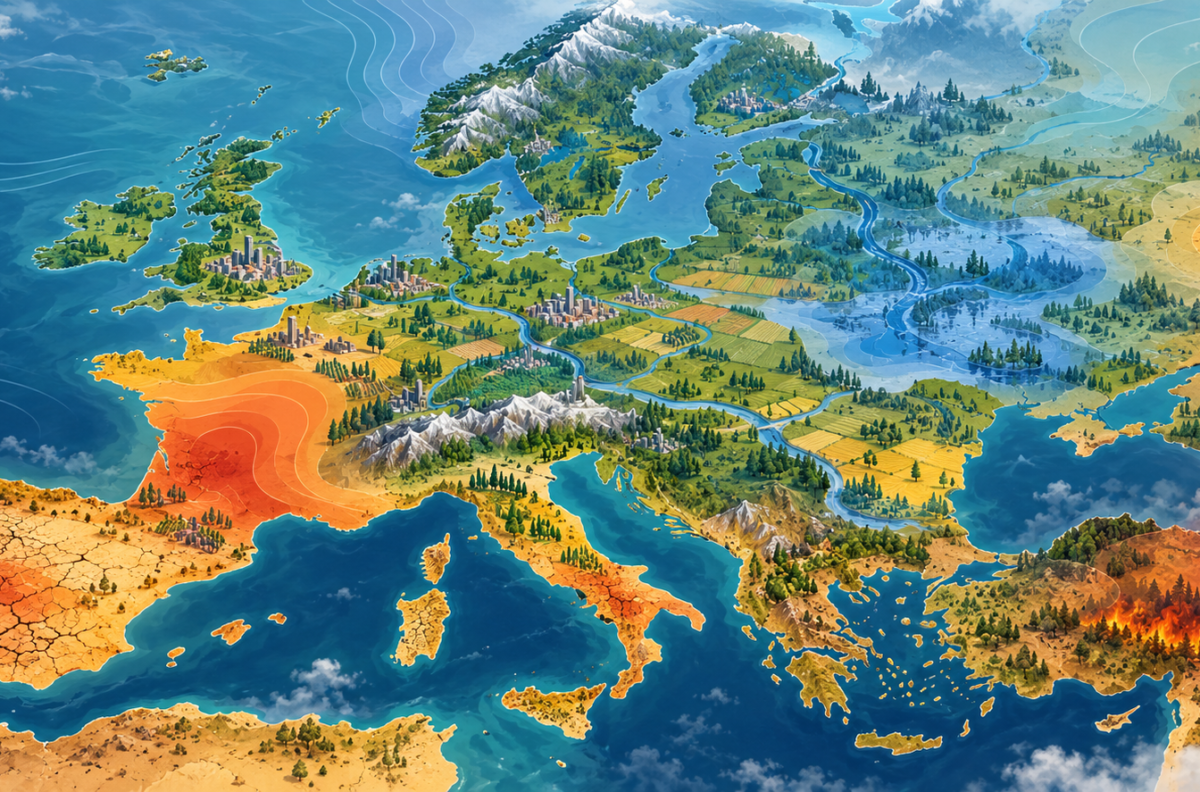
Illustration: a conceptual view of climate hazards that European resilience plans may address.
EU climate resilience plans could soon be required to prepare for a world with 3°C of global warming, under a draft reported by Bloomberg. The Commission says it is developing an integrated climate-resilience framework; Bloomberg’s draft report says the rules would ask all 27 member states to assess climate risks and prepare national plans by the end of 2030, bringing adaptation into decisions on infrastructure, water, energy and public finances.
The proposal is still in draft form. The European Commission says it is developing an integrated framework for climate resilience and risk management for adoption in the second half of 2026; the detailed provisions may change before publication. The plan is significant because it would set a common reference point for governments deciding which risks to manage and who is responsible for them.
What EU climate resilience plans could require
Bloomberg, citing a draft document, reported that the package would require national plans and ask the Commission to identify major risks, including possible climate tipping points. It would cover exposure across sectors such as energy, water, communications and government budgets. The draft also reportedly envisages plans by the end of 2030.
A Parliament briefing, published before the latest draft report, had already outlined a similar framework: a common climate reference scenario based on 3°C of global warming by 2100, national risk assessments and resilience plans, and clearer responsibility for managing risks. It said the Commission was preparing a regulation, a recommendation and other measures. That briefing is useful context, but it is not the final legislation.
For residents, the practical effects would depend on what national plans contain. Risk assessments could influence priorities for flood protection, heat planning, water supply, transport links and electricity networks. The plans would not by themselves guarantee funding or build those protections; budgets and implementation would still matter.
A 3°C scenario is a planning benchmark
The 3°C figure refers to global average warming above pre-industrial levels by the end of the century. It is a scenario against which authorities could test exposure and resilience, not a prediction that warming will stop at exactly that level, nor an emissions target that the EU wants to reach. Europe itself has warmed faster than the global average, according to the European Environment Agency.
The EEA’s 2025 assessment offers one way to understand why the scenario matters. A study it cites estimates that, without decisive additional adaptation, annual welfare losses across the EU and UK could reach at least €83 billion, or 0.65% of GDP, in a 2°C warming scenario. At 3°C, the estimate rises to €175 billion, or 1.38% of GDP. These are modelled estimates, not a bill already incurred or a precise forecast for any one country.

The figures do not mean adaptation can prevent every loss. They show why the difference between warming scenarios matters to planning: more severe heat, drought, fire and flooding risks can affect public services and assets that are costly to replace. The EEA also says European countries have adaptation policies, but progress remains uneven, with gaps in risk assessment, implementation, finance and monitoring.
| Scenario | Estimated EU and UK loss | Share of GDP |
|---|---|---|
| 2°C | €83bn | 0.65% |
| 3°C | €175bn | 1.38% |
Source: European Environment Agency, citing an economic study. Estimates assume no decisive, transformative adaptation action.
What we don’t know yet
The Commission has not yet published the final legislative text. The draft’s exact legal duties, the sectors covered, the process for reviewing plans and the consequences for countries that miss the reported 2030 deadline remain to be confirmed. Nor is it clear how much EU funding would be available to carry out the measures or how local authorities would be involved.
The next test is the Commission’s formal publication of the framework. Its final text will show whether the reported deadline and requirements survive, how the 3°C reference scenario is defined in law, and whether governments must attach budgets and measurable actions to their plans. For background, read CrispNG’s climate overshoot explainer.
Sources
- Bloomberg report on the draft proposal, republished by Insurance Journal.
- European Commission framework page.
- European Parliament research briefing on the planned framework.
- European Environment Agency climate resilience assessment.
- EEA economic risk estimates.
- CrispNG climate overshoot explainer.