

Messi: From Argentina’s biggest disappointment to its greatest football hero

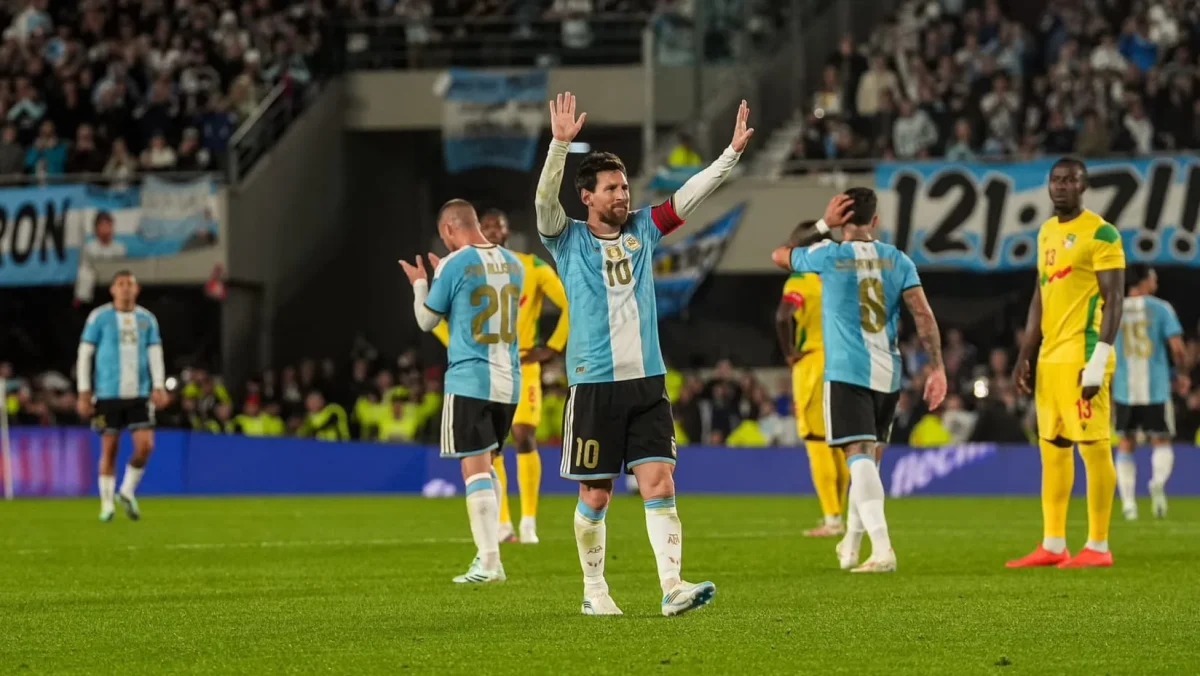
For years, Lionel Messi could do almost everything with a football except win a major trophy for Argentina.
He had conquered Europe with Barcelona. He had collected individual awards and broken scoring records. But whenever he wore Argentina’s famous blue and white shirt, the greatest prize seemed to remain beyond his reach.
That made his relationship with his country complicated.
On Tuesday, October 6, 2026, that relationship reached its final chapter.
Messi walked onto the pitch at the Monumental Stadium in Buenos Aires for the last time as an Argentina player. More than 85,000 supporters came to say goodbye.
And, fittingly, the 39-year-old left the stage with one final performance that reminded Argentina why it had fallen in love with him.
He scored a penalty and created two goals as Argentina defeated Benin 3-0 in his 208th and final international appearance.
Who is Lionel Messi?
Lionel Andrés Messi was born in Rosario, Argentina, on June 24, 1987.
He grew up playing football in his hometown before leaving Argentina as a teenager for Barcelona’s youth academy.
That decision changed the course of his life.
At Barcelona, Messi developed into one of the most successful footballers in history, winning major domestic and European trophies while establishing himself as one of the world’s most recognisable athletes.
But his success with his club created a difficult comparison.
Argentina had Diego Maradona.
And the question that followed Messi throughout much of his international career was simple: could he achieve what Maradona had done and bring the World Cup home?
Why did Argentines once criticise Messi?
Messi’s international career did not begin like a fairytale.
He made his senior Argentina debut in 2005 but was sent off just 47 seconds after coming on against Hungary.
As the years passed, the criticism became more intense.
Messi reached the 2014 World Cup final with Argentina, only for Germany to win 1-0 after extra time.
Two years later, Argentina lost the Copa América final to Chile on penalties.
It was Messi’s third consecutive major international final defeat with Argentina.
After the 2016 Copa América final, he briefly announced his retirement from international football.
For a player who had won almost everything at club level, his inability to win a major senior trophy with Argentina became a defining part of the conversation around him.
When did everything change?
Messi’s relationship with Argentina changed dramatically at the 2021 Copa América.
Argentina defeated Brazil 1-0 in the final at the Maracanã, giving Messi his first major senior international trophy with his country.
The victory removed one of the biggest criticisms surrounding his career.
But Messi was not finished.
The following year, he led Argentina to the 2022 World Cup title in Qatar.
Argentina defeated France on penalties in one of the most dramatic World Cup finals ever played.
Messi scored twice in the final and converted his penalty during the shootout.
After years of disappointment, the World Cup finally belonged to Messi and Argentina.
What did Messi win with Argentina?
The World Cup became the centrepiece of a remarkable international trophy collection.
Messi also won the Copa América with Argentina in 2021 and 2024, as well as the 2022 Finalissima against Italy.
The transformation was remarkable.
The player once accused by some supporters of failing Argentina had become the captain who delivered the country’s biggest football prize.
By the time he played his final international match, there was little left for his critics to argue.
How did Messi say goodbye?
The farewell against Benin was almost a summary of Messi’s career.
He did not simply appear on the pitch.
He influenced all three goals.
Messi delivered the corner that led to Nicolás Otamendi’s opener in the 48th minute. He then assisted Nico Paz for the second goal in the 61st minute before scoring Argentina’s third from the penalty spot in the 71st minute.
It was his 126th goal for Argentina.
More importantly, it was the final goal of an international career that lasted 21 years.
After the final whistle, Messi became emotional as the Monumental erupted in applause.
The night included tributes from former Argentina World Cup winners, fans and teammates, while a drone display was held after the match.
What records does Messi leave behind?
Messi finishes his Argentina career as the country’s most-capped player, with 208 appearances.
He is also Argentina’s all-time leading scorer with 126 goals.
His international career also includes 70 assists, according to Inter Miami’s account of his farewell.
Beyond the numbers, his greatest achievement may be the way his story with Argentina changed.
He went from being compared with Maradona and questioned for his failures in finals to becoming the captain who delivered the World Cup.
What happens to Argentina without Messi?
That is now the difficult question for Argentina.
For more than two decades, the national team had Messi.
Even when he was not scoring, his presence could change the way opponents defended and the way his teammates played.
Now Argentina must begin a new era.
Young players such as Nico Paz are already being viewed as part of the generation that will eventually carry the team forward.
But replacing Messi is not simply about finding another goalscorer.
Argentina is losing its captain, record scorer, record appearance holder and the player who defined its football for a generation.
From criticised star to national icon
Messi’s Argentina story is therefore bigger than the trophies.
It is a story of a player who endured years of criticism, lost major finals, briefly walked away from the national team and returned to eventually deliver the prizes his country wanted most.
His final performance against Benin was almost too fitting.
One goal.
Two assists.
One final victory.
Then tears, applause and a farewell from the country whose shirt had once been the biggest source of pressure in his career.
Messi leaves Argentina as a World Cup winner and national icon.
The boy who left Rosario for Barcelona at 13 returned decades later having achieved what generations of Argentine footballers had dreamed of.
And this time, Argentina was not asking him to prove anything.
It was simply saying goodbye.