
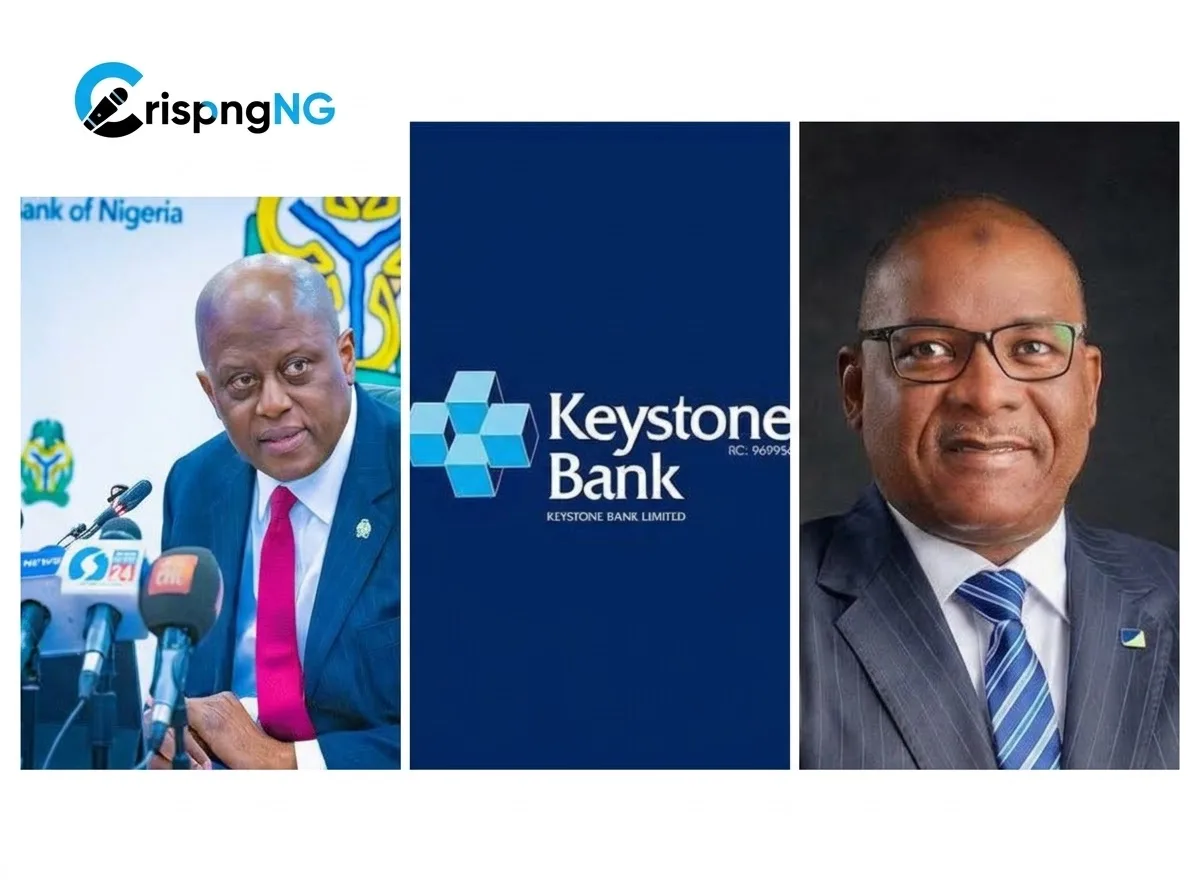
The Central Bank of Nigeria has appointed Murtala Mohammed as the acting managing director of Keystone Bank, replacing Hassan Imam. The change comes nearly three years after the regulator took control of the bank’s management and more than a year after the Federal Government became its owner.
The Central Bank of Nigeria (CBN) has appointed Murtala Mohammed as the acting Managing Director and Chief Executive Officer of Keystone Bank Limited.
The appointment took effect on November 26, 2026, following the removal of Hassan Imam, who had led the bank since January 2024.
The regulator announced the change in a statement signed by Michael Akuka, its Director of Corporate Communications and Investor Relations.
According to the CBN, the appointment was made under the powers granted to it by the Banks and Other Financial Institutions Act (BOFIA) 2020.
The apex bank said the decision was consistent with its responsibility to maintain a safe, sound and stable financial system.
However, it did not explain why Imam left, disclose Mohammed’s previous banking positions or state how long the new acting chief executive would remain in office.
The announcement has renewed attention on Keystone Bank because its leadership change comes amid a prolonged regulatory and ownership process.
Why did the CBN take over Keystone Bank in 2024?
The current situation dates back to January 10, 2024, when the CBN dissolved the boards and management teams of Keystone Bank, Union Bank and Polaris Bank.
The regulator cited violations of BOFIA 2020, including regulatory non-compliance, corporate governance failures and disregard for the conditions under which the banks received their licences.
It also raised concerns about activities that could threaten financial stability.
Following the intervention, the CBN appointed new management teams to oversee the affected institutions.
Hassan Imam became Keystone Bank’s managing director and chief executive, while Chioma A. Mang was appointed executive director.
The intervention effectively placed the bank under the regulator’s management.
However, the CBN’s action did not mean Keystone Bank had closed or lost its banking licence. The institution continued serving customers under the new management.
The regulator’s original intervention was part of a wider effort to address governance and regulatory concerns in the banking sector.
BusinessDay reported the January 2024 dissolution of the three banks’ boards.
How did the Federal Government become Keystone Bank’s owner?
Keystone Bank’s ownership also became a subject of legal proceedings after the CBN’s intervention.
Before the court ruling, the bank’s shares were held by private shareholders, including Sigma Golf Nigeria Limited and Alhaji Umaru H. Modibbo.
The Federal Government, through the Economic and Financial Crimes Commission (EFCC), challenged the acquisition of the bank by its former shareholders.
On February 11, 2025, the Lagos State Special Offences Court ordered the forfeiture of the former shareholders’ interests in the bank to the Federal Government.
The forfeiture covered approximately 6.3 billion ordinary shares.
Keystone Bank subsequently confirmed that the judgment transferred full ownership of the institution to the Federal Government.
This means the bank is government-owned, although it continues to operate as a commercial bank serving individuals and businesses.
The ownership change did not automatically convert Keystone into a government ministry or make its daily banking services public-sector transactions.
The bank said the court decision provided clarity over its ownership and created an opportunity for a recapitalisation process.
The bank’s ownership update contains its account of the court decision.
What happened to Keystone Bank’s recapitalisation?
The CBN’s banking sector recapitalisation programme adds another important dimension to the leadership change.
In March 2024, the regulator introduced new minimum capital requirements for commercial banks.
Under the framework, commercial banks with international authorisation were required to have at least ₦500 billion in capital. National commercial banks faced a ₦200 billion threshold, while regional commercial banks required ₦50 billion.
The compliance period ended on March 31, 2026.
On April 1, the CBN announced that 33 banks had met the new requirements, collectively raising ₦4.65 trillion. It also said a limited number of institutions remained subject to regulatory and judicial processes.
The regulator did not name every affected bank in that announcement.
However, subsequent reporting by Proshare identified Keystone Bank, Union Bank and Polaris Bank among institutions whose positions remained under regulatory or judicial review.
A June 2026 report by The Nation also said the three banks had been given additional time to complete their recapitalisation processes because of their legal and regulatory circumstances.
The CBN has not publicly disclosed a final, detailed capital-compliance position for Keystone Bank in the material available for this report.
Therefore, it would be inaccurate to conclude that the bank has failed recapitalisation or that its licence has been withdrawn.
The key issue is that its capital position and regulatory processes have attracted attention beyond the March deadline.
Read also: CBN Recapitalisation Deadline: Check If Your Bank Is Safe and What Customers Should Know
What does Murtala Mohammed’s appointment mean for Keystone Bank?
The appointment gives Keystone Bank a new acting chief executive at a time when its ownership, capital position and regulatory future remain important issues.
Mohammed will be expected to oversee the bank’s operations and work within the regulatory framework established by the CBN.
However, the regulator has not published details of his previous positions, professional background or specific responsibilities beyond his appointment as acting managing director and chief executive.
It has also not announced a date for appointing a substantive managing director.
These details matter because the bank’s next leadership team will have to address more than routine commercial operations.
The institution needs to maintain customer confidence, strengthen its financial position and resolve outstanding regulatory issues.
The Federal Government’s ownership also raises questions about whether it will retain the bank, introduce a new investor or pursue another ownership arrangement.
No new sale, merger or divestment has been announced alongside Mohammed’s appointment.
For now, the leadership change does not provide enough information to establish the CBN’s long-term ownership plan.
Is Keystone Bank safe, and should customers withdraw their money?
The CBN has directly addressed concerns that could arise from the leadership change.
In its November 26 announcement, the regulator said Keystone Bank remained fully operational. It also assured customers that banking services would continue normally and depositors’ funds remained secure.
This means customers should not interpret the replacement of the managing director as an announcement that the bank has closed or that withdrawals have been suspended.
Customers can continue using the bank’s services, including transfers, withdrawals, deposits and other available banking channels.
The CBN also made a similar assurance in February 2025, after the court ordered the forfeiture of the bank’s shares to the Federal Government.
At the time, it said Keystone Bank remained safe, sound and fully operational.
However, the CBN’s reassurance should be understood in its proper context. It does not mean customers should ignore official notices or assume that every possible banking risk has disappeared.
The Nigeria Deposit Insurance Corporation also provides deposit protection for eligible customers of insured deposit-taking banks. Its coverage for deposit money banks is up to ₦5 million per depositor, per institution, subject to its applicable rules.
That insurance framework is separate from the CBN’s operational assurance about Keystone Bank.
Read also: What Happens to Your Money When a Nigerian Bank Collapses? NDIC Explains
What happens next for Keystone Bank?
The immediate task is to ensure a smooth leadership transition while maintaining the bank’s services.
Beyond that, several developments will determine the institution’s future.
First, the CBN may provide further information about Mohammed’s appointment and whether it intends to confirm him as the substantive chief executive.
Second, Keystone Bank’s recapitalisation position needs greater clarity. The bank must resolve any outstanding regulatory requirements under the applicable framework.
Third, the Federal Government may eventually announce its long-term ownership plan. The bank’s current government ownership does not automatically mean it will remain under public ownership permanently.
Finally, customers and investors will be watching the bank’s financial performance, governance arrangements and ability to maintain confidence.
For now, the CBN has changed Keystone Bank’s leadership but has not announced a new ownership arrangement, closure or withdrawal of its banking licence.
The bank remains operational, while questions about its long-term management and capital position await further clarification.