

UNEP says 1.5°C overshoot is unavoidable. Can the world return below it?

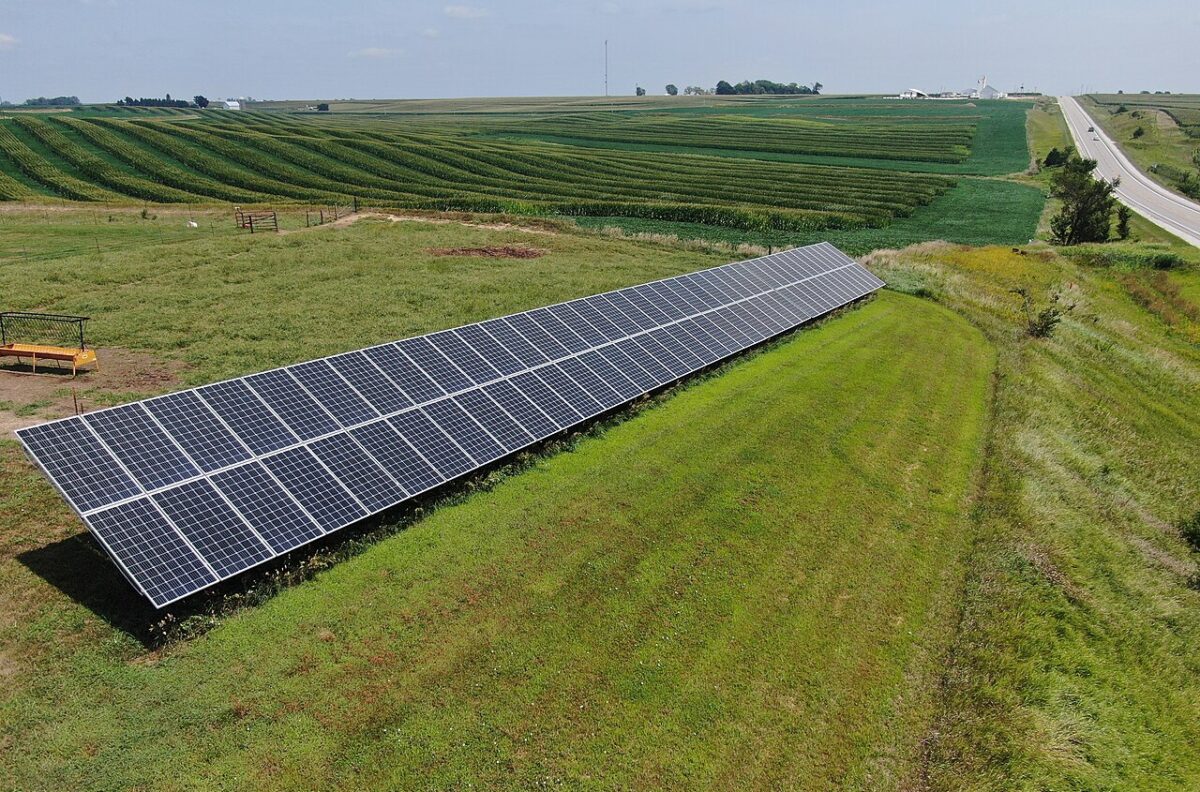
Illustrative aerial view of a US farm solar array, photographed on 9 August 2024. USDA photo by David Kosling, public domain via Wikimedia Commons; it does not depict the UNEP report or a site discussed in it.
Climate overshoot past 1.5°C is now unavoidable, the UN Environment Programme says. But its new report argues that crossing the threshold need not be permanent: one pathway gives the world about an even chance of returning to 1.5°C or below by 2100, after warming peaks higher around mid-century.
That distinction is the central message of UNEP’s Emissions Gap Report 2026: The Point of Return. The report treats climate overshoot as something to limit in height and duration while making a return pathway credible. The near-term task is no longer to prevent all overshoot.
What climate overshoot means for the 1.5°C goal
The chance of keeping warming to 1.5°C with no or only limited overshoot has gone, according to UNEP. In the report’s lowest-possible overshoot scenario, temperatures rise to roughly 1.7°C–1.8°C around mid-century before falling back to 1.5°C or below by 2100. UNEP puts the chance of reaching that end-century level at about 50 per cent.
This is a scenario, not a forecast that the world is on track to achieve. It describes a conditional route that depends on emissions cuts far steeper than governments’ current commitments.
The emissions gap is now a timing problem
To follow that route, global greenhouse-gas emissions would need to fall 18 per cent by 2030, 45 per cent by 2035 and 69 per cent by 2040, compared with 2025. Full delivery of countries’ current nationally determined contributions would produce cuts of only 5–8 per cent by 2030 and 11–15 per cent by 2035, UNEP estimates.
The gap matters because delay makes the eventual task harder. UNEP estimates that every five years of carbon dioxide emissions at today’s level adds about 0.1°C to the peak warming the world must later try to reverse.
Current pledges still point well above 1.5°C
The report projects 2.8°C of warming this century if current policies continue. If countries fully implement their national climate pledges, the projection falls to 2.6°C. Adding long-term net-zero targets brings it to 2.1°C, still above the Paris Agreement’s temperature goals.
These are modelled outcomes based on different policy assumptions; they are not certainties. They show, however, that even the most optimistic of those three policy cases is not the same as the 1.5°C return pathway.

Why the pathway depends on more than cutting emissions
The lowest-overshoot scenario also requires removing and permanently storing about 320 gigatonnes of carbon dioxide over this century—roughly eight years of 2024 global CO₂ emissions. UNEP says the social, economic and technical feasibility of doing that remains uncertain. Carbon removal is therefore a major dependency in the scenario, not a proven substitute for reducing fossil-fuel emissions now.
The report also points to evidence that policy can change emissions: its review of more than 220 policy evaluations found average reductions of 9 per cent in the electricity sector from evaluated policies, and 5–13 per cent across sectors from instruments such as carbon taxes and trading schemes over the periods studied. Those results are concentrated in particular countries and sectors, so extending them worldwide is a challenge rather than an automatic outcome.
What readers should watch next
Three indicators will show whether the return pathway is becoming more plausible: the pace of actual emissions cuts before 2030; whether countries turn renewable-energy and efficiency goals into funded policy; and whether climate plans address sectors where progress remains slow. UNEP says the next Global Stocktake can extend shared goals into 2035 and 2040, giving governments clearer milestones to measure against.
The report’s answer to “Is 1.5°C lost for good?” is therefore conditional. Avoiding overshoot is no longer realistic, but a later return remains possible in one scenario. Its roughly even odds depend on immediate, sustained cuts and large-scale carbon removal whose feasibility is uncertain.
For background, read CrispNG’s explainer on climate change and the Paris Agreement.
Featured image credit: USDA photo by David Kosling/Wikimedia Commons (public domain). The solar-farm photograph is illustrative and is not connected to the UNEP report.
Sources: UNEP report announcement and key figures; full Emissions Gap Report 2026; UNEP explainer on the 1.5°C overshoot pathway.