

Emefiele trial: 5 things witness said about N124.86bn CBN withdrawal

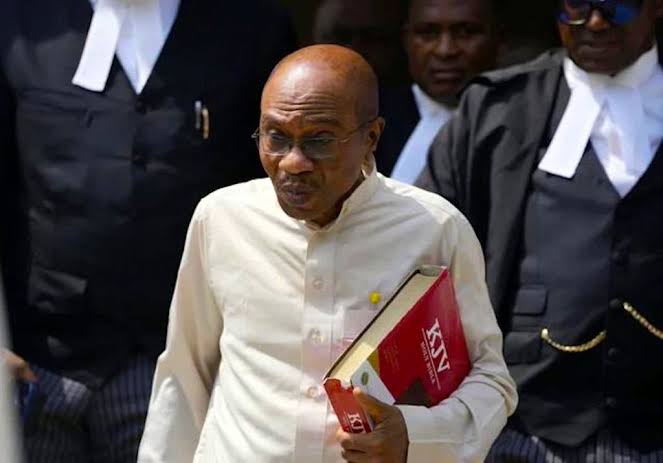
The ongoing trial of former Central Bank of Nigeria (CBN) governor Godwin Emefiele has taken another turn after a Federal Ministry of Finance director told the court that the ministry and the Office of the Accountant-General of the Federation (OAGF) were unaware of a N124.86 billion withdrawal from the apex bank.
Ali Mohammed, a director in the Ministry of Finance, appeared before the Federal Capital Territory High Court sitting in Maitama, Abuja, as the 10th prosecution witness in the case.
His testimony focused on how the N124.86 billion transaction was recorded and whether the relevant government offices knew about or authorised the withdrawal.
The witness said the transaction was classified in the ministry’s records as a “direct debit” by the CBN.
Here are five things to know about the testimony.
1. Finance Ministry said it did not know about the N124.86bn withdrawal
Mohammed told the court that none of the three divisions under his supervision was aware of the N124.86 billion transaction.
He said he became aware of the issue after the Ministry of Finance received a letter from a team investigating a larger N154 billion withdrawal allegedly made by the CBN.
The director said he contacted the relevant divisions in his department to establish whether they had any knowledge of the transaction.
According to him, the divisions responsible for state and public finance, trade, and banking and other financial institutions had no information about the withdrawal.
He said the State and Public Finance Investment Division was particularly relevant because it oversees the CBN.
The witness’s testimony was therefore that the ministry was not aware of the N124.86 billion withdrawal when it occurred.
2. The Accountant-General’s office was also said to be unaware
Mohammed told the court that he subsequently wrote, through the Permanent Secretary of the Ministry of Finance, to the Office of the Accountant-General of the Federation.
The purpose, he said, was to establish whether the OAGF knew about the transaction.
He said the OAGF responded that it was not aware of the transaction.
According to the witness, the response described the movement of the funds as a direct debit from the CBN.
The documents exchanged between the Ministry of Finance and the OAGF were subsequently tendered by the prosecution and admitted by the court after defence counsel Olalekan Ojo, SAN, raised no objection.
3. What does ‘direct debit’ mean in the case?
One of the key points from Mohammed’s testimony was his explanation of the expression “direct debit”.
When asked to explain the term as it appeared in the document, he told the court that it meant the money was withdrawn from the CBN without recourse to another government office.
The witness said the Ministry of Finance’s records did not show that the ministry had knowledge of the N124.86 billion withdrawal.
He also said the OAGF, which is supervised by the Ministry of Finance, would ordinarily receive a directive before such a withdrawal was made.
Mohammed added that the document before the court did not indicate that the Ministry of Finance had directed the OAGF to make the withdrawal from the Consolidated Revenue Fund.
4. Earlier testimony linked the money to CBN’s internal debts
The latest testimony came after evidence from another prosecution witness, Hamisu Abdullahi, a CBN director who previously told the court about the N124.86 billion transaction.
Abdullahi said the CBN had accumulated internal debts from directives it received to make payments to government agencies without corresponding funds being provided for the payments.
According to his testimony, the accumulated obligations reached N124.86 billion.
He said the money was subsequently debited from the Consolidated Revenue Account to settle the outstanding obligations.
The witness had also told the court that there was no National Assembly approval for the withdrawal and no presidential approval for the debit.
However, during cross-examination, Abdullahi said Emefiele did not personally benefit from the money and that he had not come across any complaint that anyone was prejudiced by the settlement of the debts.
5. The case is still being heard
The latest testimony does not amount to a conviction or establish that Emefiele is guilty of the allegations against him.
Emefiele is being prosecuted by the Economic and Financial Crimes Commission (EFCC) in connection with allegations including disobedience to lawful directives and unlawful acts allegedly causing harm to members of the public in relation to the naira redesign policy.
The former CBN governor has denied the allegations.
The latest proceedings are part of the prosecution’s presentation of evidence before the court. The defence is expected to cross-examine witnesses and challenge the prosecution’s evidence as the trial continues.
The court adjourned the case until Wednesday, October 7, 2026, for cross-examination and continuation of the trial.
What the latest testimony means
At the centre of the latest evidence is a question of procedure: whether the N124.86 billion could be withdrawn from the government’s consolidated account without the involvement or approval of the relevant government authorities.
The prosecution’s latest witness told the court that the Ministry of Finance and the Accountant-General’s office were unaware of the transaction.
Earlier evidence from a CBN official, however, provided an explanation for why the funds were withdrawn, linking the money to outstanding obligations the apex bank had accumulated.
The court will ultimately have to consider the evidence from both sides and determine whether the prosecution has proved the allegations against Emefiele beyond the required legal standard.
For now, the latest testimony has placed the alleged N124.86 billion withdrawal and the absence of knowledge by key finance authorities at the centre of another stage of the former CBN governor’s trial.