

Can a Police Officer Remove your Number Plate in Nigeria?

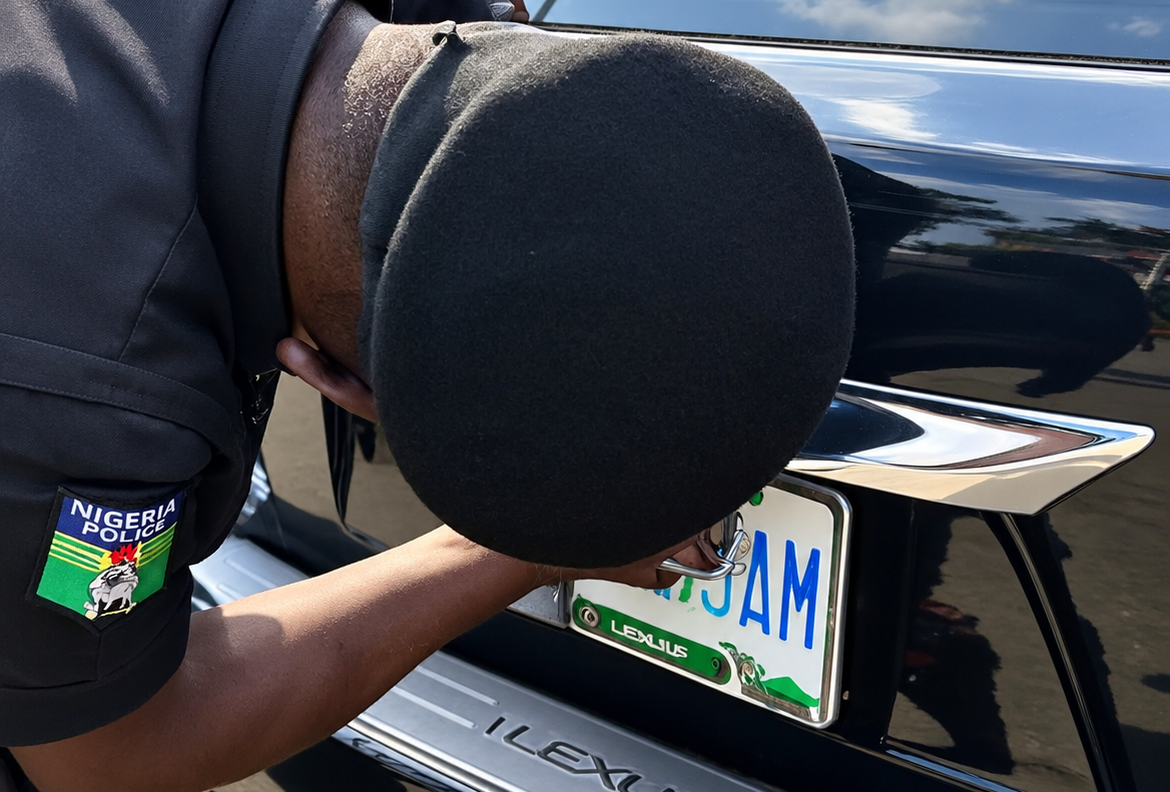
A video showing a Nigerian police officer using a spanner to remove the number plate of a Lexus during a traffic stop has raised questions about the powers of police officers on Nigerian roads.
The straightforward answer is no, a police officer cannot simply remove a vehicle’s number plate as a roadside punishment for an ordinary traffic offence.
There is no general provision in the Nigeria Police Act 2020 that gives a police officer the power to physically remove a vehicle’s number plate during a routine traffic stop as a penalty for a traffic violation.
That is different from situations where a vehicle or its number plate is connected to a criminal investigation and the police have lawful grounds to seize property as evidence.
What can the police do during a traffic stop?
The Nigeria Police Force has powers to stop, question and search people and vehicles in circumstances permitted by law.
The Police Act 2020 provides a framework for police searches, including searches based on reasonable grounds and prescribed procedures. An officer conducting a search is also required to identify themselves and state the purpose of the search.
Those powers, however, should not be confused with a general power to dismantle a vehicle or remove its number plate.
A traffic stop does not automatically give a police officer unlimited authority over a motorist’s property.
Who deals with number-plate violations?
This is where the FRSC and the police have to be separated.
The Federal Road Safety Corps has specific statutory responsibilities relating to road safety, including vehicle registration and number-plate regulation.
The FRSC’s current offence schedule specifically lists vehicle number plate violation as a traffic offence, with a prescribed penalty.
The FRSC also has a vehicle-number-plate verification system through its National Vehicle Identification Scheme.
Therefore, the existence of a number-plate offence does not mean that every police officer has the same enforcement powers as the FRSC.
The police have their own law-enforcement mandate. The FRSC has its own road-safety and traffic-regulation mandate.
Can a police officer remove the plate if the driver has committed a traffic offence?
Not simply as a penalty.
There is no general police power that allows an officer to say, in effect, “You committed this traffic offence, so I will remove your number plate.”
The proper enforcement procedure depends on the particular offence and the agency empowered to enforce it.
This distinction is important because a number plate is part of a vehicle’s official identification. Removing it on the roadside is not the same thing as issuing a traffic penalty or directing a motorist to correct an offence.
The FRSC’s own 2025 enforcement compendium makes the position even clearer. Its instructions to enforcement personnel state that officers should not forcefully remove a number plate, wheel spanner, jack, spare tyre or similar item from an offender in lieu of confiscation.
That instruction is directed at FRSC personnel, not the police, but it reinforces the distinction between lawful enforcement and simply physically removing property from a vehicle.
When can police take a number plate?
There is an important exception.
A number plate can potentially become evidence in a criminal investigation.
The police have powers under criminal-procedure laws to seize property taken during an arrest or investigation, or property suspected to have been stolen or connected with an offence.
Under Section 337 of the Administration of Criminal Justice Act 2015, where police seize property during an arrest or investigation, or property suspected to have been stolen or connected with an offence, the seizure is required to be reported to a court within the prescribed period, which is not more than 48 hours under that provision.
Therefore, the situation changes if, for example:
- the number plate is suspected to be fake or stolen;
- the plate is connected to a vehicle involved in a criminal offence;
- the plate itself is relevant evidence in an investigation;
- or there is another lawful basis for seizure under applicable criminal-procedure law.
In such a case, the police are not removing the plate simply because the driver committed an ordinary traffic offence. They are taking property as part of a lawful criminal investigation, subject to the relevant legal safeguards.
What if the vehicle has a fake or altered number plate?
That is different from a normal traffic violation.
A fake, altered or tampered number plate may raise issues beyond road safety and could provide grounds for investigation where there is reasonable suspicion of an offence.
The FRSC has previously taken enforcement action over tampered number plates, and a Federal High Court ruling reported by the Corps affirmed its authority to enforce number-plate regulations.
But even where an offence is suspected, enforcement must still be carried out according to law.
An officer cannot simply create a punishment that is not provided by law.
What should you do if an officer tries to remove your plate?
The first thing is do not physically resist the officer.
Instead, the motorist should calmly ask:
“What offence have I committed, and under which law are you removing my number plate?”
The motorist can also ask for the officer’s name, rank and identification.
If the officer says the vehicle is being seized or the plate is being taken as evidence in a criminal investigation, the motorist should ask for the reason and the police station or authority to which the vehicle or plate is being taken.
Where it is safe and lawful to do so, the motorist should document the incident, including:
- the officer’s name or identification;
- location and time of the incident;
- the vehicle’s registration number;
- the alleged offence; names or contacts of witnesses;
- and any receipt, notice or document issued by the officer.
The motorist can then seek legal advice or make a formal complaint if the action was believed to be unlawful.
What motorists should not do
A driver should not turn a roadside dispute into a physical confrontation.
Even when an officer appears to be acting outside their lawful powers, resisting arrest, assaulting an officer or obstructing police work can create a separate legal problem.
The better approach is to comply with lawful instructions, document the incident and challenge unlawful conduct through the appropriate channels.
So, can police remove your number plate?
For an ordinary traffic offence: No.
There is no general provision in the Nigeria Police Act 2020 authorising police officers to physically remove a motorist’s number plate as a routine traffic penalty.
Where the plate is connected to a suspected crime or is being lawfully seized as evidence: Yes, a seizure can occur, but it must have a lawful basis and follow the applicable criminal-procedure rules.
The distinction matters.
A police officer’s authority to stop or investigate a motorist is not the same as an automatic power to remove parts of the vehicle.
For ordinary number-plate violations, the relevant road-safety enforcement framework remains separate from the police’s criminal-law enforcement role. The FRSC itself recognises vehicle number-plate violations and has specific enforcement procedures for them.
In short: a traffic stop does not, by itself, give a police officer the right to unscrew your number plate.