

Why Gabriel Bortoleto’s 80-place F1 penalty still means last on the US GP grid


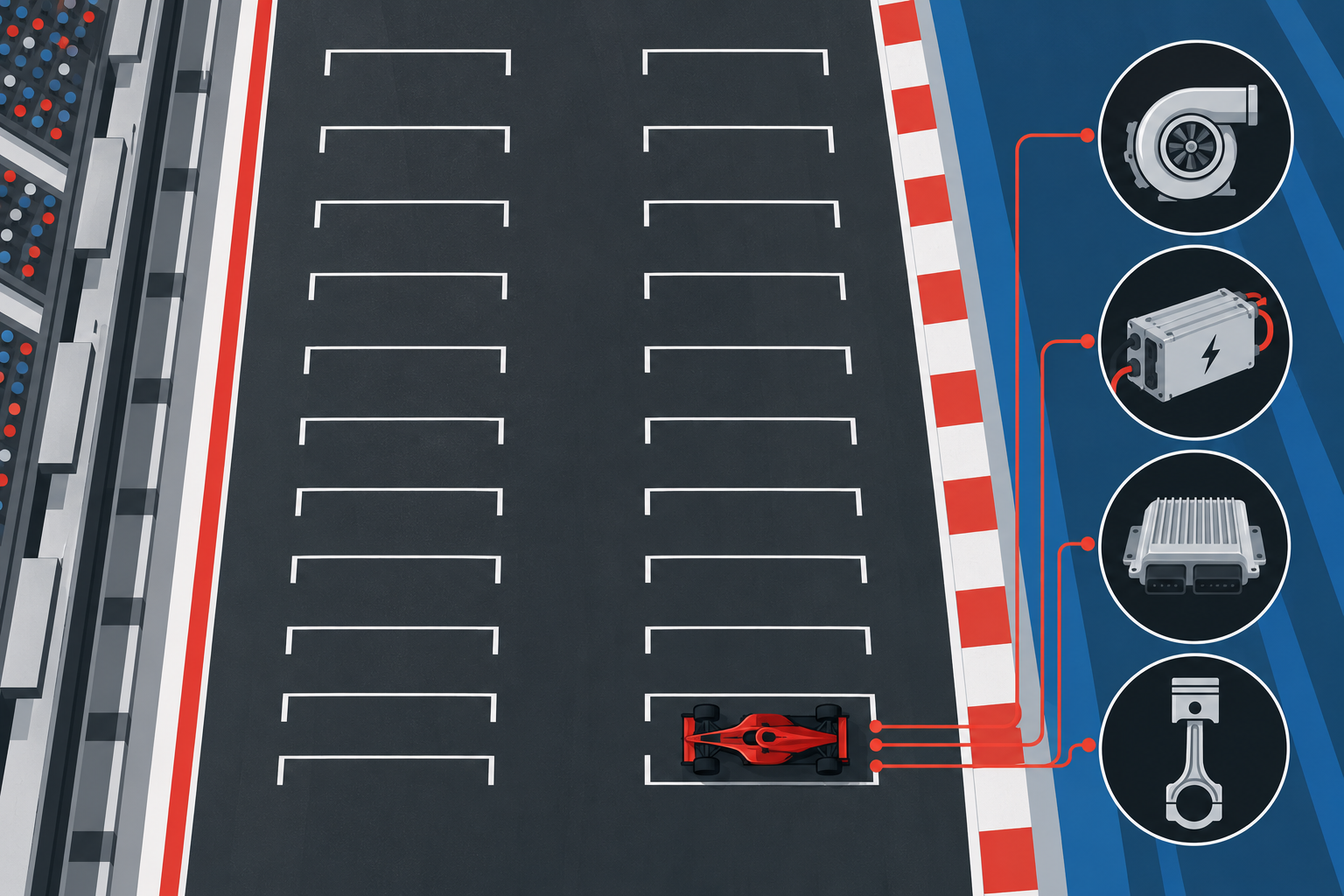
Illustration generated for this explainer; it does not depict the 2026 United States Grand Prix.
Gabriel Bortoleto will start the United States Grand Prix from 22nd on Sunday, although his qualifying lap put him 13th. His 80-place penalty is the combined result of power-unit components a driver uses beyond the seasonal allowance and Formula 1’s rule for large grid penalties.
The 80-place penalty does not mean Bortoleto literally lost 80 spots. Austin has 22 cars, so there are only nine places between 13th in qualifying and the final slot. Eighty is the sum of the formal penalties assigned for Audi’s component changes.
How the 80-place penalty added up
Under the FIA’s 2026 sporting rules, the first use of an extra power-unit element of a type carries a 10-place drop; further overages of that type add five places each. The penalties accumulate. Bortoleto’s initial component changes brought a 20-place sanction. Audi introduced several more elements before qualifying, adding another 60 places, according to Formula 1’s account of the stewards’ decisions.
The Saturday list included a fifth engine, turbocharger, exhaust set, energy store and control electronics unit, a fourth MGU-K and a seventh ancillary component. The FIA’s ruling assigned 10-place penalties to five additional elements and five places apiece to the extra energy store and control electronics unit. Together with Friday’s sanction, that made 80.
Why the 80-place penalty puts him last
FIA rules place drivers with more than 15 cumulative grid penalties behind all other classified drivers. This keeps the grid usable while preserving the penalty total in the official record. In Austin’s 22-car order, the practical effect was a move from 13th to 22nd.
The FIA’s starting grid lists Kimi Antonelli on pole and Bortoleto last. Franco Colapinto, who qualified 14th, is 21st after a 10-place drop. Arvid Lindblad also loses five positions, moving from ninth in qualifying to 14th.
What the penalty does and does not tell us
The rule adds up the number and sequence of extra power-unit elements; it does not impose an 80-place punishment for a single incident. The grid order alone also does not explain why Audi chose to change the parts. FIA notices identify the elements and rule references, but readers need Audi’s own explanation to understand its technical reasoning.
For Bortoleto, the immediate consequence is clear: he starts behind every other car despite reaching Q2 and posting the 13th-fastest qualifying time. The remaining question is how much ground he can recover in the race, not whether he has 80 cars to pass.
Read our 2026 Formula 1 season coverage for more on the championship picture.
Sources and rules
- Formula 1: power-unit changes and penalty breakdown
- FIA: qualifying classification
- Formula 1: official starting grid
- FIA 2026 sporting regulations
- RacingNews365: second power-unit change and penalty calculation