
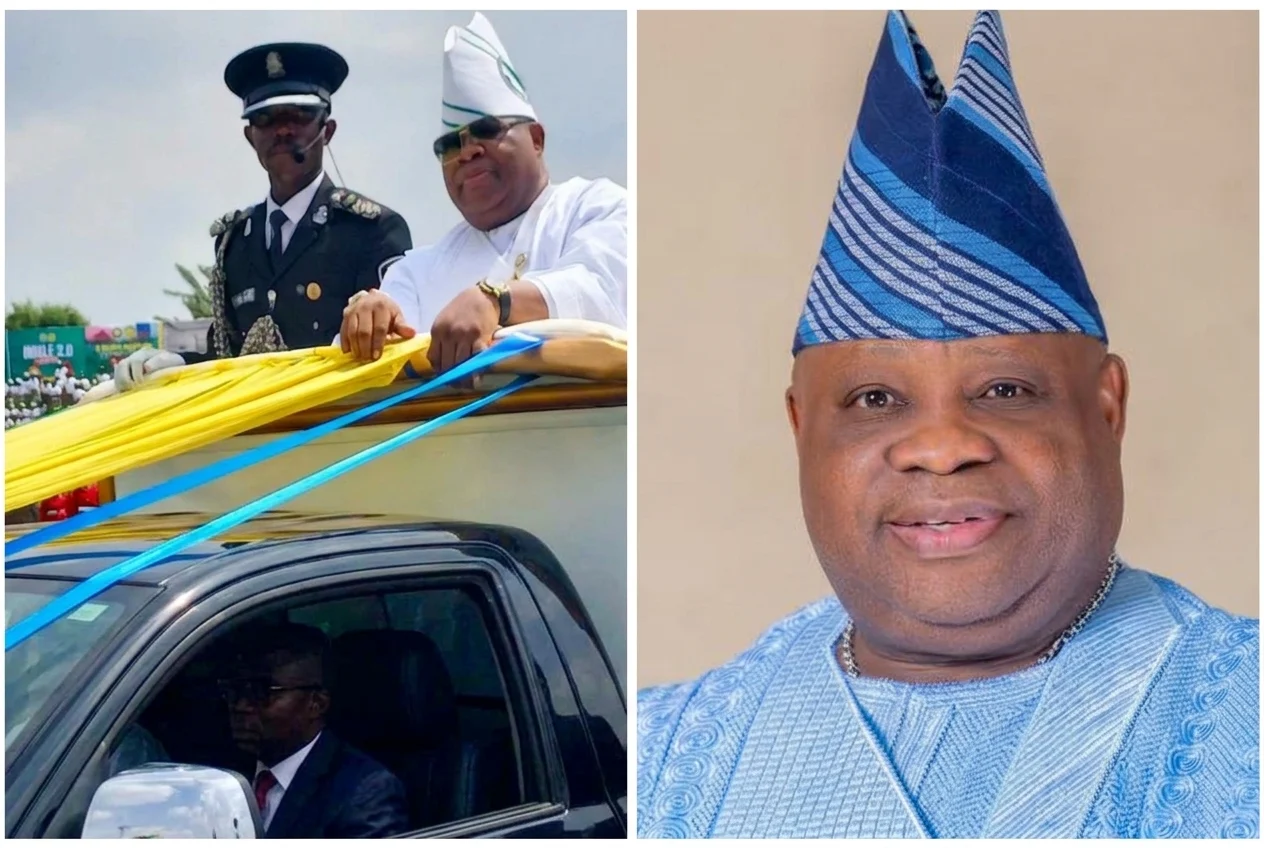
Governor Ademola Adeleke has begun his second term as Osun State governor with an ambitious promise to move the state beyond its dependence on civil service activities and build an economy driven by industrialisation, agriculture, technology and private investment.
Sworn in on Friday, November 27, 2026, at the Osogbo City Stadium, alongside his deputy, Kola Adewusi, Adeleke outlined a development agenda covering healthcare, education, electricity, water supply, infrastructure and job creation. Vice-President Kashim Shettima represented President Bola Tinubu at the inauguration.
The inauguration marks the beginning of another four-year tenure, but the more significant question is how the administration will turn its promises into measurable improvements in the lives of Osun residents.
Adeleke is also entering the new term with unfinished projects and governance concerns identified by civil society group The Osun Masterminds, which gave his first four years a mixed assessment.
Here are 10 major things to note about Adeleke’s second term, including the promises, outstanding challenges and economic targets that will shape his administration until 2030.
1. Adeleke Begins His Second Four-Year Term Until 2030
Adeleke’s inauguration on November 27 formally begins another four-year term as Osun governor, following his re-election in the August 15, 2026 governorship election.
He won the election on the platform of the Accord Party after leaving the Peoples Democratic Party (PDP). The governor polled 511,067 votes, defeating the All Progressives Congress (APC) candidate, Bola Oyebamiji, who secured 444,815 votes.
His new tenure gives the administration another opportunity to pursue projects and policies introduced during its first term, while addressing concerns that remain unresolved across the state.
The governor described his re-election as a triumph of the people’s will and called for unity among political stakeholders.

2. Moving Osun From a Civil Service Economy to an Industrial Hub
One of Adeleke’s biggest promises is to reduce Osun’s dependence on a civil service-driven economy and transform it into an industrialised state.
The governor said his administration would encourage private-sector investment and work with economic advisory organisations to create new economic opportunities.
His proposed initiatives include agro-processing factories, industrial parks across the senatorial districts, free trade zones and improvements to the business environment.
If implemented, these projects could create opportunities for businesses, farmers, manufacturers and job seekers.
However, the administration will need to demonstrate how these investment proposals will attract businesses, generate employment and increase economic activity beyond government spending.
3. Three Digital Hubs Planned for Osun’s Senatorial Districts
The digital economy is another major part of Adeleke’s second-term agenda.
The governor promised to establish a digital hub in each of Osun’s three senatorial districts to support youth development and job creation.
The initiative is expected to provide opportunities for young people to acquire digital skills and participate in technology-related economic activities.
The administration also plans to pursue sports and tourism development as part of its broader strategy for wealth creation.
The progress of the digital hubs will be an important measure of whether the government’s technology promises translate into accessible opportunities for young people across the state.

4. Local Government Funding Crisis Remains a Major Issue
The lingering dispute over local government administration and funding is one of the most important challenges facing Adeleke as he begins his second term.
During his inaugural address, the governor disclosed that President Bola Tinubu had intervened in the dispute and expressed confidence that it would be resolved within one week.
The crisis has affected the administration’s ability to complete some grassroots projects, particularly the rehabilitation of primary healthcare centres.
Adeleke’s expectation is that resolving the dispute will allow outstanding projects to resume.
The issue also has wider implications for local government administration, access to council funds and the delivery of services at the grassroots.
Whether the promised resolution materialises will be an early test of the administration’s ability to address one of the most persistent governance challenges in Osun.
5. Completing the Rehabilitation of 332 Primary Healthcare Centres
Healthcare delivery is another area Adeleke has promised to prioritise.
The governor said his administration upgraded and equipped 232 of Osun’s 332 primary healthcare centres during its first term, including the installation of solar and power facilities.
He explained that the original plan was to complete the rehabilitation of all 332 centres, but the local government funding dispute disrupted the programme.
Adeleke promised to complete the remaining facilities once the crisis is resolved.
He also pledged to upgrade general hospitals, recruit additional healthcare workers and expand the supply of drugs across the state.
However, the state will need to address more than physical infrastructure. The availability of doctors, nurses, diagnostic equipment and essential medicines will also determine whether the facilities can provide reliable healthcare services.
READ ALSO
6. Osun Electricity Regulatory Commission to Be Established
Adeleke announced plans to immediately establish the Osun State Electricity Regulatory Commission in line with the state’s power sector law, which he said he signed earlier in 2026.
The proposed commission is expected to play a role in regulating the state’s electricity market and supporting efforts to improve power supply.
The governor identified reliable electricity as an important requirement for economic growth, particularly as the administration seeks to attract industrial investment.
The development is significant because businesses, manufacturers and households require dependable electricity to operate effectively.
The establishment of the commission will be an important first step, but residents and businesses will ultimately look for improvements in electricity availability, regulation and service delivery.
7. Rehabilitation of Major Waterworks and the Ilesa Water Project
Access to clean and reliable water is another infrastructure issue on Adeleke’s second-term agenda.
The governor promised to rehabilitate major waterworks across Osun and find a lasting solution to the long-standing Ilesa water project.
He also pledged to complete ongoing projects while initiating new infrastructure developments.
The Ilesa water project is particularly important because its completion has remained a major expectation for residents who need improved access to public water supply.
The administration will face the task of moving beyond announcements to ensure that rehabilitated facilities become operational and provide regular water to communities.

8. More Teachers, School Renovations and Scholarships
Adeleke has also promised additional investment in education during his second term.
His agenda includes recruiting more teachers, accelerating the rehabilitation of public schools, expanding bursary and scholarship programmes and maintaining affordable tuition.
The governor also promised to tackle cultism in schools and revive technical colleges.
These plans cover several challenges within the education sector, from teacher availability and learning conditions to access to financial support.
The proposed revival of technical colleges is also important to the administration’s wider economic ambitions, as vocational and technical education can help prepare young people for employment in industry and other sectors.
The impact of these promises will depend on sustained investment in teaching, learning facilities and the quality of education delivered across the state.
9. A ₦927.37 Billion 2027 Budget to Support the Development Agenda
Adeleke’s second term will begin with a proposed ₦927.37 billion budget for the 2027 fiscal year, presented to the Osun State House of Assembly on November 25.
Tagged the Budget of Advanced Commitment and Expansion, the proposal allocates ₦559.3 billion, representing 60 per cent of the total, to capital expenditure. Recurrent expenditure accounts for the remaining 40 per cent.
The governor said the budget would prioritise infrastructure, human capital development, agriculture, security, workers’ welfare and job creation.
The proposed spending plan is significant because many of the projects announced during the inauguration will require substantial funding.
However, the budget is a proposal presented to the legislature, not proof that the projects have been completed or that the entire allocation will be spent as planned.
The administration will need to demonstrate how the funds are approved, released and translated into verifiable projects across the state.
10. The Osun Masterminds Gives Adeleke’s First Term a Mixed Assessment
While Adeleke has outlined an ambitious agenda for his second term, the administration is also facing calls to address shortcomings identified during its first four years.
On the day of his inauguration, civil society organisation The Osun Masterminds congratulated the governor but presented a mixed assessment of his administration’s record.
The group acknowledged progress in areas such as the payment of portions of inherited pension and half-salary arrears, improvements in workers’ welfare, debt reduction, increased internally generated revenue and the delivery of road and flyover projects.
It also recognised the operationalisation of the University of Ilesa and reforms in the solid minerals sector.
However, the organisation raised concerns about the condition of major roads in Osogbo and other communities, shortages of healthcare workers and equipment, and the quality of public education.
It also argued that improved revenue and debt figures had not eliminated Osun’s dependence on federal allocations.
The group called for stronger local government accountability, transparent procurement, publication of budget performance reports and more durable infrastructure projects.
Its assessment adds another dimension to Adeleke’s second term: the administration will not only be judged by new promises but also by how it addresses weaknesses identified in its existing development record.
What Osun Residents Will Expect From Adeleke’s Second Term
Adeleke’s second term comes with commitments covering industrialisation, healthcare, education, electricity, water supply, agriculture and youth employment.
Some of the proposals are new initiatives, while others involve completing projects that began during his first tenure.
The local government funding dispute, in particular, could influence how quickly the administration delivers some of its grassroots development plans.
The proposed 2027 budget will also provide an early indication of how the government intends to finance its priorities.
For Osun residents, the most important measure will be whether these commitments produce visible improvements in public services, infrastructure, employment opportunities and household welfare.
The governor has another four years to pursue his development agenda. The challenge now is to turn the promises made at his inauguration into projects and outcomes that residents can assess.