

Why Can’t Nigerian Politicians Focus on Capacity Instead of Name-Calling?

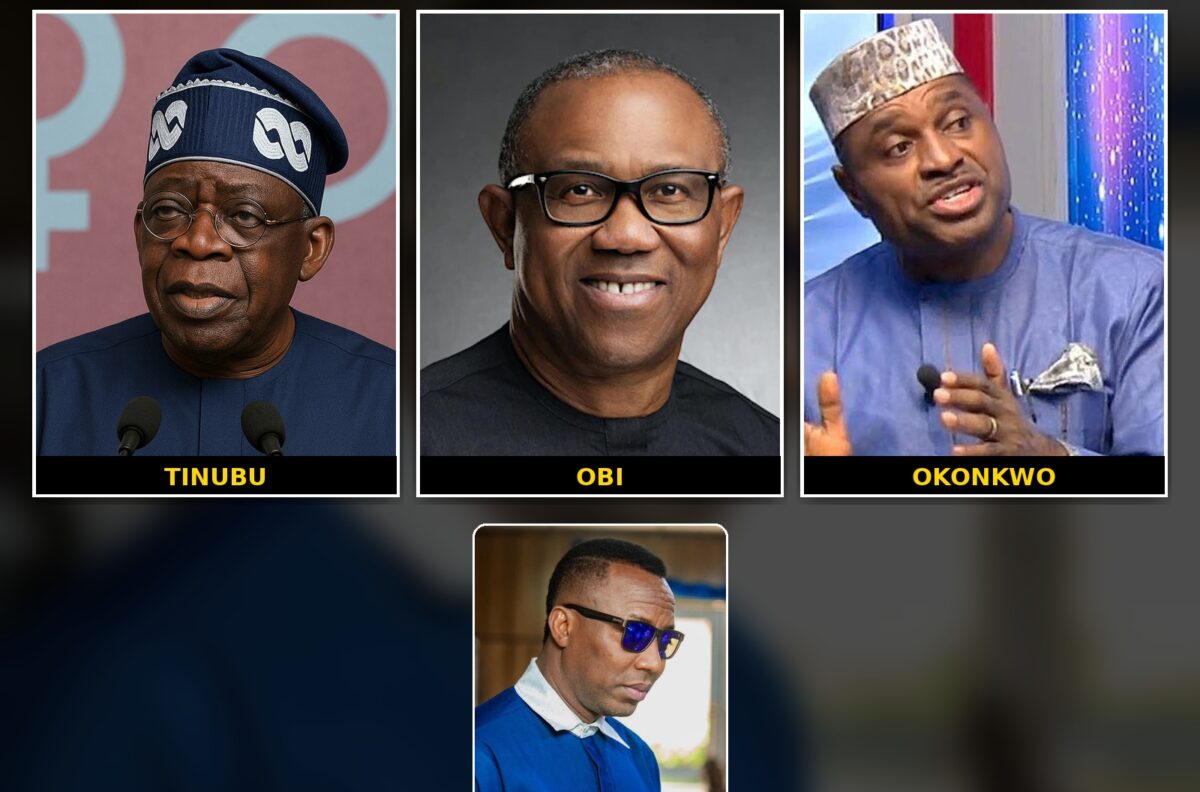
Kenneth Okonkwo’s latest description of Peter Obi as a “content creator” may look like another ordinary political exchange on social media. But it points to a larger problem in Nigeria’s political culture: political name-calling in Nigeria has increasingly become a substitute for political argument.
The irony is difficult to miss. Politicians seeking the highest offices in the country spend enormous energy telling Nigerians what is wrong with their opponents, but far less time explaining what they themselves would do differently.
And this is not peculiar to one political camp.
From “content creator” to “political conman”
Okonkwo knows Obi particularly well. He was once one of the former Anambra governor’s prominent defenders and served as a spokesperson during the 2023 presidential campaign.
Their relationship has since collapsed spectacularly.
In June 2026, Okonkwo accused Obi and some NDC leaders of demanding ₦10 million from House of Representatives aspirants for party tickets. Obi rejected the allegation and threatened legal action. He eventually filed an ₦8 billion defamation suit against Okonkwo at the Anambra State High Court.
The controversy did not end there. Okonkwo has also described Obi and Rabiu Kwankwaso as “political conmen” over their political decisions. He has maintained that he stands by his criticisms despite the lawsuit.
Now comes the “content creator” description.
But should Nigerians really be surprised?
This is the same political environment in which President Bola Tinubu’s media aide, Bayo Onanuga, has repeatedly engaged Obi publicly. In May, Onanuga described Obi as a “Gbajue politician of this era” while attacking his political strategy.
There have been other labels and personal attacks from the wider political ecosystem. Some supporters of the ruling party have dismissed Obi’s movement as nothing more than an online phenomenon. Yet the once-mocked “four people tweeting in a room” helped produce a movement that became a major force in the 2023 election.
So, what exactly are Nigerian politicians trying to prove?
The problem would be dishonest if it were presented as an APC problem alone.
Obi’s supporters and political allies have also engaged in aggressive rhetoric against Tinubu and his government although Obi has consistently distanced himself from such politics. Former
Then there is Omoyele Sowore.
Sowore’s political language has often been deliberately confrontational. In 2025, he described Tinubu as a “criminal” in a social media post, leading to a cybercrime case against him. The matter was still before the courts in 2026.
Sowore has also attacked Obi, accusing him of “gaslighting” Nigerians over the 2012 fuel subsidy protests.
None of these examples means criticism should be prohibited. Politicians must be questioned, challenged and held accountable.
The problem begins when attacking the person becomes easier than interrogating the policy.
Why is name-calling so attractive?
There is actually a reason this style of politics thrives online.
Research published in Acta Politica in August 2026 found that personal and uncivil political negativity generated more engagement than policy-based or civil criticism. Another study found that negative emotional content can predict higher engagement on social media.
In other words, “your economic policy is ineffective because…” may generate less attention than “you are a fraud”.
That creates an incentive for politicians and their supporters.
An insult can trend.
A policy document may not.
But a democracy cannot be governed by trends.
Where is the competition of capacity?
Imagine if the 2027 political conversation were dominated by questions such as:
Who has the better plan for electricity?
Who can create productive jobs?
Who understands Nigeria’s education crisis?
Who has the clearest security strategy?
Who can reform the civil service?
Who has demonstrated competence with public money?
Who has built institutions that survived their tenure?
Those are the questions Nigerians should be asking.
Instead, political timelines are increasingly filled with arguments over who is a fraud, who is a content creator, who is clueless, who is selfish, who is a criminal and who is incapable of winning an election.
This is not political accountability.
It is political theatre.
The bitter politics may outlive the politicians
The danger is that political name-calling does more than embarrass politicians.
It trains citizens to defend personalities rather than principles.
Once a voter becomes emotionally invested in a politician, criticism of that politician begins to feel like an attack on the voter. The result is a political culture where evidence matters less than loyalty.
That is how a country can have millions of people arguing passionately about politicians while having remarkably little conversation about governance.
Nigeria does not need politicians who are incapable of fighting.
It needs politicians capable of fighting over ideas.
There is nothing wrong with exposing corruption, incompetence, hypocrisy or failed leadership. But allegations should be supported with evidence, while political opponents should be challenged on records, policies and capacity.
The question Nigerians should therefore keep asking every political camp is simple:
If your candidate is truly better, why not prove it with capacity instead of insults?
Because if winning requires destroying the reputation of everyone standing in the way, then perhaps the political class has forgotten the real purpose of winning in the first place.