

Could Russia strike NATO next? Secret drone bases fuel fresh warning

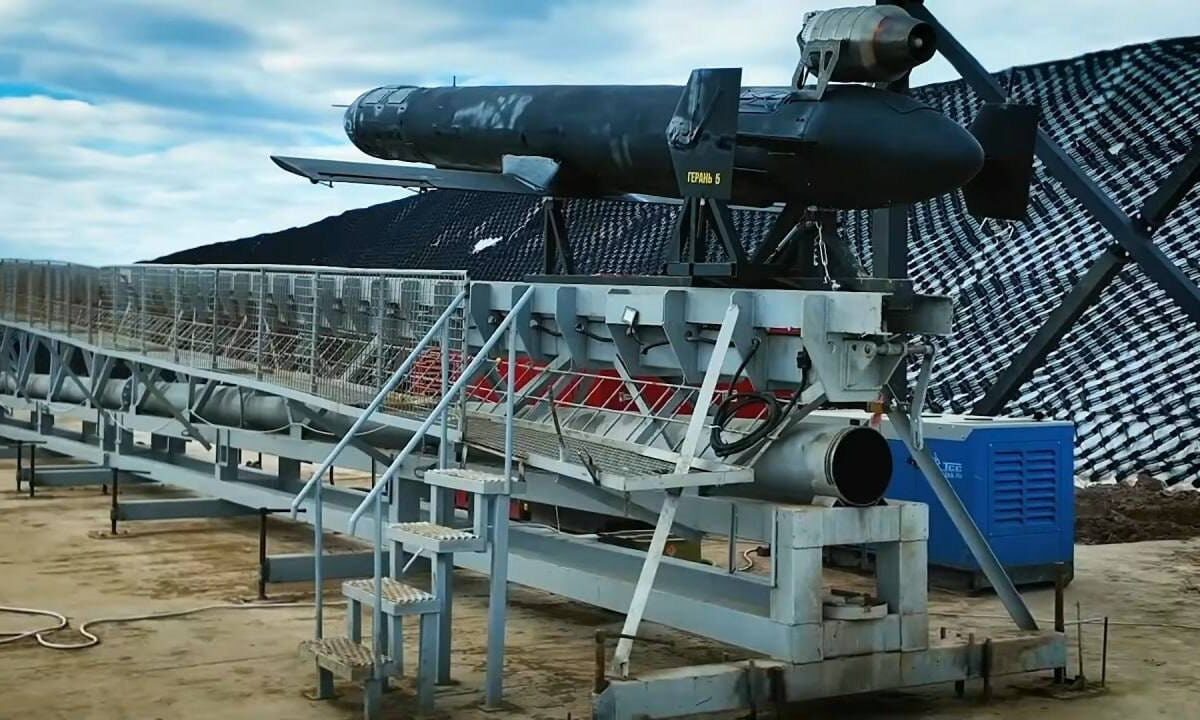
A Russian Geran-5 in a launch demonstration video from Russian state media. CREDIT: Brady Africk
Russia has reportedly expanded a network of secret drone launch sites near its borders with Ukraine and Belarus, raising fresh concerns about the ability of Moscow to conduct long-range drone operations close to NATO territory.
An investigation cited by Newsweek says at least 10 Russian sites have been equipped with new launch infrastructure capable of deploying advanced long-range drones. The findings come as NATO countries continue to monitor the risk of the Russia-Ukraine war spilling over into alliance territory.
The reported expansion does not establish that Russia is preparing to attack NATO. However, the location and capabilities of the sites have intensified questions about Europe’s air defenses and how the alliance would respond to future drone incursions.
Recent developments have added to those concerns. On August 16, a suspected Russian drone entered Romanian airspace and was shot down by a Spanish F-18 operating on a NATO air-policing mission, according to Reuters.
Russia Reportedly Builds 10 New Drone Bases
According to the investigation referenced by Newsweek, Russia has established at least 10 locations along its borders with Belarus and Ukraine where new drone-launch infrastructure has been installed.
A separate report based on The Telegraph’s investigation identified 59 launch rails across the sites, with around 20 described as longer rails potentially designed for newer long-range, jet-powered drones.
The facilities reportedly include converted military installations, airports and sites in remote areas. Some are already being used as part of Russia’s drone campaign against Ukraine.
The launch rails are significant because they allow fixed-wing drones to be launched without relying on conventional runways. Their deployment could allow Russia to position large numbers of drones closer to potential targets and increase the frequency of attacks.
Advanced Russian Drones Could Reach Deeper Into Europe
The reported infrastructure expansion coincides with the development of newer Russian drone variants designed to travel farther and operate at higher speeds.
The Newsweek report cited estimates that the Geran-5 could travel approximately 1,000 kilometres, or more than 600 miles. From Russian territory near Ukraine or Belarus, that range could potentially put parts of NATO’s eastern flank within reach.
A separate account of the investigation said some launch locations could place Warsaw within the potential range of newer Russian drones. However, the reporting also stressed that there is no evidence that Russia is preparing an attack on Poland.
The distinction is important. A drone’s theoretical range does not mean an attack is planned or that a particular target will be attacked.
NATO Airspace Incursions Add to the Concern
The reported Russian drone infrastructure comes as NATO countries face an increasing number of incidents involving unmanned aircraft crossing or approaching alliance airspace.
On Sunday, Romania said a drone entered its airspace from neighbouring Moldova after overnight Russian attacks on Ukraine. A Spanish F-18 operating under NATO’s air-policing mission shot down the drone over an unpopulated area, while a NATO military spokesperson said it appeared to be Russian.
The incident was reportedly the fourth drone incursion into Romanian territory since Russia’s full-scale invasion of Ukraine began in 2022.
NATO officials are investigating whether such incidents are accidental consequences of the war, caused by electronic warfare or deliberate attempts to test the alliance’s defenses.
READ ALSO
Why is Trump threatening Oman? Strait of Hormuz talks put Gulf State in spotlight
Russia’s Drone Warfare Has Changed the Security Picture
The war in Ukraine has transformed the role of drones in modern warfare. Russia has used large numbers of Iranian-designed Shahed drones, alongside domestically produced variants such as the Geran-2, while both sides have continued developing longer-range systems.
The expansion of Russian drone production and launch infrastructure has created a new challenge for European militaries. NATO members must defend against drones that can be relatively inexpensive to deploy while potentially requiring expensive fighter aircraft or air-defense missiles to intercept.
The recent Romanian incident illustrates the problem. NATO jets were used to intercept a drone, while the alliance and individual member states are also working to expand ground-based air-defense and counter-drone capabilities.
Russia Accused of Testing NATO Defenses
The concerns extend beyond the physical damage that drones can cause. Military officials have warned that repeated incursions could allow Russia to study how NATO responds.
Germany’s top military officer, General Carsten Breuer, recently said Russia was using drones and other hybrid tactics to test the alliance’s reactions and identify weaknesses.
Hybrid warfare can include activities that fall below the threshold of conventional war, including cyberattacks, disinformation, sabotage and attacks against vulnerable infrastructure.
NATO has warned about Russian hybrid activities for years, while officials have generally considered a full-scale Russian attack against the alliance unlikely.
Is Russia Preparing to Attack NATO?
The reported construction of drone bases has triggered renewed speculation about the possibility of a Russian attack on NATO, but the evidence presented in the reports does not prove that Moscow is preparing an invasion or direct strike against alliance territory.
Russia has repeatedly rejected claims that it intends to attack NATO countries.
The immediate concern is instead the combination of expanding Russian drone capabilities, the proximity of some launch sites to NATO territory and the growing number of airspace incidents linked to the war in Ukraine.
NATO countries are responding by strengthening air defenses, increasing surveillance and conducting military exercises designed to prepare for a range of possible scenarios.
Europe Watches Russia’s Drone Expansion Closely
The reported Russian drone bases add another layer to Europe’s increasingly complex security environment. The war in Ukraine has already produced repeated incidents near NATO borders, while Russia’s expanding drone capabilities are forcing European governments to rethink how they protect their airspace.
For NATO, the challenge is not simply whether a Russian drone could reach alliance territory. It is also how quickly and proportionately the alliance can detect, identify and respond to an incursion without allowing individual incidents to trigger a wider confrontation.
For now, there is no confirmed evidence that Russia is planning an attack on NATO territory. But the reported expansion of its long-range drone infrastructure, combined with recent airspace incidents, is likely to keep the alliance on heightened alert.
FAQ
1. Has Russia built secret drone bases that could target NATO?
According to the Newsweek report, Russia has established at least 10 sites capable of launching long-range drones that could potentially reach NATO territory. The report says analysts at intelligence firm DroneSec identified new launch infrastructure through satellite imagery.
2. Where are Russia’s alleged new drone launch sites?
The reported sites are located along Russia’s borders with Belarus and Ukraine. Newsweek says they include remote countryside locations as well as military bases and airports.
3. How many Russian drone launch rails have reportedly been identified?
The report says Russia has installed dozens of new launch rails, with at least 20 reportedly capable of launching some of its more advanced long-range attack drones.
4. Could Russian drones reach NATO territory?
According to the report, some newer Russian drones have sufficient range to potentially reach areas of NATO territory from launch positions close to Ukraine or Belarus. The report cites estimates that the Geran-5 can travel about 1,000 kilometres, or more than 600 miles.
5. What is the Geran-5 drone?
The Geran-5 is described in the supplied report as a more advanced Russian attack drone with a reported range of around 1,000 kilometres. Ukrainian intelligence says Russia is increasing production of upgraded Geran drone variants.
6. What are Geran-4 and Geran-5 drones?
The Newsweek report identifies the Geran-4 and Geran-5 as upgraded Russian attack drones. It says Russian industry is reportedly producing about 3,000 upgraded Geran-4 and Geran-5 drones per month, citing Ukrainian military intelligence.
7. Are Russian drones already entering NATO airspace?
The report says drones and missiles have repeatedly breached NATO airspace since Russia launched its full-scale invasion of Ukraine in February 2022. It also says these incidents have sometimes prompted NATO countries to scramble fighter aircraft.
8. What happened when Russian drones entered Poland?
Newsweek reports that at least 20 drones crossed into Poland in September 2025. NATO officials accused Russia of testing the alliance’s response to an attack.
9. Did a Russian missile recently crash in Poland?
According to the supplied Newsweek report, a Russian cruise missile crashed in eastern Poland the previous month, close to the country’s border with Ukraine. The incident contributed to concerns about the vulnerability of NATO’s eastern flank.
10. Is Russia planning to attack NATO?
Russia has repeatedly denied that it plans to attack NATO territory, describing such claims as “nonsense,” according to the supplied report. The report says NATO considers a large-scale Russian attack on the alliance highly unlikely.
11. Could Russia launch a limited attack on NATO?
The report says some alliance officials have warned that Russia could potentially attempt a limited or probing operation against NATO territory rather than launch a large-scale invasion.
The report specifically mentions the possibility of an operation involving one of the Baltic states or Poland.
12. When could Russia potentially attack NATO?
The Newsweek report cites earlier reporting that Russia could attempt a limited operation against NATO territory or intensify hybrid attacks as early as September 2026. This is presented as an intelligence assessment and warning, not confirmation that an attack has been planned.
13. What is Russia’s hybrid war against NATO?
A hybrid war refers to activities that can undermine or pressure another country without conventional open warfare. The report says this can include cyberattacks, information campaigns, arson and attacks against vulnerable infrastructure such as undersea cables.
14. Is Russia already conducting hybrid attacks against NATO?
The report says NATO believes Russia has been conducting a hybrid campaign against the alliance for years. Germany’s senior military officer, General Carsten Breuer, was quoted as saying hybrid attacks are taking place every day in NATO countries.
15. Why are Russian drones important in the NATO-Russia confrontation?
The report says Russia’s expanding drone capabilities could allow Moscow to launch larger numbers of drones while making them more difficult to intercept. Drone warfare has also become a major feature of the war in Ukraine, giving NATO countries an opportunity to study Russian tactics and technology.
16. How has the Ukraine war changed drone warfare?
The supplied report describes the war in Ukraine as a major testing ground for drone technology. Russia and Ukraine have competed to improve the range, speed, production and effectiveness of unmanned systems.
17. What are Shahed drones?
The report says Russia is known for using Iranian-designed Shahed drones against Ukraine, including a domestically produced Russian version known as the Geran-2.
18. Why are Poland and the Baltic states particularly important to NATO?
The supplied report identifies Poland and the Baltic states as possible areas of concern in scenarios involving a limited Russian military operation against NATO. It says NATO countries are also conducting exercises to prepare for potential Russian military action in the Baltic region.
19. Is NATO preparing for a Russian invasion?
According to the report, NATO countries are rehearsing how they would respond if Russian forces entered a Baltic state. However, the report also stresses that the alliance considers a large-scale Russian attack on NATO highly unlikely.
20. What is NATO’s eastern flank?
NATO’s eastern flank refers broadly to member states located on the alliance’s eastern side, closer to Russia and the war in Ukraine. These countries have received particular attention because of their proximity to Russia and the potential for spillover from the conflict.
21. What does Russia say about the NATO attack warnings?
Russia has rejected claims that it is preparing to attack NATO territory. According to Newsweek, Moscow has described such claims as “nonsense.”
22. Why are Russia’s new drone bases causing concern?
The reported expansion of launch infrastructure could allow Russia to deploy larger numbers of long-range drones from positions closer to NATO territory. Analysts cited in the report say the development could increase Moscow’s ability to launch drones while making interception more difficult.
23. Could Russian drones reach Poland?
The report says the range of some newer Russian drones could potentially place NATO territory within reach when the drones are launched from Russian positions near Ukraine or Belarus. It specifically discusses the potential range of the Geran-5.
24. Is NATO at war with Russia?
The supplied report does not state that NATO and Russia are formally at war. Instead, it describes increasing tensions, airspace incidents, hybrid attacks and preparations for possible future scenarios involving the alliance and Russia.
25. What happens if Russia attacks a NATO member?
The supplied article does not provide a detailed explanation of NATO’s formal response mechanisms. It does say NATO countries are rehearsing potential responses to a Russian military operation against a Baltic state.
26. Why is Russia building more long-range drones?
The report links Russia’s expanding drone infrastructure to the evolution of drone warfare during the Ukraine conflict. The expansion could allow Russia to launch greater numbers of drones and use systems with longer ranges and improved capabilities.
27. What is the latest NATO news about Russia?
The latest development highlighted by Newsweek is a report that Russia has established at least 10 drone launch sites potentially capable of striking NATO territory, amid warnings about a possible limited Russian attack or increased hybrid activity.
28. Should people be worried about a Russia-NATO war?
The supplied report describes heightened security concerns but also notes that NATO considers a large-scale Russian attack highly unlikely. The possibility of limited or hybrid operations remains part of the warnings discussed in the article.
29. What does Russia’s drone expansion mean for European security?
The reported expansion could increase pressure on NATO’s eastern members and force European countries to strengthen air defenses, drone detection and counter-drone capabilities. The report presents the development as part of the broader transformation of warfare since Russia’s invasion of Ukraine.
30. What should NATO countries expect next?
The report suggests NATO countries will continue monitoring Russian drone capabilities, strengthening defenses and conducting military exercises. The immediate risk remains uncertain, with the article emphasizing that a large-scale attack on NATO is considered unlikely while limited and hybrid threats remain a concern.