
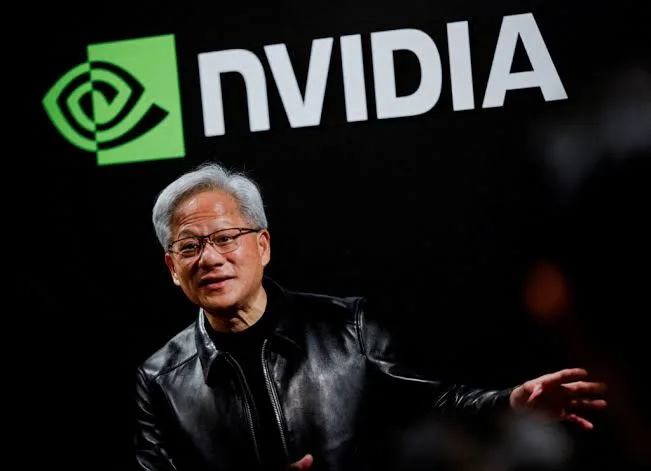
Nvidia shares surged by about 33% on Monday, November 23, after the company’s board reinstated co-founder Jensen Huang as president and chief executive. His return reversed a leadership crisis that had unsettled investors and triggered a sharp sell-off in technology stocks.
The chipmaker’s shares rallied after its board unanimously approved Huang’s return with immediate effect. The announcement followed 11 days of uncertainty over the company’s leadership and the future of its artificial intelligence business.
According to Reuters, the stock’s surge added about $900 billion to Nvidia’s market value during trading.
The Nasdaq also gained more than 6%, while the S&P 500 rose about 5%. Other technology and semiconductor companies recorded gains as investors welcomed the leadership change.
The rally followed a difficult period for Nvidia. Huang’s departure had raised concerns about the company’s dependence on its co-founder and its position in the global AI industry.
Why did Nvidia shares rise after Huang’s return?
Investors reacted positively because Huang has played a central role in Nvidia’s growth and business strategy.
He co-founded the company in 1993 and led its transformation from a graphics chip manufacturer into a major supplier of artificial intelligence processors.
Nvidia’s chips now power data centres and computing systems used by leading technology companies. These processors support the development and operation of advanced AI models.
Huang also maintains important relationships with customers, technology partners and policymakers. His influence extends beyond the company’s engineering operations.
His resignation therefore raised questions about whether another executive could maintain the same direction and industry relationships.
The board’s decision to bring him back appeared to restore confidence among investors who feared a prolonged leadership crisis.
Read also: Jensen Huang Resigns: How Two Alleged Affairs Cost Nvidia’s CEO His Job
How did Jensen Huang leave Nvidia and return?
Huang’s leadership crisis began after reports emerged about his alleged relationships with two women.
One report linked him to Alice Huang, a Singapore-based businesswoman whom US officials reportedly suspected of working for Chinese intelligence.
A separate report alleged that he had an inappropriate relationship with a Nvidia employee.
Huang admitted to having an affair outside his marriage but did not admit to participating in espionage. The allegations against Alice Huang also remain unproven.
Nvidia’s board initially launched an independent investigation. Huang resigned on November 12, and the company appointed its Chief Financial Officer, Colette Kress, as interim CEO.
However, support for his return grew in the following days.
US President Donald Trump publicly backed Huang’s reinstatement and said the government had no reason to believe his return posed a national security risk.
On November 23, Nvidia announced that its board had voted unanimously to restore him as president, CEO and board director.
Read also: Colette Kress: 7 Things to Know About Nvidia’s Interim CEO
Nvidia’s investigation will continue despite his return
Huang’s reinstatement does not end the controversy surrounding his departure.
In its official announcement filed with the US Securities and Exchange Commission, Nvidia said its independent directors would continue investigating reports that Huang had been targeted by a foreign intelligence effort.
The company also confirmed two additional governance measures.
First, it has established a National Security and Export Control Committee made up entirely of independent directors. The committee will oversee trade compliance and national security risks.
Second, Nvidia will recruit a Chief Compliance Officer to supervise compliance across the company. The new officer will report to the board’s Nominating and Corporate Governance Committee.
Nvidia also said it would continue cooperating with ongoing government investigations and inquiries.
These steps show that the company still faces questions about corporate governance, national security and its handling of sensitive technology.
Does the share-price rally mean Nvidia has recovered?
Not necessarily.
Although the 33% surge represented a major rebound, it followed a difficult period for the company and the wider technology market.
Nvidia’s shares had suffered heavy losses after Huang’s departure. The stock also faced pressure from concerns about the sustainability of AI investment and tighter scrutiny of advanced chip exports to China.
The Monday rally restored part of the lost market value, but it did not resolve those wider concerns.
Investors must still consider whether Nvidia can maintain its growth, manage regulatory pressures and meet demand for its AI processors.
Read also: Nvidia’s $500 Billion AI Chip Bookings: What the US Supercomputer Deals Mean
Huang’s return has restored a familiar leader to the world’s most influential AI chipmaker. However, Nvidia must still demonstrate that its business can withstand regulatory scrutiny and the changing demands of the global AI market.