

Nigerian Navy Warns of Fake Recruitment: How to Spot Genuine Government Jobs

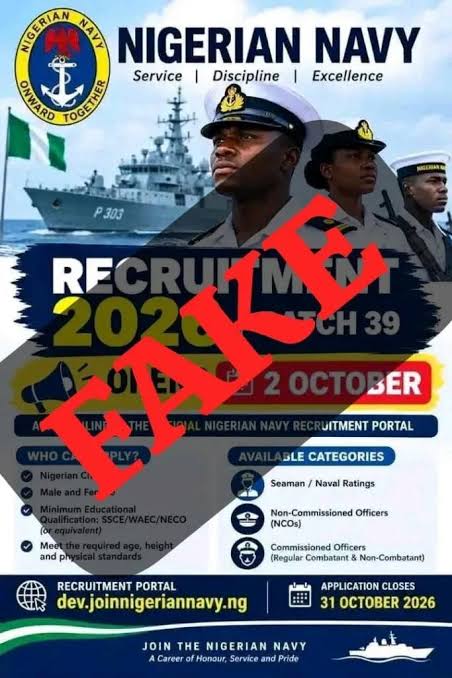
A recruitment notice can spread across WhatsApp, Facebook, X and other social media platforms within hours, but its popularity does not make it genuine.
The Nigerian Navy recently warned Nigerians about a fake notice claiming that its 2026 Batch 39 recruitment exercise was ongoing, highlighting a problem that continues to affect people searching for government jobs.
The Navy said the circulating notice was not authorised or published by the service and advised prospective applicants to ignore recruitment information coming from unofficial sources. It also reminded the public that its recruitment exercise is free and that no third party is authorised to collect money from applicants.
For Nigerians looking for jobs in government agencies, the incident raises an important question: how can you tell whether a recruitment notice is genuine before applying, sharing your personal information or paying money?
Here are some things to check.
1. Check the agency’s official website
The first step is to go directly to the website of the government agency named in the recruitment notice.
Do not rely only on the link contained in a WhatsApp message, Facebook post or forwarded social media publication.
The Nigerian Navy specifically identified its official recruitment website as joinnigeriannavy.navy.mil.ng and its main website as navy.mil.ng. It said legitimate recruitment information, including eligibility requirements, application timelines and procedures, would be published through its official communication channels.
This distinction matters because scammers can create websites that use names, colours, logos and language resembling those of government institutions.
The Federal Civil Service Commission has similarly advised applicants to verify recruitment announcements through its official website and authorised communication channels before clicking links or submitting personal information.
2. Don’t assume a social media post is official
A recruitment announcement may appear on social media, but applicants should establish whether the account that posted it actually belongs to the government agency.
A post carrying a government logo is not enough evidence that it is genuine.
The Nigerian Navy said prospective applicants should ignore recruitment information from unofficial websites, social media accounts and other channels not recognised by the service.
Government agencies can use social media to communicate with the public, but the safest approach is to cross-check an announcement against the agency’s official website or another recognised government channel.
3. Check the recruitment portal before entering your details
One of the biggest warning signs is a recruitment link that cannot be traced back to an official government announcement.
The Federal Civil Service Commission recently warned Nigerians against clicking on or submitting personal information through unsolicited recruitment links shared by individuals, WhatsApp groups, social media accounts and unofficial websites.
Applicants should therefore avoid entering information such as identification details, bank information or other sensitive data into an unfamiliar website simply because it claims to be a government recruitment portal.
The Universal Basic Education Commission has also warned about a fake 2026/2027 recruitment website and said the platform circulating the false notice was a phishing site unrelated to the commission. UBEC said its authentic recruitment information would be published on its official website and verified social media platforms.
4. Be suspicious if someone asks for payment
A request for money should immediately prompt further verification.
The Nigerian Navy said its recruitment exercise is free of charge and that no third party is authorised to recruit applicants or collect recruitment fees on its behalf.
The Federal Civil Service Commission has also warned applicants against people demanding money for recruitment forms, shortlisting, appointment letters or preferential treatment. The commission said recruitment into the Federal Civil Service is not conducted through private agents or middlemen who claim they can secure employment.
This means job seekers should be particularly cautious when someone promises to “help” them secure a government position in exchange for money.
5. Look for the official recruitment requirements
A genuine recruitment exercise should provide clear information about who can apply and how the application will be conducted.
Applicants should look for details such as:
- Available positions
- Educational qualifications
- Age requirements, where applicable
- Other eligibility conditions
- Application procedure
- Opening and closing dates
- Official application portal
- Contact or help-desk information
The Federal Civil Service Commission says applicants should carefully read official vacancy announcements for the positions, qualifications, eligibility requirements, application procedure and closing date before applying.
If a message simply says “government recruitment is ongoing” and directs applicants to an unfamiliar link without verifiable details, it should not be treated as genuine until confirmed.
6. Cross-check the information with another official source
When in doubt, do not rely on the person who sent you the announcement to confirm whether it is genuine.
Go directly to the government agency involved.
For example, if a recruitment message claims to be from a ministry or agency, search for the institution’s official website and check its latest announcements.
The Federal Civil Service Commission has advised applicants to seek clarification directly from the commission through its official website and authorised communication channels where they are uncertain about a recruitment announcement.
This is particularly important when a recruitment message is spreading rapidly on social media.
7. Check whether the government agency has actually announced recruitment
Not every government agency is recruiting at all times.
This may sound obvious, but it is one of the easiest things for scammers to exploit.
The Office of the Head of the Civil Service of the Federation has previously warned that false online publications claiming to advertise federal government employment opportunities were not genuine and said legitimate federal employment opportunities would be published through official government websites and portals.
The Police Service Commission has similarly warned Nigerians about fake recruitment portals and said genuine recruitment exercises would be announced through its official channels, including its website and press releases.
Therefore, before filling out a form, first establish whether the agency has actually announced an ongoing recruitment exercise.
What Nigerians should do before applying
A simple verification process can help job seekers avoid many recruitment scams.
First, identify the government agency named in the announcement.
Second, visit the agency’s official website independently instead of clicking the forwarded link.
Third, check its latest news, press releases or recruitment section for the same announcement.
Fourth, verify that the application portal is the one specified by the agency.
Fifth, check whether the agency says the application is free or whether any legitimate fees are involved.
Finally, do not submit sensitive information or make payments until the recruitment exercise has been independently verified.
A government logo does not make a recruitment notice genuine
One of the biggest mistakes job seekers can make is judging an announcement by its appearance.
A fake recruitment notice can contain an agency’s logo, official-looking photographs, names of government officials and convincing language.
That does not establish that the agency published it.
The Federal Civil Service Commission has specifically advised Nigerians not to assume that a recruitment message is genuine merely because it carries the commission’s name, logo or purported branding.
The same principle applies to other government agencies.
The Nigerian Navy’s latest warning is therefore a reminder to job seekers that verification should come before application.
FAQ
How can I know if a government recruitment notice is genuine?
Check the government agency’s official website and verified communication channels. Confirm that the same recruitment announcement appears there before applying.
Can I trust government recruitment messages shared on WhatsApp?
Do not assume they are genuine simply because they were shared on WhatsApp. Cross-check the information with the relevant agency’s official website or authorised channels.
Do government recruitment exercises require payment?
This depends on the particular exercise and agency, but applicants should be highly cautious about individuals demanding money to secure government employment. The Nigerian Navy, for example, says its recruitment exercise is free and does not authorise third parties to collect recruitment fees.
What should I do if I find a suspicious recruitment portal?
Do not submit personal information or make payments. Verify the claim directly with the government agency concerned and follow its guidance on reporting suspicious information.
Is a recruitment notice genuine if it carries a government logo?
Not necessarily. Government agencies have warned that fraudulent recruitment notices can use official names, logos and branding. Applicants should verify the announcement through the agency’s recognised official channels.