

FG’s ₦70,000 transport support is temporary


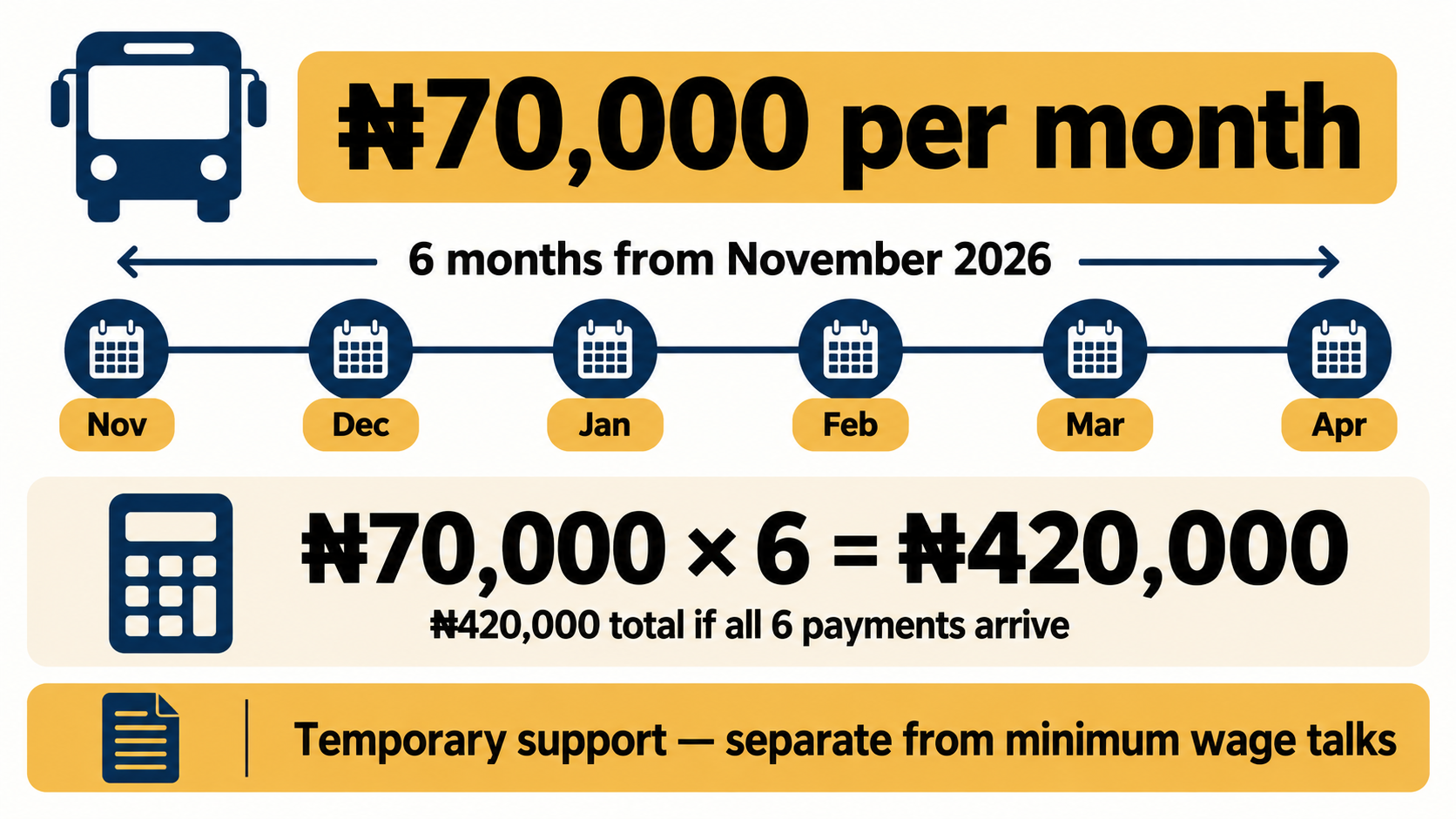
Illustration: Crisp Nigeria.
The Federal Government and Nigeria Labour Congress (NLC) agreed on October 27 to a ₦70,000 transport support intervention for public-service workers for six months, starting in November. The agreement also urges state and local governments to join, which means the federal deal alone does not confirm that every public worker in Nigeria will receive it. The key questions are who is covered, how the money will reach them and whether a temporary payment is enough to meet labour’s demand for higher wages, according to the Labour Ministry statement.
Recent coverage describes the ₦70,000 transport support as a monthly payment, although the Ministry statement does not set the exact payment date within each month. That still makes it different from a change to a worker’s basic salary. See the monthly payment report. That distinction affects what staff can expect after the six-month period and how the policy applies beyond federal payrolls.
Who is covered by the ₦70,000 transport support?
The October 27 memorandum sets out an undertaking by the Federal Government after a conciliation meeting with the NLC in Abuja. It describes a ₦70,000 transport intervention “across all levels” for six months from November. In the same resolutions, the parties urge state and local governments to “key into” the process and encourage unions to push for implementation at their levels.
That wording leaves an important distinction. The federal government has agreed to the measure with the NLC; the statement asks subnational governments to participate, rather than confirming that they have adopted it. A state or local employee should therefore check for a circular from their own employer or a communication from their union before counting on the payment.
The published resolution also does not set out a complete list of eligible grades, payroll categories or employment arrangements. “Across all levels” signals breadth within the agreement, but the public text leaves the detailed administrative rules for later clarification.
How the transport support differs from a salary increase
News reports describe the intervention as ₦70,000 a month. If six monthly payments are made in full, that would add up to ₦420,000 over the period. This is a simple total of the announced amount and duration, not a revised annual salary or a promise that the payment will continue after April 2027.
The distinction matters because the same meeting did not settle when a new national minimum wage should take effect. The parties agreed to establish a Minimum Wage Negotiation Committee and start work immediately, but recorded a disagreement on the implementation date. That process is separate from the transport intervention and from the earlier wage proposal discussed by public-sector unions.
The memorandum also covers other payments, each with its own timetable: peculiar-allowance arrears are to be paid in three equal instalments starting in November, while 19 months of health-worker allowance arrears are to be cleared within three months from December. Those commitments are not part of the six-month transport calculation, and the statement gives no total for the arrears.
Why TUC and NLC disagree
The Trade Union Congress (TUC) rejected the temporary transport measure on October 28 and called for an immediate increase in salaries instead. In a statement signed by President Festus Osifo and Secretary-General Nuhu Toro, the congress argued that temporary wage awards are not far-reaching and pointed to its account of incomplete payments under the 2023 award. Those are the TUC’s stated reasons for opposing the proposal, set out in its TUC rejection.
On October 29, NLC President Joe Ajaero said the NLC negotiated without the TUC and questioned why the other congress was challenging an agreement it did not sign. He also said any salary increase required a formal process. The exchange shows that the two labour centres differ both on the form of relief and on who can speak for workers in this negotiation, as reported in the NLC response.
What we don’t know yet
The public agreement does not specify the exact payment dates, the payroll process or which employer will resolve a missed instalment. It also leaves open how many states and local governments will opt in, and on what terms. The government has not published a beneficiary count or a costed implementation schedule in the resolution.
Both sides agreed to meet again after one month to review progress, but the memorandum gives no calendar date for that review. The first practical check for federal employees is a November circular or payslip entry from their employer; state and local employees can ask their payroll office or union whether their government has formally joined the intervention.
Sources: Labour Ministry statement; TUC statement; NLC response.