

Labor day 2026: The surprising history behind America’s day for workers

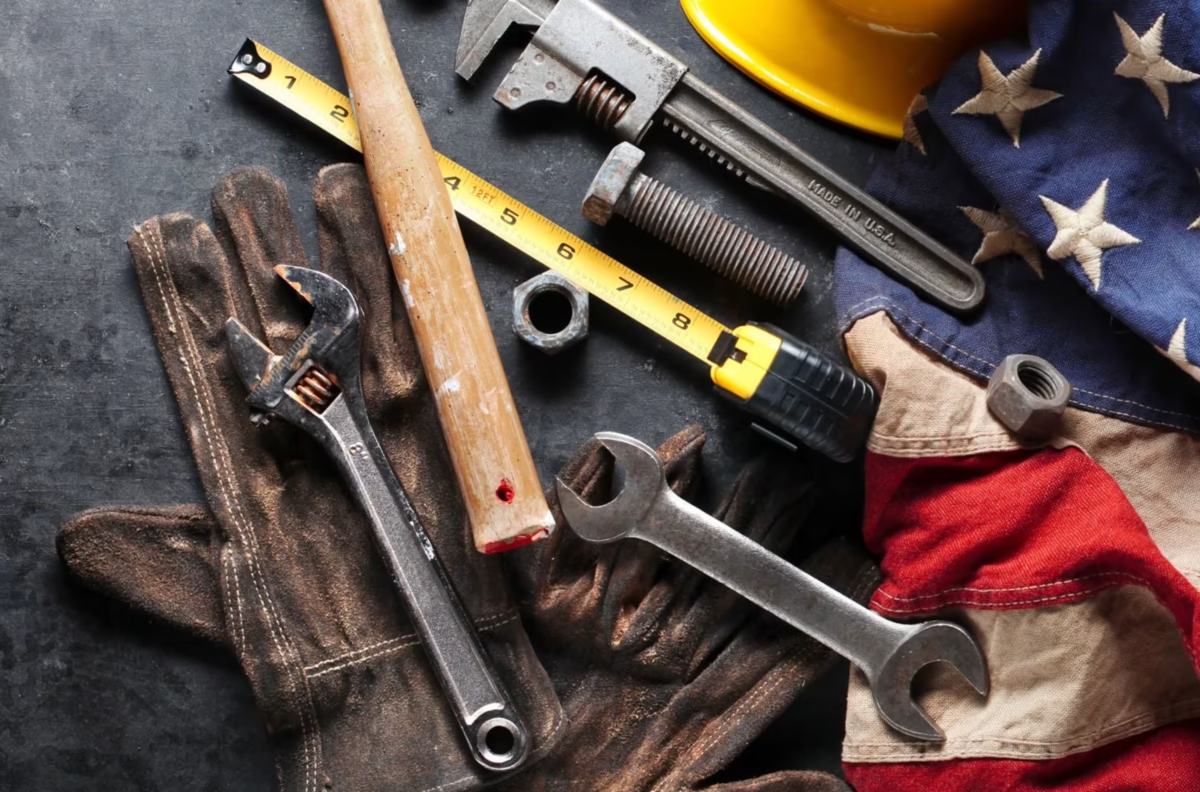
Labor day 2026. Credit: Silver V/Getty Images
Labor Day is often treated as the unofficial end of summer in the United States, marked by barbecues, parades, travel and a long weekend. But the federal holiday has a much more complicated history, one rooted in organized labor, competing claims over who created it and a push to recognize the growing power of American workers.
Observed on the first Monday in September, Labor Day became a national holiday in 1894. Its origins, however, go back more than a decade earlier, when workers and labor organizations began demanding a day that would celebrate their contributions to the country’s economic and social development.
The story also contains a mystery that has never been completely settled: Who actually founded Labor Day?
When Is Labor Day 2026?
Labor Day 2026 will be observed on Monday, September 7.
The federal holiday is held on the first Monday of September every year. Federal recognition dates to June 28, 1894, when Congress passed legislation establishing Labor Day as a legal holiday and President Grover Cleveland signed it.
By the time the federal government acted, the holiday had already spread across much of the country.
The First Labor Day Was Held in New York
The first recorded Labor Day celebration took place in New York City on September 5, 1882.
The Central Labor Union organized the event at a time when American workers were increasingly organizing around wages, working conditions and their place in a rapidly industrializing economy.
The day’s format was strikingly similar to modern Labor Day celebrations. Workers participated in a street parade designed to demonstrate the strength and unity of labor organizations before gathering for a festival focused on recreation and family entertainment.
It was not initially a federal holiday. It was a movement organized from the ground up.
The Central Labor Union held another Labor Day celebration on September 5, 1883, helping establish the event as an annual tradition.
Who Invented Labor Day? The Answer Is More Complicated Than You Think
The question of who founded Labor Day has produced a long-running historical dispute involving two labor leaders: Peter J. McGuire and Matthew Maguire.
Peter McGuire, a prominent carpenter and co-founder of the American Federation of Labor, has traditionally received much of the credit. Historical records indicate that he proposed setting aside a day for workers in 1882.
But Matthew Maguire, a machinist who served as secretary of the Central Labor Union in New York, has an equally important claim.
Recent historical research has strengthened the case that Matthew Maguire proposed the holiday while serving with the Central Labor Union. A New Jersey historical account even pointed to a contemporary newspaper editorial describing Maguire as the undisputed author of Labor Day as a holiday.
Both men were present at the first Labor Day parade in New York.
That means the familiar story of a single person inventing the holiday does not fully capture what happened. Labor Day emerged from a broader organizing movement, even as historians continue to debate which man deserves the founder’s title.
How Labor Day Spread Across America
The holiday moved quickly from a local labor celebration into a state-level movement.
Oregon became the first state to officially recognize Labor Day on February 21, 1887. Colorado, Massachusetts, New Jersey and New York followed that year.
By the end of the decade, Connecticut, Nebraska and Pennsylvania had also adopted Labor Day.
The movement continued expanding. By 1894, another 23 states had adopted the holiday.
That growing acceptance helped create the political pressure for federal recognition.
On June 28, 1894, Congress passed legislation making the first Monday in September a national holiday, and President Grover Cleveland signed it into law.
READ ALSO
Gloria Steinem dies at 92: Why the issues she took from Ms. Magazine to the #MeToo Era still matter
Why Was Labor Day Created in September?
The choice of September was connected to the early New York celebrations rather than the date of a particular national labor event.
The first Labor Day was held in September 1882, and the September date became established as the holiday spread.
The decision also separated the American holiday from May 1, or International Workers’ Day, which had become closely associated with labor activism and the international socialist movement.
That distinction gave the American holiday its own identity while still preserving its central purpose: honoring workers and their contribution to the nation’s prosperity.
Labor Day Was Once About Workers, Not Just a Three-Day Weekend
The original Labor Day vision was much closer to a public demonstration of worker solidarity than the modern holiday most Americans recognize.
Early celebrations featured parades, speeches, festivals and gatherings involving workers and their families.
Over time, the holiday developed a stronger civic and economic focus. Prominent speakers began addressing workers’ rights, the economy and the role of labor in American democracy.
The American Federation of Labor later designated the Sunday before Labor Day as Labor Sunday, giving the weekend a spiritual and educational dimension.
The holiday gradually became part of the wider American calendar, but its labor roots never disappeared.
Why Labor Day Still Matters in 2026
More than 130 years after becoming a federal holiday, Labor Day remains tied to questions about wages, workplace protections, union membership and the changing nature of employment.
The U.S. economy looks radically different from the industrial economy of the 1880s. Manufacturing has declined as a share of employment, while technology, healthcare, logistics, professional services and the gig economy have expanded.
Yet the basic issue behind the holiday remains recognizable: how workers contribute to the country’s economic strength and how the benefits of that economic activity are distributed.
That makes Labor Day more than a historical commemoration.
For many Americans, September 7, 2026, will simply mean a day away from work. But the holiday’s original purpose was to make workers themselves visible — not merely the products, services and economic growth their labor produced.
The Labor Day Tradition Nearly Looks Different Today
The holiday’s early organizers imagined Labor Day as a public display of worker unity followed by a celebration.
That basic formula survived remarkably well.
Parades continue in some communities, while family gatherings, outdoor events and end-of-summer celebrations have become dominant traditions elsewhere.
The change reflects how American society has evolved. The original parade was designed partly to demonstrate the collective power of organized labor. Today’s celebrations are often less explicitly political.
Still, the underlying idea remains embedded in the name: Labor Day is about labor.
What Happened on the First Labor Day?
The first Labor Day in New York was not a quiet affair. Workers gathered for a large parade before taking part in a festival.
The event was designed to showcase the strength and unity of trade and labor organizations while giving workers and their families an opportunity to relax and celebrate.
The U.S. Department of Labor notes that the first celebration was almost a disaster, adding another unusual detail to the holiday’s origin story.
What began as a local labor movement eventually became one of America’s most recognizable federal holidays.
Frequently Asked Questions About Labor Day 2026
When is Labor Day 2026?
Labor Day 2026 falls on Monday, September 7. It is observed on the first Monday of September every year.
Why do Americans celebrate Labor Day?
Americans celebrate Labor Day to recognize the social and economic contributions of workers and the American labor movement.
Who created Labor Day?
The founder is disputed. Peter J. McGuire and Matthew Maguire are both credited with proposing the holiday in 1882, with historical research giving significant support to Matthew Maguire’s claim.
When was the first Labor Day?
The first Labor Day celebration took place in New York City on September 5, 1882, organized by the Central Labor Union.
When did Labor Day become a federal holiday?
Labor Day became a national legal holiday in 1894, after Congress passed legislation on June 28 and President Grover Cleveland signed it.
Which state first recognized Labor Day?
Oregon was the first state to officially recognize Labor Day, passing legislation on February 21, 1887.
Is Labor Day a federal holiday?
Yes. Labor Day is a federal holiday in the United States and is observed on the first Monday of September.
Why is Labor Day on Monday?
Congress established Labor Day for the first Monday in September. The Monday placement also creates a three-day weekend for many workers.
Is Labor Day the same as May Day?
No. Labor Day in the United States is observed on the first Monday in September. May Day, or International Workers’ Day, is observed on May 1 and has a separate historical development and international labor tradition.
What is the real meaning of Labor Day?
At its core, Labor Day is a tribute to American workers and the social and economic contributions of labor. Its roots lie in the late 19th-century movement for greater recognition of workers and organized labor.