

Japan earthquake death toll rises to 34 as rescuers race against time after Kumamoto mall collapse and explosion

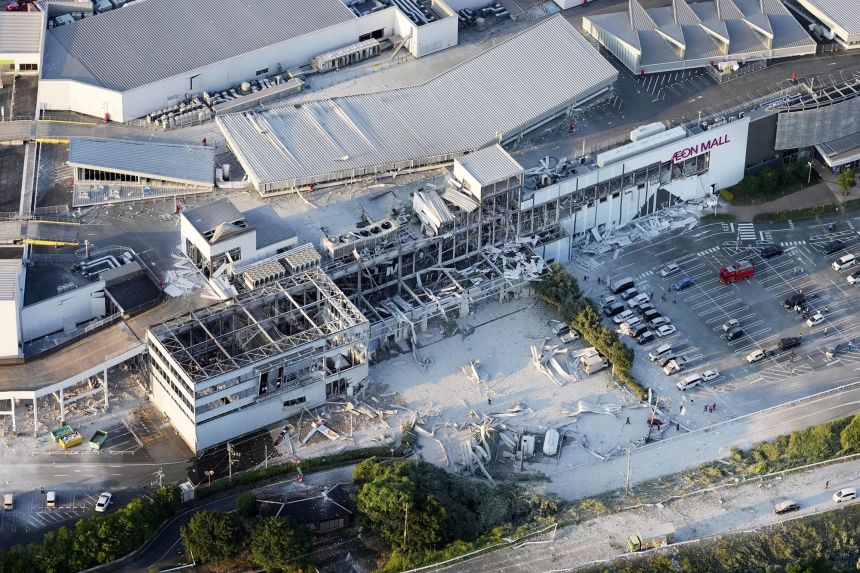
An aerial view shows the damaged Aeon Mall shopping centre after an explosion which occured after an earthquake with a preliminary magnitude of 7.1 struck Japan’s southern Kumamoto prefecture, on Tuesday. Kyodo/Reuters
Japan is facing one of its deadliest natural disasters in years after a powerful earthquake struck Kumamoto Prefecture on Kyushu Island, killing at least 34 people and leaving thousands displaced. Rescue workers continue searching for survivors beneath collapsed buildings while authorities battle a growing humanitarian challenge as intense summer heat threatens evacuees sheltering in emergency centers.
The disaster has drawn widespread attention after Aeon Mall Kumamoto, which had only recently reopened following years of earthquake-resistant reconstruction, partially collapsed before a powerful explosion ripped through the shopping complex. The tragedy has become a symbol of the devastating force of the latest earthquake and the challenges Japan continues to face despite its world-renowned earthquake engineering.
As aftershocks continue across the region, officials are warning residents to remain vigilant while emergency crews work around the clock in a race against time.
Japan Earthquake Leaves 34 Dead as Search Operations Continue
Authorities in Kumamoto confirmed on Thursday that the death toll has increased to 34, with rescue operations continuing across several heavily damaged communities.
The magnitude 6.8 earthquake, which struck at a shallow depth of approximately 10 kilometers (6 miles) on Tuesday, caused widespread destruction throughout Kumamoto Prefecture. Hundreds of buildings suffered structural damage, roads cracked, and power infrastructure was severely affected.
Emergency responders have deployed thousands of personnel to locate survivors trapped beneath collapsed buildings, while medical teams continue treating the injured.
Officials caution that casualty figures could rise as rescue operations continue in the hardest-hit areas.
Aeon Mall Collapse Raises Questions After Recent Earthquake-Proof Reconstruction
One of the most heartbreaking scenes unfolded at Aeon Mall Kumamoto, where part of the shopping center collapsed before an explosion occurred roughly an hour after the initial earthquake.
The mall had become a symbol of Kumamoto’s recovery after suffering major damage during the devastating 2016 Kumamoto earthquakes, which claimed more than 270 lives.
Following that disaster, the shopping complex underwent extensive reinforcement designed to improve earthquake resistance. Engineers strengthened ceilings, upgraded structural systems, and relocated heavy fixtures to reduce falling hazards.
The renovated complex officially reopened in June 2026, promoting itself as a disaster-resistant facility capable of serving future generations.
Tuesday’s earthquake shattered those expectations.
Investigators believe the explosion that followed the collapse was likely caused by a gas leak, although authorities say the exact cause remains under investigation.
Four victims were recovered from the mall’s rubble, while rescue teams continue examining damaged sections of the building.
Thousands Displaced as Extreme Heat Creates New Emergency
The earthquake has created a second crisis as approximately 9,000 residents remain inside evacuation centers.
Weather forecasts predict temperatures approaching 39°C (102°F), prompting officials to warn of heatstroke risks among displaced families and rescue workers.
Many evacuation centers initially lost electricity and water supplies following the quake, leaving vulnerable residents without air conditioning during dangerously hot weather.
Japan’s Defense Minister Shinjiro Koizumi announced the emergency delivery of 300 air-conditioning units, with half being installed in evacuation centers across Kumamoto.
Aid workers say elderly residents are particularly vulnerable, with some shelters reporting cases of heat-related illness requiring hospital treatment.
READ ALSO
More Than 100 Aftershocks Keep Residents on Edge
The powerful earthquake has been followed by more than 100 aftershocks, forcing many residents to avoid returning home.
Numerous families have chosen to sleep inside their vehicles or open spaces due to fears that additional tremors could trigger further building collapses.
Japan’s meteorological authorities continue monitoring seismic activity closely and have urged residents to remain prepared for stronger aftershocks.
The repeated shaking has complicated rescue operations and slowed efforts to inspect damaged infrastructure safely.
Factory Collapse Adds to the Growing Death Toll
Beyond the shopping mall, rescue crews are also searching through the remains of a Nippon Paper factory in Yatsushiro City.
The factory partially collapsed during the earthquake, killing at least five workers.
Company officials said 11 employees were trapped, with rescue teams successfully pulling seven people from the damaged structure while continuing efforts to locate others.
Industrial facilities across Kumamoto are undergoing structural inspections before operations can safely resume.
Survivors Describe Terrifying Moments During the Earthquake
Residents across Kumamoto described violent shaking unlike anything they had previously experienced.
Hiroko Ogata, a 75-year-old restaurant owner in Yatsushiro, said she hid beneath a table as her building shook violently.
“I thought I would die,” she recalled, explaining that despite living in the region for decades, she had never experienced an earthquake of such intensity.
Similar stories have emerged from across Kyushu as survivors recount the sudden destruction caused by the shallow quake.
What Happens Next?
Search-and-rescue operations remain the highest priority as emergency crews continue looking for survivors trapped beneath collapsed structures.
Authorities are also focused on restoring electricity, water services, and transportation while supporting thousands of displaced residents.
Investigators are expected to examine why portions of the recently rebuilt Aeon Mall failed despite extensive earthquake-resistant upgrades.
Japan’s experience with seismic disasters means reconstruction efforts are expected to begin quickly, but officials acknowledge that recovery from this latest tragedy could take months or even years.
FAQ
What happened in Japan today?
A powerful magnitude 6.8 earthquake struck Kumamoto Prefecture on Japan’s Kyushu Island, causing widespread destruction, building collapses, power outages, and multiple fatalities.
How many people died in the Japan earthquake?
As of the latest official update, 34 people have died, with rescue teams continuing to search for survivors. Authorities say the number may increase as recovery efforts continue.
Where did the earthquake occur?
The earthquake struck Kumamoto Prefecture on Japan’s southern island of Kyushu, one of the country’s most earthquake-prone regions.
How strong was the Japan earthquake?
The earthquake measured magnitude 6.8 and occurred at a shallow depth of approximately 10 kilometers (6 miles), making the shaking particularly intense near the epicenter.
Why did the Aeon Mall collapse?
The mall suffered severe structural damage during the earthquake. Investigators are examining the exact cause despite the building having undergone extensive earthquake-resistant reconstruction after the 2016 Kumamoto earthquakes.
What caused the explosion at Aeon Mall?
Authorities believe the explosion was likely caused by a gas leak, although investigations are still ongoing to determine the exact cause.
Was the mall recently rebuilt?
Yes. Aeon Mall Kumamoto reopened in June 2026 after years of renovation designed to improve earthquake resistance following damage sustained during the 2016 earthquakes.
How many aftershocks have occurred?
Officials have recorded more than 100 aftershocks, and residents have been warned to expect additional seismic activity.
Is there a tsunami warning?
No widespread tsunami warning has been reported following this earthquake.
How many people have been displaced?
Approximately 9,000 residents are staying in evacuation centers, while many others are temporarily living in their vehicles due to fears of additional aftershocks.
Why are evacuation centers facing challenges?
Many shelters initially lost electricity and water following the earthquake. High temperatures approaching 39°C (102°F) have increased concerns about heatstroke among evacuees.
What assistance is Japan providing?
The government has deployed thousands of rescue workers, military personnel, emergency medical teams, generators, and hundreds of air-conditioning units to support evacuation centers and ongoing rescue operations.
How does this compare to the 2016 Kumamoto earthquake?
The latest disaster has revived painful memories of the 2016 Kumamoto earthquakes, which killed more than 270 people and caused extensive regional damage. The collapse of the recently rebuilt Aeon Mall has become one of the defining images of the current disaster.
Are rescue operations still ongoing?
Yes. Search-and-rescue teams continue working around the clock at collapsed buildings, including Aeon Mall and a damaged paper factory, while authorities remain hopeful of finding additional survivors.