

Japan earthquake today: 7.1 magnitude quake traps shoppers, sparks mall explosion and mass evacuations in Kumamoto

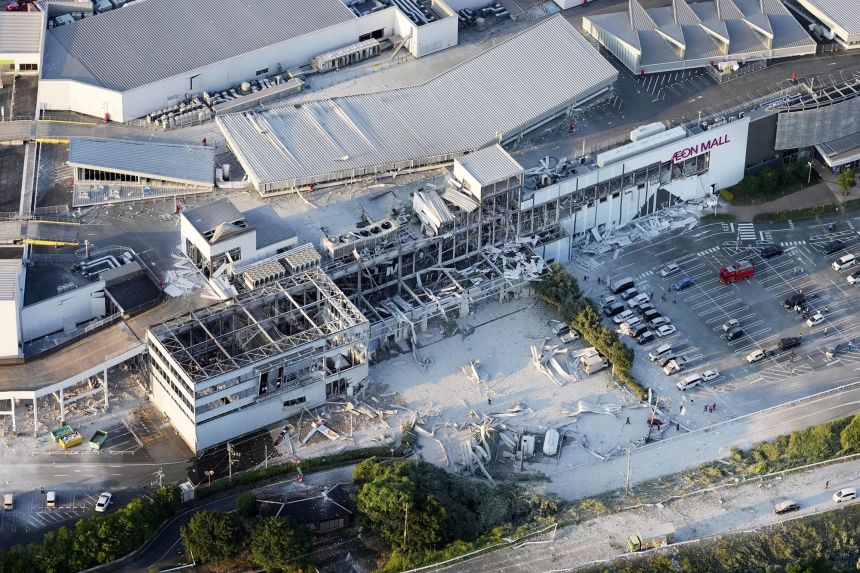
An aerial view shows the damaged Aeon Mall shopping centre after an explosion which occured after an earthquake with a preliminary magnitude of 7.1 struck Japan’s southern Kumamoto prefecture, on Tuesday. Kyodo/Reuters
A powerful 7.1-magnitude earthquake struck southwestern Japan on Tuesday, causing widespread destruction across Kumamoto Prefecture, trapping people inside a partially collapsed shopping mall, damaging roads and buildings, disrupting transportation, and prompting authorities to order the evacuation of around 300,000 residents.
The quake, which hit at 4:27 p.m. local time, registered the highest possible Shindo 7 intensity on Japan’s seismic scale, highlighting the violent shaking experienced in the region. Emergency crews rushed to rescue trapped victims as reports emerged of fires, power outages, collapsed structures, and a possible explosion at a major shopping center.
Authorities are still assessing casualties and structural damage while warning residents to prepare for strong aftershocks over the coming week.
Powerful 7.1 earthquake strikes Kumamoto Prefecture
According to the Japan Meteorological Agency (JMA), the earthquake measured magnitude 7.1 with a shallow depth of approximately 10 kilometers (6.2 miles). The epicenter was located roughly 20 kilometers south of Kumamoto City, the largest city on Kyushu Island.
The tremor triggered emergency earthquake alerts across several prefectures, including Kumamoto, Nagasaki, Fukuoka, Saga, Oita, Miyazaki, and Kagoshima.
Japan initially issued a tsunami warning forecasting waves of up to one meter. However, after further monitoring, authorities lifted the warning after confirming that no significant tsunami activity had developed.
Shopping mall partially collapses as rescue efforts continue
One of the most serious incidents occurred in Kashima Town, where part of an Aeon Mall reportedly collapsed following the earthquake.
Emergency services confirmed that multiple people became trapped after sections of the mall’s second floor gave way. Witnesses also described hearing what sounded like a powerful explosion shortly after the quake struck.
Police indicated that several people were feared dead inside the damaged complex, while firefighters launched extensive rescue operations to locate survivors beneath the debris.
Eyewitness Kazuya Tsurunaga told Japanese broadcaster TBS that he heard an enormous blast while cleaning broken dishes inside a nearby restaurant.
He described seeing a massive cloud of smoke rise into the air, comparing the falling debris to volcanic ash spreading through the neighborhood.
The exact cause of the reported explosion remains under investigation.
Power outages, damaged roads and transportation disruptions
The earthquake caused widespread infrastructure damage across southern Japan.
Kyushu Electric Power reported that approximately 48,000 households lost electricity shortly after the quake.
Large cracks appeared on highways and major roads, while several buildings caught fire or suffered partial collapses. Rail operator JR Kyushu suspended services, including high-speed Shinkansen bullet trains, as engineers inspected tracks for damage.
Kumamoto Airport temporarily closed its runway, forcing airlines to divert or cancel flights.
Major telecommunications providers KDDI and NTT Docomo also reported disruptions caused by damaged transmission infrastructure and power outages.
Several major manufacturers, including TSMC, Sony, and Fujifilm, evacuated employees from nearby facilities as a precaution while safety inspections were carried out.
Government deploys emergency response as thousands evacuate
Japanese Prime Minister Sanae Takaichi confirmed that the government immediately activated its national emergency response system following the earthquake.
An Emergency Assembly Team was established at the Prime Minister’s Office to coordinate rescue operations and assess the scale of the disaster.
Authorities reported injuries across multiple locations, along with fires, collapsed buildings, damaged bridges, and significant road destruction.
The Disaster Management Agency instructed approximately 300,000 residents to move to evacuation centers as emergency crews continued rescue efforts.
The government also announced that around 3,600 members of Japan’s Self-Defense Forces would assist with disaster response and recovery operations.
Officials urged residents to avoid damaged buildings and remain alert for additional seismic activity.
READ ALSO
No safety concerns reported at nuclear facilities
Despite the powerful shaking, Japan’s Nuclear Regulation Authority confirmed that there were no abnormalities at nearby nuclear power stations.
The International Atomic Energy Agency (IAEA) also stated that the Sendai Nuclear Power Plant had reported no damage or operational safety issues following the earthquake.
Officials said monitoring would continue as aftershocks remain possible.
Hospital reports injuries as aftershocks remain a concern
Public broadcaster NHK reported that at least one hospital had already treated more than 50 injured people, while additional injuries were reported among passengers aboard a high-speed train.
The Japan Meteorological Agency warned residents that aftershocks could continue for approximately one week.
Authorities also cautioned that heavy shaking may increase the risk of landslides in mountainous areas already weakened by the earthquake.
Kumamoto’s painful history with devastating earthquakes
Tuesday’s disaster revives painful memories of the 2016 Kumamoto earthquake sequence, when two powerful earthquakes measuring 6.5 and 7.3 struck the region just days apart.
The disaster claimed more than 270 lives, injured thousands, and caused extensive destruction, including severe damage to the historic Kumamoto Castle.
Officials confirmed that sections of Kumamoto Castle’s stone walls have again suffered damage during Tuesday’s earthquake.
Japan remains one of the world’s most earthquake-prone nations
Japan experiences roughly 1,500 earthquakes every year, owing to its location along the Pacific Ring of Fire, where four major tectonic plates converge.
The country accounts for nearly 20% of the world’s earthquakes measuring magnitude 6.0 or greater.
Its extensive earthquake warning systems, strict building standards, and emergency preparedness have significantly reduced casualties over the years. However, powerful shallow earthquakes like the one in Kumamoto continue to pose serious risks because of their intense ground shaking and potential to damage infrastructure.
Emergency officials continue search-and-rescue operations while monitoring aftershocks and assessing the full scale of the destruction.
Frequently Asked Questions
What happened in Japan today?
A magnitude 7.1 earthquake struck Kumamoto Prefecture on Japan’s southern Kyushu Island, causing building collapses, trapping people in a shopping mall, damaging infrastructure, and prompting mass evacuations.
Where was the epicenter of the Japan earthquake?
The earthquake’s epicenter was approximately 20 kilometers south of Kumamoto City in Kumamoto Prefecture at a depth of around 10 kilometers.
How strong was the Japan earthquake?
The Japan Meteorological Agency measured the earthquake at magnitude 7.1, with the shaking reaching Shindo 7, the highest level on Japan’s seismic intensity scale.
Was there a tsunami after the earthquake?
A tsunami warning was initially issued for waves of up to one meter but was later lifted after authorities confirmed there was no significant tsunami threat.
Were there any casualties?
Authorities confirmed multiple injuries, while police reported that several people were feared dead following the collapse and explosion at an Aeon shopping mall. Rescue operations are ongoing, and casualty figures remain subject to official confirmation.
How many people were evacuated?
Japan’s Disaster Management Agency instructed approximately 300,000 residents to evacuate to designated emergency shelters.
What happened at the Aeon Mall?
Part of an Aeon Mall in Kashima Town collapsed after the earthquake. Emergency services reported that several people were trapped inside, and witnesses described hearing an explosion shortly afterward. Rescue efforts are continuing.
Were nuclear power plants affected?
No. Japan’s Nuclear Regulation Authority and the International Atomic Energy Agency confirmed that nearby nuclear facilities, including the Sendai Nuclear Power Plant, reported no damage or safety concerns.
Why does Japan experience so many earthquakes?
Japan sits on the Pacific Ring of Fire, where four major tectonic plates meet. This geological setting makes the country one of the most earthquake-prone regions in the world.
Are more earthquakes expected?
Yes. The Japan Meteorological Agency has warned that strong aftershocks may continue for about one week, and residents are advised to remain cautious and follow official safety guidance.
How did the earthquake affect transportation?
Bullet train services were suspended, Kumamoto Airport temporarily closed its runway, flights were diverted or canceled, and several roads and highways sustained significant damage.
What should residents do after a major earthquake?
Authorities advise residents to stay away from damaged buildings, prepare for aftershocks, monitor official emergency updates, use evacuation centers if instructed, and avoid coastal areas until all tsunami advisories are lifted.