

Is Trump Trying to Annex Canada, Mexico and Greenland?

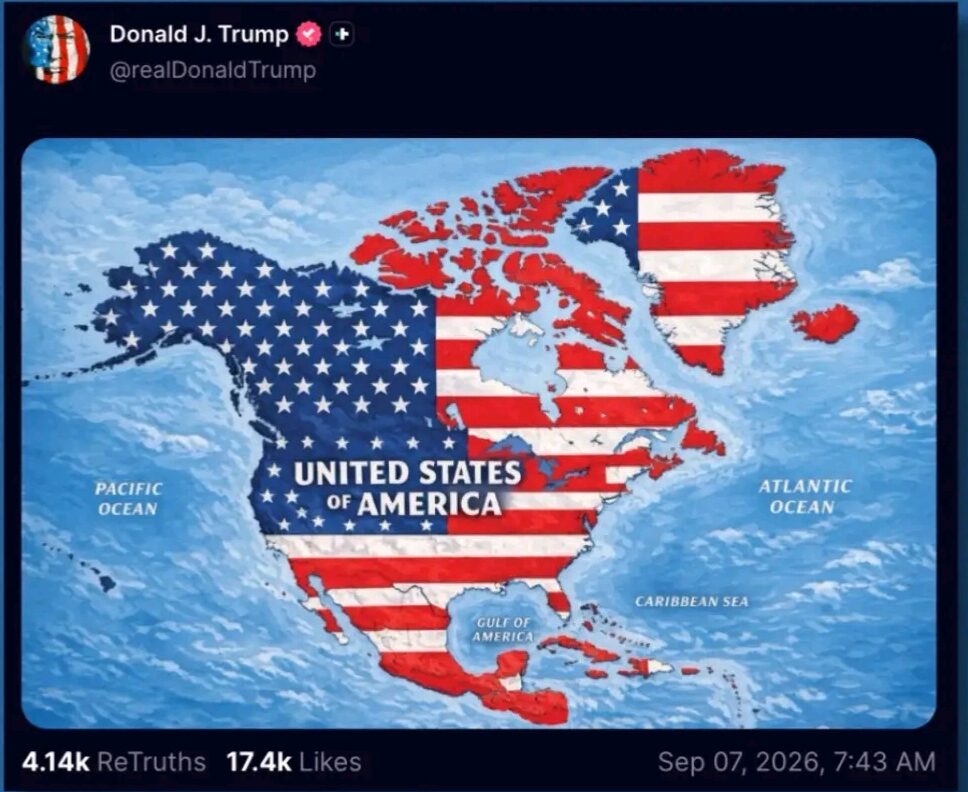
Donald Trump has put the question back on the table: Is he trying to annex Canada, Mexico and Greenland? A map he posted on Truth Social showed Canada, Greenland, Iceland, Mexico, Central America and the Caribbean under the American flag. The entire area was labelled “United States of America.” Trump offered no explanation.
The image does not amount to a legal annexation plan. But it comes after months of statements, diplomatic pressure and strategic moves that make the map more significant than an ordinary social media post.
Why does the annex Canada, Mexico and Greenland question keep returning?
Greenland is where Trump’s territorial ambitions have been most explicit.
Trump has repeatedly argued that the United States needs control of Greenland for national security. In January 2025, he said the US needed the Arctic territory for international security and refused to rule out economic or military pressure. Greenlandic leaders have repeatedly rejected the idea.
The issue later moved beyond Trump’s speeches.
In December 2025, Trump appointed Louisiana Governor Jeff Landry as a special envoy to Greenland. Landry said he wanted to help make Greenland part of the United States, triggering strong reactions from Denmark, Greenland and European allies.
READ ALSO: “Is Trump trying to take Greenland? New US envoy appointment sparks global outrage”
That history is important because the latest map did not appear in isolation.
What moves suggest Trump could annex Canada, Mexico and Greenland?
Canada has repeatedly appeared in Trump’s territorial rhetoric.
He has called for Canada to become the 51st US state and has linked the idea to trade, defence and America’s economic interests. His administration has also used tariffs and other economic pressure against Canada. The two countries are currently locked in another trade dispute, adding another layer to an already strained relationship.
Mexico is different.
There is no comparable formal Trump proposal to make Mexico a US state or territory. Yet Mexico appeared prominently in the latest map, alongside Canada and Greenland.
That makes the image broader than Trump’s earlier Greenland campaign.
It suggests an imagined American sphere stretching across much of North America, Central America and the Caribbean.
That does not prove an annexation plan. It does, however, show how far the symbolism has expanded.
Can Trump actually annex Canada, Mexico and Greenland?
This is where the distinction between political messaging and government action matters.
Canada and Mexico are sovereign states. Greenland is an autonomous territory within the Kingdom of Denmark. The European Commission describes Greenland as having extensive self-government under the Danish Kingdom.
Trump cannot simply redraw those borders with a social media post.
But his Greenland campaign has already moved beyond rhetoric. There have been diplomatic talks involving the United States, Denmark and Greenland, while Trump has continued to insist that American control is strategically necessary.
Greenland’s strategic position explains much of the pressure.
The island sits between North America and Europe and is important to Arctic security, military planning and access to potential mineral resources. Its importance is increasing as competition grows in the Arctic.
That is why Denmark and Greenland have treated Trump’s statements as a serious sovereignty issue rather than simply dismissing them as political theatre.
What does the EU’s Greenland move have to do with Trump’s map?
The timing offers another important clue.
On September 7, European Commission President Ursula von der Leyen announced a €200 million partnership package for Greenland. The funding will support areas including digital connectivity, energy, fisheries, tourism, housing and critical raw materials.
The announcement came just hours before Trump’s controversial map appeared.
There is no evidence that the two events were coordinated.
But the timing reveals something bigger: Greenland is becoming a contest for influence.
The EU is strengthening its economic relationship with Greenland while the United States continues pushing for greater control over the territory.
For Greenland, European investment provides another source of economic and political support at a time when Washington’s intentions are creating uncertainty.
So, is Trump trying to annex Canada, Mexico and Greenland?
The evidence does not show a formal US plan to annex all three.
But it does show a pattern.
Trump has repeatedly advocated US control of Greenland. He has pushed the idea of Canada becoming the 51st state. His latest map places both countries, as well as Mexico and several other territories, inside an imagined United States.
That makes the map more than a random image.
It is part of a wider pattern of territorial rhetoric and strategic pressure that has already produced diplomatic protests.
Iceland, for example, summoned the US ambassador after the map appeared and described the post as inappropriate.
The real question, then, is not whether Trump’s map has legally annexed anything.
It has not.
The question is how far his territorial ambitions will move from symbols and statements into concrete policy — and whether Canada, Mexico, Greenland, Denmark and America’s other allies are prepared for that possibility.