
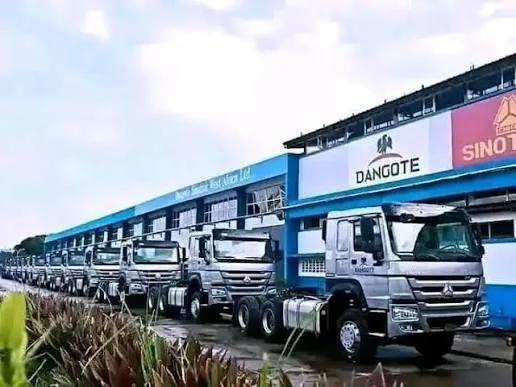
Aliko Dangote is expanding his involvement in Nigeria’s commercial vehicle market, moving from a major investment in compressed natural gas-powered trucks to locally assembled electric heavy-duty vehicles through his partnership with China’s Sinotruk.
Africa’s richest man, Aliko Dangote, has taken another step into the alternative-fuel vehicle market after unveiling a locally assembled electric heavy-duty truck in Lagos.
The vehicle was introduced on November 15, 2026, through Dangote Sinotruk West Africa Limited, a joint venture between Dangote Group and China’s Sinotruk Group.
The development expands the company’s commercial vehicle assembly business into electric mobility. It also follows Dangote Refinery’s earlier investment in thousands of compressed natural gas (CNG)-powered trucks for fuel distribution.
According to Business Insider Africa, the new move reflects Dangote’s expanding interest in alternative-fuel transportation and local vehicle manufacturing.
From 4,000 CNG trucks to electric vehicles
In August 2025, Dangote Petroleum Refinery began receiving 4,000 CNG-powered trucks for its nationwide petroleum distribution programme.
The refinery estimated the investment at ₦720 billion. It said the fleet would help reduce logistics costs and improve the direct delivery of petroleum products to filling stations, manufacturers and other large consumers.
The first batch of the trucks began loading petroleum products in September 2025.
According to Reuters, the initiative was designed to reduce the refinery’s reliance on third-party transporters as it expanded its distribution operations.
The latest electric vehicle project, however, operates through a different business arrangement.
Dangote Sinotruk is introducing electric heavy-duty trucks alongside its existing range of conventional trucks, tippers, pickups, light trucks and buses.
Read also: Dangote Fleet Management Graduate Programme 2026: How to Apply
What is known about Dangote’s electric truck?
The electric heavy-duty truck was unveiled at the joint venture’s assembly facility in Ikeja, Lagos.
Speaking at the event, Devakumar V.G. Edwin, Group Vice-President of Dangote Industries Limited, said electric commercial vehicles could reduce operating costs and tailpipe emissions.
However, he noted that the benefits would depend on the vehicle’s application, electricity prices and access to charging infrastructure.
The company also acknowledged that successful adoption would require reliable charging facilities, spare parts, technical expertise and after-sales support.
Sinotruk Group President Liu Wei described the unveiling as a major development for Nigeria and the wider African automotive industry.
He said the partnership had assembled more than 8,000 vehicles locally since its first heavy-duty truck rolled off the Nigerian assembly line in 2017.
The company also plans to deepen technical training for Nigerian engineers and technicians, including opportunities to train at Sinotruk facilities in China.
Read also: FRSC Hails Dangote Cement as Truck Crashes Drop 56% Across Nigeria
Can electric trucks succeed in Nigeria?
Despite the announcement, important details about the new vehicle remain undisclosed.
The company has not published its selling price, battery capacity, driving range, charging time or planned production volume.
These details will matter to transport operators considering whether electric trucks can offer a practical alternative to conventional vehicles.
Charging infrastructure and electricity costs also present major questions. An electric truck may reduce fuel expenses, but its overall running costs will depend on the availability and price of reliable electricity.
The company’s promise to support customers with charging infrastructure and technical services could therefore become an important part of its rollout.
What Dangote’s latest move means
The electric truck unveiling signals a new phase in Dangote Sinotruk’s expansion from conventional vehicle assembly into new-energy transportation.
The partnership began in 2010 and formally became a joint venture in 2014. Its assembly operations have since expanded to include more advanced manufacturing processes.
However, the next test will be whether local assembly can develop into a commercially sustainable electric truck business.
For Nigeria, the development offers an opportunity to strengthen local manufacturing and technical skills. But its wider impact will depend on production capacity, affordability, charging infrastructure and demand from transport operators.