

FAAC revenue in 2026 hit ₦31.46tn in nine months


Illustration: Crisp Nigeria.
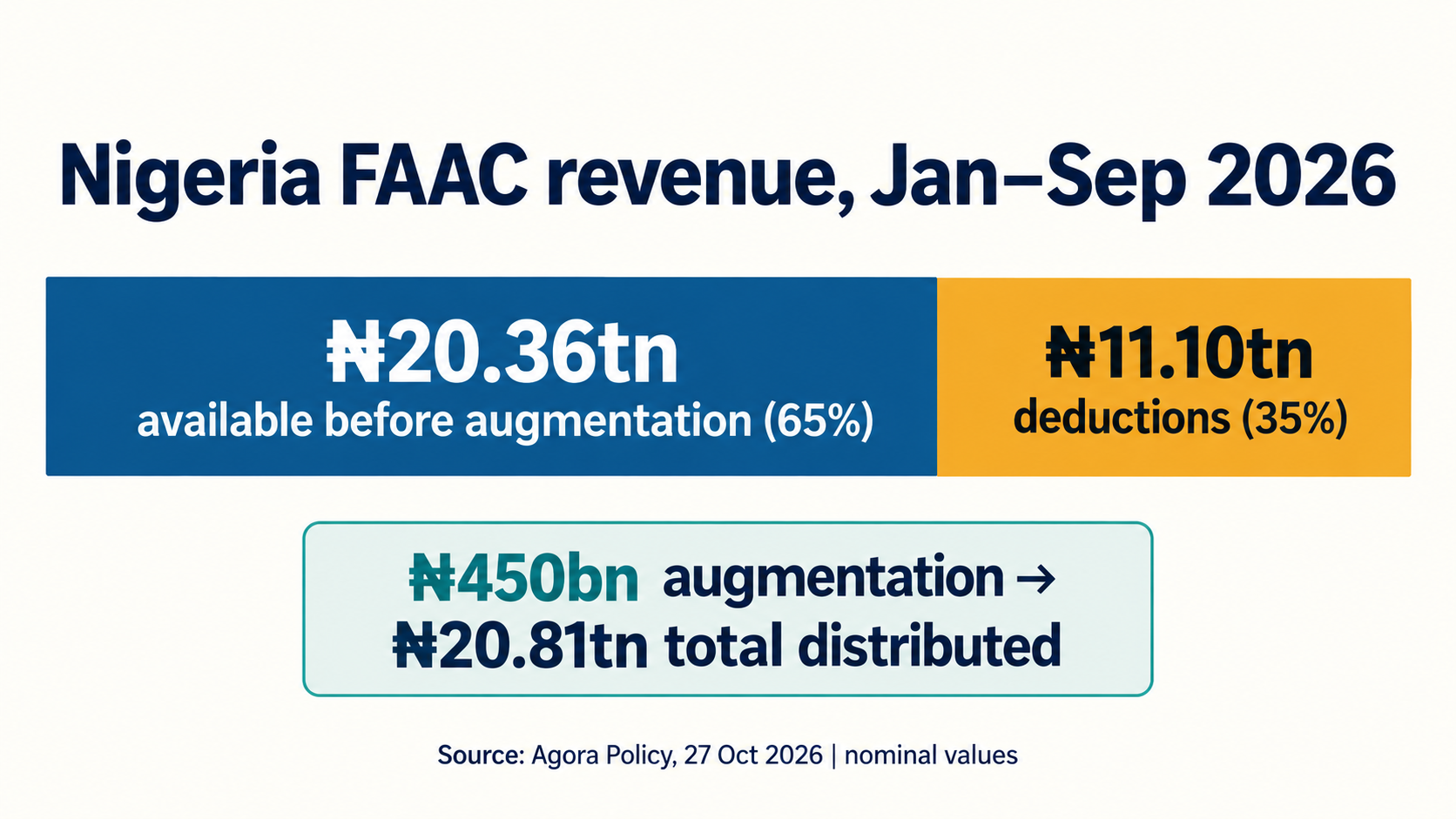
FAAC revenue in 2026 reached ₦31.46tn in the first nine months. That was 12.6 per cent above the same period of 2025, according to an Agora Policy analysis published October 27. Deductions of ₦11.10tn left ₦20.36tn available for distribution before augmentation. A further ₦450bn brought the total distributed to ₦20.81tn.
Gross receipts show how much entered the Federation Account. Allocations show what the federal, state and local governments can plan to spend. A larger gross total can coexist with weaker-than-budgeted mineral receipts and uneven monthly flows.
Why the headline does not equal shared cash
Agora Policy’s breakdown shows that statutory revenue contributed ₦24.25 trillion, or 77.1 per cent of the gross total. Value added tax brought in ₦7.21 trillion, or 22.9 per cent. From the combined ₦31.46 trillion, ₦11.10 trillion—about 35 per cent—was recorded as deductions, leaving ₦20.36 trillion available before augmentation.
Those deductions are not one single expense. The report lists ₦4.78 trillion for interventions, ₦3.56 trillion for savings, ₦1.21 trillion in refunds, ₦1.09 trillion in collection costs and ₦469.06 billion in transfers. Each category serves a different purpose. Gross receipts are not the same as money that would otherwise go directly into government budgets.
A further ₦450 billion augmentation brought the total distribution to ₦20.81 trillion. The Federal Government received ₦7.35 trillion, states ₦7.01 trillion and local governments ₦4.92 trillion; oil-producing states received ₦1.53 trillion as 13 per cent derivation, which Agora reports separately even though it accrues to states. A gross revenue headline is not the amount available to any one tier.
This distinction matters to anyone tracking budgets or borrowing. Federation receipts are divided among the tiers. Each government also has its own spending obligations. Crisp Nigeria has reported on Nigeria’s debt position. The FAAC figures add context to the revenue side of those choices.
FAAC revenue in 2026 rose, but growth slowed
The nine-month gross total rose from ₦27.95 trillion in January–September 2025 to ₦31.46 trillion in the same period of 2026. That is an increase of ₦3.51 trillion, or 12.6 per cent, in nominal naira terms.
The comparison is striking, but it needs a time-period label. Nine months in 2026 exceeded the full-year gross totals for 2021 through 2024. It also reached about 88 per cent of the ₦35.81tn recorded across all of 2025. These are nominal totals. They are not like-for-like measures of annual growth or purchasing power. They also do not show how much governments can buy with their allocations.
Monthly figures also moved substantially. Agora put February’s gross revenue at ₦2.23tn and July’s at ₦5.15tn. The gap was ₦2.92tn. Receipts rose from ₦7.63tn in Q1 to ₦11.08tn in Q2 and ₦12.75tn in Q3. Growth slowed from about 45 per cent between Q1 and Q2 to 15 per cent in Q3.
That variation matters for budgets because a strong month may not repeat at the same level. Agora recommends cautious revenue assumptions for recurring commitments. Its analysis does not show that every state or federal budget relies on July’s peak.
Mineral receipts fell short of the budget benchmark
The report’s comparison with the 2026 budget adds another layer. It puts mineral revenue at ₦12.35 trillion against a ₦27.98 trillion budget benchmark, or 44.1 per cent. Non-mineral statutory revenue reached ₦11.91 trillion against ₦14.21 trillion, or 83.8 per cent; together, the two categories reached 57.5 per cent of their combined budget targets.
The figures show a larger gap in mineral receipts than in non-mineral statutory receipts. The totals do not explain why mineral receipts missed the benchmark. They also do not show each factor’s contribution, including production, prices, exchange rates or collection timing. Agora notes that aggregate totals cannot isolate those contributions.
What we don’t know yet
The nine-month analysis gives aggregate totals and broad revenue categories. It does not show what each state or local council received after adjustments. It also does not show how governments spent their allocations. The Finance Ministry archive currently lists releases only through February 2026. It therefore did not provide the September breakdown or underlying monthly tables for comparison in this run.
The next useful check is the publication of the October FAAC communiqué and complete allocation tables. That will show the next monthly distribution; it will not revise the January–September figures unless the committee publishes a correction.
Sources: Agora Policy; Finance Ministry archive.