

East wing ballroom contract: White House faces scrutiny over reported $500M no-bid deal for Trump’s ballroom project

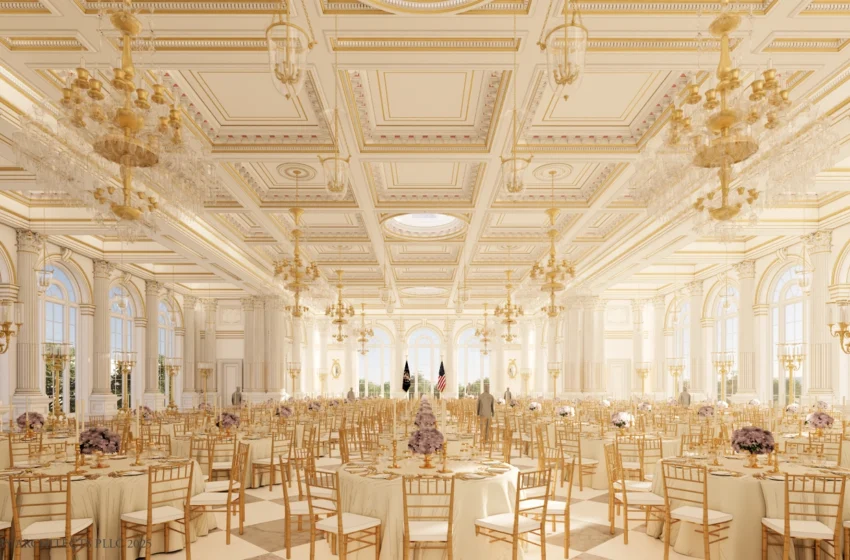
An architectural rendering of the new State Dining Room that President Trump has commissioned. Picture: The White House
A new report has intensified scrutiny surrounding President Donald Trump’s controversial White House ballroom project after documents reportedly revealed that the administration awarded a no-bid contract worth up to $500 million for construction through an office exempt from standard federal procurement rules.
According to documents obtained by The Washington Post, the contract was routed through the White House Executive Residence rather than traditional federal procurement channels, allowing officials to bypass competitive bidding requirements typically used for large government projects. The development has renewed debate over government transparency, taxpayer spending, and the legal authority behind the ambitious East Wing redevelopment.
Report Says Executive Residence Was Used to Award Contract
The Washington Post reported that the confidential agreement was awarded to Clark Construction, a Virginia-based contractor, through the Executive Residence, an office responsible for maintaining the White House residence and which is exempt from many federal contracting rules requiring public disclosure and competitive bidding.
The report also states that President Trump personally participated in negotiating portions of the construction costs. According to Reuters, which cited the Washington Post’s findings, the contractor reportedly applied a 3 percent profit margin during the project’s initial work. Reuters noted it was unable to independently verify the report, and neither the White House nor Clark Construction immediately commented following requests for response.
Why the No-Bid Contract Is Drawing Attention
Competitive bidding is commonly used across federal agencies to encourage transparency and secure the best value for taxpayers. Procurement experts cited by the Washington Post said the Executive Residence has legal authority to issue contracts without competitive bidding, but questioned whether a project of this scale should have followed a more open process.
The report further alleges that construction costs have risen substantially since the ballroom was first announced, while internal documents indicate projected contractor earnings could total tens of millions of dollars over the course of the project.
Ballroom Project Continues Amid Legal Challenges
The East Wing ballroom has remained one of President Trump’s highest-profile construction projects since plans were unveiled to replace the existing East Wing with a significantly larger event venue.
Construction has continued while courts consider ongoing legal challenges brought by preservation groups, which argue that demolishing or significantly altering portions of the historic White House complex required congressional authorization.
Earlier this year, a federal appeals court temporarily allowed work to continue while litigation proceeds, leaving the project’s long-term legal future unresolved.
READ ALSO
White House Frames Project as National Security Infrastructure
In recent weeks, President Trump has increasingly described the ballroom as more than a ceremonial venue.
New renderings released by the White House describe the development as a “Great National Security Facility and Ballroom,” emphasizing planned security infrastructure beneath and around the building.
Trump has said the project will include hardened construction materials and advanced protective systems, while previous court filings have argued that parts of the development are essential to presidential security.
The administration has also highlighted proposed underground facilities, blast-resistant construction and enhanced defensive capabilities as key components of the overall redevelopment.
Funding Questions Continue to Spark Debate
Funding for the ballroom has remained politically contentious.
President Trump previously stated that wealthy donors would finance the ballroom. However, reports indicate the administration later sought congressional approval for additional federal funding tied to security upgrades associated with the project.
According to Reuters, Senate Republicans declined a request for approximately $1 billion in taxpayer funding for security improvements connected to the development.
Questions surrounding public versus private financing have become a central issue in both political debate and ongoing court proceedings.
What’s Next for the East Wing Ballroom?
Construction on the ballroom remains underway while legal challenges continue through the federal court system.
The latest reporting surrounding the alleged no-bid contract is expected to fuel additional scrutiny over procurement procedures, project costs and oversight of one of the most significant structural changes ever proposed for the White House complex.
Whether courts ultimately uphold the administration’s legal authority, or require additional congressional approval, could determine the future of the project and establish important precedents for future presidential construction initiatives.
FAQ
What is the East Wing ballroom contract?
The East Wing ballroom contract refers to the reported agreement to construct a new ballroom at the White House. According to reporting by The Washington Post, the contract is worth up to $500 million and was awarded without competitive bidding through the Executive Residence.
Why is the contract considered controversial?
The controversy centers on the reported use of a no-bid procurement process for a major construction project, raising questions about transparency, taxpayer value, and government oversight.
Who received the East Wing ballroom contract?
According to reports, Virginia-based Clark Construction received the contract to build the East Wing ballroom. Reuters cited The Washington Post’s reporting but noted it could not independently verify the details.
Why wasn’t competitive bidding used?
The reported agreement was routed through the Executive Residence, an office that is exempt from some federal competitive bidding requirements. Critics argue that open competition could have improved transparency and cost efficiency.
Is the White House ballroom privately funded?
President Trump has repeatedly said private donors would fund the ballroom. However, reports indicate the administration later sought federal funding for related security upgrades, leading to political debate over taxpayer involvement.
Why is the ballroom being described as a national security facility?
The administration has increasingly characterized the project as both a ballroom and a national security facility, citing underground infrastructure and enhanced protective features as part of the broader redevelopment.
Is construction still underway?
Yes. Construction has continued while legal challenges over the project’s authorization move through the courts.
What legal issues surround the East Wing ballroom?
Historic preservation groups argue that demolishing or substantially altering the East Wing required congressional approval. The Trump administration disputes that interpretation, and the case remains in litigation.
Could the project still be stopped?
Yes. Although construction is currently allowed to proceed under an appeals court order, future court rulings could affect the project’s scope or legality.