

West Pier Brighton: What happened during Storm Austen?

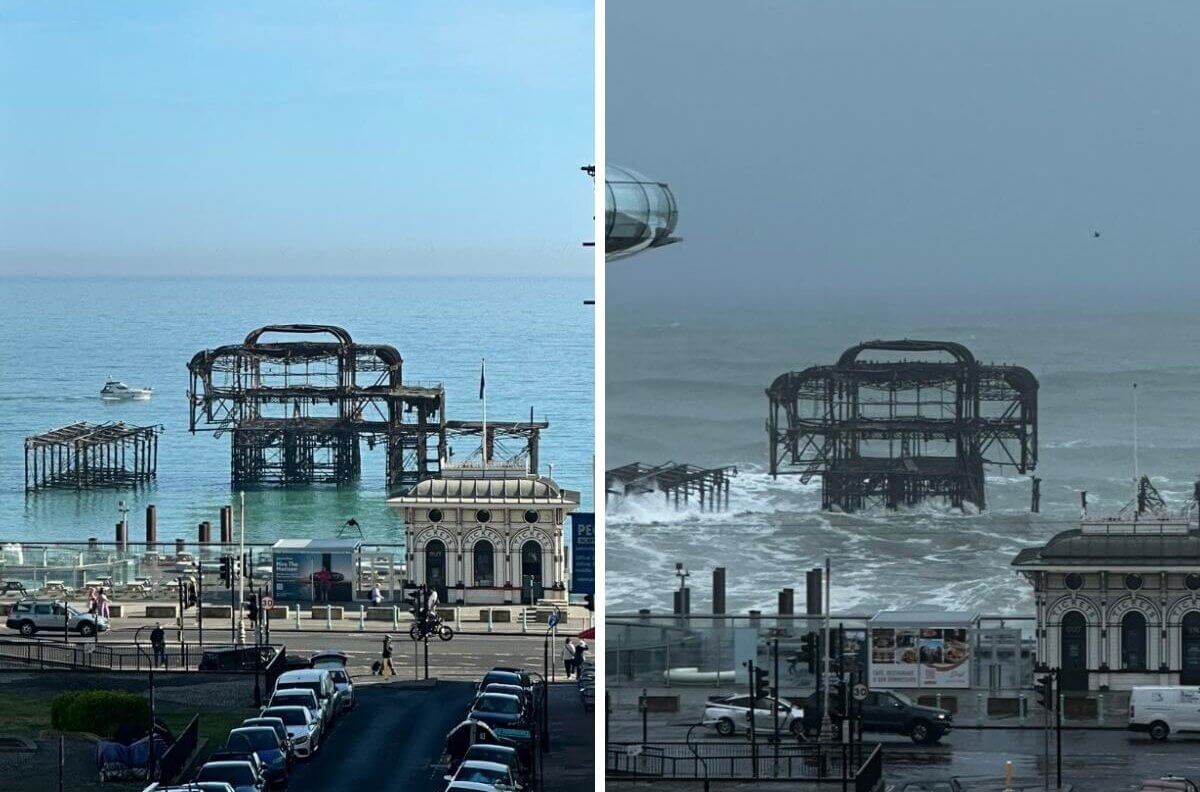
Pictures show the pier before and after Storm Austen hit (Image: Charlotte Beare)
A section of Brighton’s historic West Pier has collapsed into the sea as Storm Austen battered the south coast of England with powerful winds and large waves, renewing attention on the deteriorating remains of one of the city’s best-known landmarks.
Footage of the collapse showed part of the structure giving way under the force of the rough sea. The incident was reported as the storm caused widespread travel disruption, power cuts and damage across parts of the United Kingdom.
The latest collapse adds to decades of damage that have left the West Pier largely destroyed. Once a major attraction drawing millions of visitors, the structure has stood as a striking but increasingly fragile feature of Brighton’s seafront since it closed to the public in 1975.
West Pier Brighton: What Happened During Storm Austen?
Storm Austen brought strong winds and heavy seas to parts of southern England, with Brighton among the locations affected by the severe weather.
According to BBC reporting, footage showed one side of the West Pier collapsing into the water as large waves struck the historic structure.
The exact size of the section that fell was not specified in the report. However, the incident highlights the continuing vulnerability of the pier’s remaining framework, which has suffered extensive damage from storms and fires over the years.
The collapse occurred amid wider disruption caused by Storm Austen, including power outages affecting thousands of properties and transport interruptions across England, Wales and other parts of the UK.
The storm also prompted warnings for strong winds along parts of the south coast, with authorities urging people to take care around exposed coastal areas.
History of Brighton’s West Pier
The West Pier first opened in 1866 and became one of Brighton’s defining seaside attractions during the Victorian era.
Designed as a place for entertainment and leisure, the pier attracted visitors seeking sea views, performances and the traditional British seaside experience. At the height of its popularity, it reportedly drew around two million visitors.
Its fortunes changed after the Second World War as visitor numbers declined and the structure became increasingly difficult to maintain.
The pier eventually closed to the public in 1975. Over the following decades, its condition deteriorated, transforming it from a busy entertainment venue into a ruined landmark visible from Brighton’s beach.
Despite its decline, the West Pier remained an important part of the city’s identity. Its skeletal remains became a familiar sight along the coastline and a reminder of Brighton’s Victorian seaside heritage.
READ ALSO
What the UK’s 72-Hour Emergency Advice Actually Asks Households to Do
How Storms and Fires Destroyed the West Pier
The latest collapse is part of a long history of damage that has progressively reduced the West Pier to its surviving framework.
Major sections fell into the sea during storms in late 2002, causing further damage to an already deteriorating structure.
In 2003, two separate fires destroyed much of what remained. The fires significantly accelerated the pier’s decline, leaving its iron framework exposed to the elements.
Subsequent storms continued to damage the structure, with powerful waves and harsh coastal conditions weakening the remaining sections over time.
The West Pier’s location leaves it exposed to the force of the sea, particularly during periods of severe weather. Each major storm creates the possibility of further sections breaking away.
The latest incident demonstrates how little of the original structure remains protected from the elements.
Storm Austen Causes Widespread UK Travel Disruption
The collapse in Brighton formed part of a wider pattern of disruption as Storm Austen moved across the UK.
The storm brought strong gusts, rough seas and damage to infrastructure, with weather warnings covering parts of southern England, south-west England and Wales.
Rail services were disrupted in several regions after trees fell onto railway lines. Great Western Railway reported problems affecting routes in Devon and Cornwall, while other operators warned passengers of cancellations, delays and amended services.
Ferry services were also affected, including crossings between the UK and continental Europe. Some airport operations experienced disruption as strong winds affected travel.
The storm also left thousands of properties without electricity in parts of England and Wales, with Cornwall among the areas reporting significant outages.
Forecasters warned that further severe weather could follow, with Storm Boelo expected to bring additional strong winds to Scotland, Northern Ireland and northern England over the weekend covered by the report.
Why the West Pier Collapse Matters to Brighton
The West Pier is more than a damaged seaside structure. It is a historic landmark closely associated with Brighton’s development as a coastal resort.
Its remains have become part of the city’s visual identity, attracting the attention of visitors, photographers and people interested in its architectural history.
The pier’s decline also illustrates the challenges of preserving historic coastal structures exposed to increasingly damaging weather events. Once sections of a structure have been weakened by fire, corrosion and repeated storms, further deterioration can become difficult to prevent.
The latest collapse may renew questions about the future of the remaining framework and how it can be managed safely as part of Brighton’s seafront.
However, the available report does not specify whether officials have announced a new inspection, conservation plan or restoration decision following the latest incident.
For now, the collapse marks another significant moment in the long decline of a landmark that once welcomed millions of visitors.
Frequently Asked Questions About Brighton’s West Pier
1. What happened to Brighton’s West Pier?
A section of Brighton’s historic West Pier collapsed into the sea during Storm Austen, as strong winds and large waves battered the south coast of England.
2. When was Brighton’s West Pier built?
Brighton’s West Pier opened in 1866 during the Victorian era and became a popular destination for seaside entertainment.
3. Why is Brighton’s West Pier in ruins?
The pier closed in 1975 after a decline in popularity and increasing deterioration. Major sections collapsed during storms in late 2002, while two fires in 2003 destroyed much of the remaining structure. Further storms caused additional damage.
4. Is Brighton’s West Pier still open to visitors?
No. The West Pier closed to the public in 1975. Its surviving remains are not an operating public pier.
5. How many visitors did Brighton’s West Pier attract?
At its peak, the West Pier reportedly attracted around two million visitors, making it a major seaside attraction.
6. Did Storm Austen cause the West Pier to collapse completely?
The report confirms that a section of the pier collapsed, but it does not establish that the entire remaining structure fell into the sea.
7. What caused the latest West Pier collapse?
The collapse occurred as Storm Austen brought strong winds and large waves to Brighton. The remaining structure had already suffered decades of deterioration, previous storm damage and fire damage.
8. Will Brighton’s West Pier be rebuilt?
The report does not announce a new rebuilding plan or confirm that restoration will take place. Any future decision would depend on plans for the historic structure and the condition of what remains.
9. Where is Brighton’s West Pier located?
The West Pier is located on the seafront of Brighton, in East Sussex, on England’s south coast.
10. What other damage did Storm Austen cause in the UK?
Storm Austen caused travel disruption, fallen trees, ferry and rail interruptions, and power cuts affecting thousands of properties across parts of England and Wales.